• Menu
  • Skip to primary navigation
  • Skip to main content
  • Skip to primary sidebar

Country Life In BC Logo

The agricultural news source in British Columbia since 1915

  • Headlines
  • Calendar
  • Subscribe
  • Advertise
  • About
  • Archives
  • Contact
  • Search
  • Headlines
  • Calendar
  • Subscribe
  • Advertise
  • About
  • Archives
  • Contact
  • Search

Primary Sidebar

Originally published:

DECEMBER 2019
Vol. 105 Issue 12

Subscribe Now!

Sign up for free weekly FARM NEWS UPDATES

Loading form…

Your information will not be
shared or sold ever

Stories In This Edition

Parties unite on trespass legislation

Protesters rally at Ag Day

Got milk?

Peace faces worst grain harvest in 30+years

Editorial: Light in darkness

Back Forty: The West is packing its bags. Does Ottawa care?

Farmers’ passion for the land is strong

Ranchers voice ALR concerns at public meetings

Chefs, farmers foster new relationships

Sidebar: VFM Direct shuts down

Summerland grower steps up as co-op president

Recommendations from report nearly fully implemented

Food and beverage innovation centre launched

Japanese beetle control an industry priority

Langley farmers launch local farmers’ institute

BC agritech attracting major partners

New dam safety information flows

Bee-utiful

No-till takes centre stage at field day

Students showcase on-farm research projects

Emergency plans top agenda for bison ranchers

Rad

Regulatory issues top concerns for cattlemen

Processing adds value to Cowichan farm

Mentorship network helps new farmers

Research: Gene-editing eliminates horns in dariy bulls

Preserving owl, bat habitat is good for farming

Sidebar: Better bait

Seed app helps producers grow research data

Cannabis class wins high marks at BC fairs

Cannabis growers square off against diseases, pests

Pear-fect

Sidebar: Breaking the mold

Fine-tune feeding for healthier lambs

Farm Story: Performance anxiety knows no boundaries

Island AgSafe consultant changes gears

Woodshed: Intrigue deepens as barn repairs take shape

Century Farm award honours historic milestone

Jude’s Kitchen: So much to celebrate

More Headlines

Follow us on Facebook

Comments Box SVG iconsUsed for the like, share, comment, and reaction icons

6 days ago

A BC Forest Practices Board investigation has found overgrazing has damaged grasslands in the Coutlee Range Unit near Merritt — and the range-use plan meant to prevent it was unenforceable. With complaints about overgrazing on the rise and grasslands covering just 1% of BC's land mass, the findings raise fresh questions about how the province manages one of its most vulnerable — and valuable — food-producing ecosyste#BCAg#BCAg ... See MoreSee Less

Link thumbnail

Board finds overgrazing rules unenforceable unmeasurable

www.countrylifeinbc.com

MERRITT – A BC Forest Practices Board investigation has found instances of non-compliance related to overgrazing have damaged open grasslands in the Mine pasture, part of the Coutlee Range Unit near...
View Comments
  • Likes: 6
  • Shares: 6
  • Comments: 6

Comment on Facebook

Several ranchers in recent years have gone into temporary non use on that range , so that means the grass should grow. But drought conditions/lack of rain and snow don’t allow that to happen . Dried up springs , creeks waterholes in various pastures add to over grazing where there is water , as livestock and everything else stay close to the water source . So even though less cattle are on it , over grazing appears. There is a large volume of horses on it 365 days/year which is wrong ! They pull grass right out of the ground when it’s just trying to grow ,, opens the door for weeds to grow in. That don’t help it. Aging infrastructure ( fences) laying on the ground, pipe line building , ( lack of commitment to fence maintenance) amongst all users contributes also to over grazing. Recreational atv users leaving gates open between pastures allows livestock to go back or ahead in pastures also expidites over grazing. Logging ( bcts) has no problem laying out cut locks on both sides of a fence , then it gets smashed down during logging and they don’t take responsibility to stand it back up or clean the cattle gaurds out when they are done , that happened 4 years ago on pasture 5 up there . I bet it is still not fixed . There are lots of contributing factors to the problem.

Tragedy of the commons.

I looked through the report. I saw nothing about the effects of noxious weeds on productive grasslands. This particular area is vulnerable because of the Ministry’a efforts to diversify the use of the Grasslands.

This pasture is under tremendous pressure not only from cattle but from irresponsible local residents who treat it as a landfill dumping all manner of household debris here. And don't even get me started on the mud bogging and camping in sensitive riparian areas. The feral horses are in this pasture 365 days a year just hammering it. Would sure be nice to see some enforcement action on people who are intentionally ripping up the grasslands and riparian areas. Cattle could be a valuable resource for rebuilding soils and native grasses in this area with the help of electric fencing and/or e-collars. The humans will be harder to manage.

The Forest and Range Practices Act was written by lawyers for global forest licencee shareholders. Results-based = unenforceable.

Also, can we talk about the impact of a pipeline being built through the middle of this field for multiple years?

View more comments

1 week ago

East Kootenay rancher Randy Reay is digging a new well after two natural water sources dried up on his Crown tenures. A new Living Lakes Canada assessment found 15% of mapped aquifers in the region are high-priority for monitoring, yet 80% of those go unmonitored. With over 48% of BC's provincial observation wells reporting below-normal groundwater levels, ranchers and researchers are sounding the alarm on water security. The story is in our March edition, and we've posted it to our website thi#BCAgk.

#BCAg
... See MoreSee Less

Link thumbnail

Water woes: groundwater under pressure across BC

www.countrylifeinbc.com

JAFFRAY – As a young boy growing up in the Kootenay-Boundary region, Randy Reay never expected to run out of water. But this year, in mid-February, his fields are bare. There is no snow halfway up t...
View Comments
  • Likes: 8
  • Shares: 7
  • Comments: 1

Comment on Facebook

Jaffrey is in the east Kootenays not kooteney boundary

2 weeks ago

BC farmers are bracing for prolonged higher input costs as war in the Middle East drives up fuel and fertilizer prices. Nitrogen fertilizer costs were already climbing before the Iran conflict began, with prices still roughly 60% above pre-pandemic levels. Farm Credit Canada warns that unlike 2022, strong commodity prices may not offset rising costs this time. Local suppliers expect supply challenges and further price increases ahead.

#BCAg
... See MoreSee Less

Link thumbnail

Fertilizer prices on the rise

www.countrylifeinbc.com

War in the Middle East has delivered a generational shock to energy prices, meaning BC farmers can expect a prolonged period of higher costs not just for fuel but also for fertilizer.
View Comments
  • Likes: 2
  • Shares: 1
  • Comments: 0

Comment on Facebook

2 weeks ago

... See MoreSee Less

View Comments
  • Likes: 1
  • Shares: 0
  • Comments: 0

Comment on Facebook

2 weeks ago

Cameron Stockdale is the new executive director of provincial farm safety organization AgSafeBC. Find out more in this week's Farm News Update from Country Life in B#BCAg#BCAg ... See MoreSee Less

Link thumbnail

New leadership at AgSafe BC

www.countrylifeinbc.com

Cameron Stockdale is the new executive director of provincial farm safety organization AgSafeBC, succeeding Wendy Bennett. Bennett left AgSafeBC in September 2025, following 12 years with the…
View Comments
  • Likes: 5
  • Shares: 1
  • Comments: 0

Comment on Facebook

Subscribe | Advertise

The agricultural news source in British Columbia since 1915
  • Email
  • Facebook

Parties unite on trespass legislation

Statute amendments a key triumph of annual Ag Day

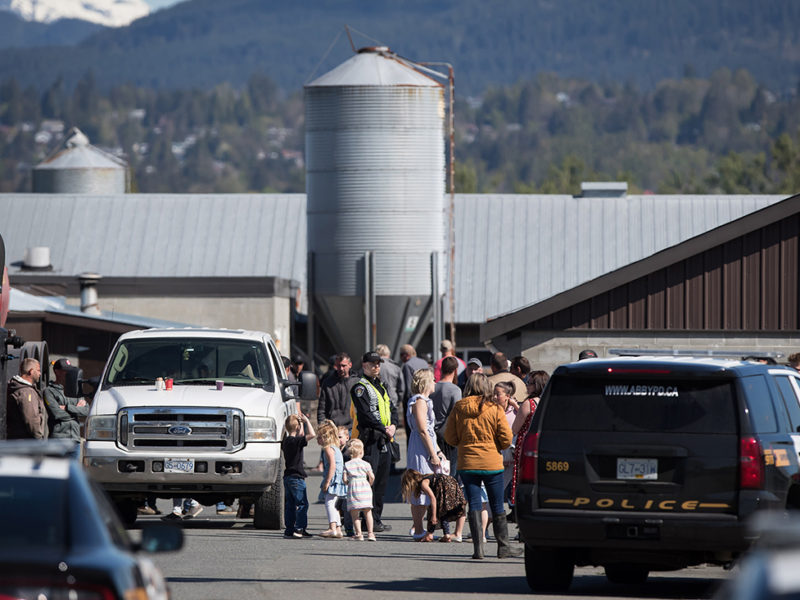
A police officer stands on the property at Excelsior Hog Farm surrounded by people who showed up to support the farmers after protesters occupied a barn, in Abbotsford, B.C., on Sunday April 28, 2019. Approximately 50 people occupied a barn and another 135 individuals protested on the rural road outside the farm after People for the Ethical Treatment of Animals released a video last week that it says shows dead piglets as well as fully grown pigs with growths and lacerations. THE CANADIAN PRESS/Darryl Dyck

December 1, 2019 byPeter Mitham

VICTORIA – Unanimous support for tough laws to protect agrifood operations against trespassers was a highlight of agriculture day in Victoria this year.

Opposition proposals were embraced by the government, resulting in a rare show of unity among the parties on an issue that has hit farmers hard over the past several years.

“We understand that a farm or a ranch, it’s not just a workplace, it’s a home and it’s a place with children and grandparents. Trespass, mischief, prowling at night, these are all against the law and must be treated as such,” BC agriculture minister Lana Popham told producers and representatives of farm organizations at a reception in Victoria on October 28.

The announcement was met with applause, and BC Agriculture Council chair Stan Vander Waal said farmers across the province should feel lighter as a result. BCAC urged the province to take action in April, following the invasion of Excelsior Hog Farm by more than 100 activists.

“This was a big ask from agriculture,” he said. “Most of us here feel a lot lighter tonight when it comes down to the confidence we have in our ability to do what we do for agriculture.”

Attorney general David Eby and solicitor general Mike Farnworth stood alongside Popham, pledging their support for the move.

Eby led the charge, introducing the Miscellaneous Statutes Amendment Act, which among other things addressed the province’s trespass legislation. Opposition members stepped up on October 21, with Abbotsford West MLA Mike de Jong asking for an amendment to include livestock operations among the premises protected from trespass in legislation.

Chilliwack-Kent MLA Laurie Throness jumped in October 28 with a private member’s bill aimed at protecting all forms of agrifood operations and stipulating fines of up to $50,000 on those who contaminate such “food establishments.”

“It’s our hope that the government will take this bill or respond with its own to send a strong preventative message to activists, like that sent by the government of Alberta earlier this month, and that BC will act decisively to protect farmers, processors and animals alike from unlawful trespass,” he told the legislature.

Popham, Eby and Farnworth all said that would happen.

“To have our laws reflect that care and concern that we have for the work that you do is really important,” Eby said. “We’re on your side and we’ve amended the law to make it absolutely clear to everybody.”

The bill included “a building or permanent structure designed or used for shelter for livestock,” as well as vehicles and aircraft used for the same, among the premises where trespassing was explicitly prohibited. However, no fines were specified; these will follow in regulations under the act.

The bill passed October 29 and received royal assent on Halloween.

Dairy farmers were particularly pleased with the development.

Organizing meetings for “Dairy is Scary,” a campaign launched by Canadian activist Erin Janus that raised the ire of New Brunswick farmers earlier this year, have been taking place in BC.

The meetings are hosted by Direct Action Everywhere, a six-year-old animal rights group founded in San Francisco. It was planning protests during the BC Dairy Conference in Vancouver, November 27-28. Fraser Valley farm families fear they could be next.

“Our association takes the issue of trespassing seriously,” BC Dairy Association general manager Jeremy Dunn said in response to the amended Trespass Act. “We are glad to see our government recognizes the importance of protecting our food system, and has committed to ensuring safe working environments for farming families, their employees and their animals.”
Related Posts

You may be interested in these posts from the same category.

Province to oversee livestock welfare

Peace Region land-sharing proposal nixed

Cedar Valley licence reinstated

Quick action on allegations

Douglas Lake challenge dismissed

No right to roam

Douglas Lake wins appeal

SlaughterRight training launched by ag ministry

Activists plead not guilty

Hog producers face changes to code of practice

RCMP investigate dead sheep

Province consults on trails

Previous Post: « Ranchers voice ALR concerns at public meetings
Next Post: No-till takes centre stage at field day »

Copyright © 2026 Country Life in BC · All Rights Reserved