
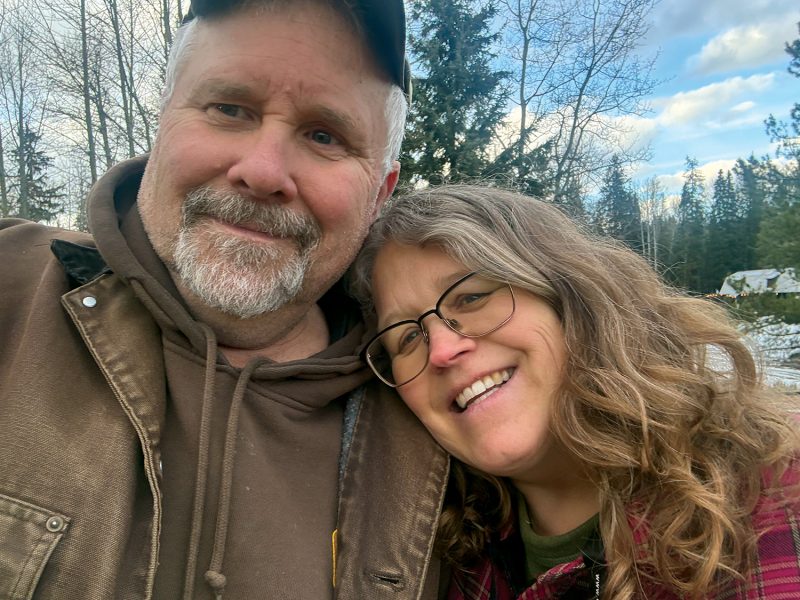
QUESNEL – The challenging state of BC’s forestry industry over two decades ago led to an unexpected opportunity for two professional foresters living in BC’s northern Interior.
Ted Traer and his wife Heloise Dixon-Warren were career foresters – Traer worked with the BC Ministry of Forests while Dixon-Warren was a consultant in the private sector. When the industry entered a downturn in the early 2000s, the Houston Forest Service District office closed, and Traer was transferred to Quesnel.
With two daughters aged two and five in tow, the couple bought a logged 65-acre property with a pond, pasture, fixer-upper house from the 1970s and a whole lot of native plants. They named it Moose Meadows Farm for the number of moose beds in the back section.
Twenty-four years later, the family has a well-established agri-tourism business with 21 different structures reflecting the diversity of activity on the property.
“We just kept trying new things and it exploded,” says Dixon-Warren. “There was no formal business plan, and not everything we tried worked, so we would just stop doing it and try something else. We do a lot of things in a small way to create the overall agri-tourism experience while fulfilling our commitment to sustainable farming and forestry practices.”
Whether they are caring for their alpacas, donkeys and chickens, collecting birch sap for syrup, foraging evergreen boughs to make Christmas wreaths, or running the Bouchie Lake Country Store they own down the road, there is always something going on. About 400 people visit the farm each year to attend workshops, festivals and tours and to stay in two Airbnb units.
Moose Meadows’ success is a reflection of increased interest in agri-tourism across the country. The Canadian agri-tourism market is projected to grow by more than $100 million between 2024 and 2029, according to a 2024 report by Bonafide Research, with a major driver being consumers’ interest in where food comes from.
A 2023 study by the Cariboo Regional District cites exceptional opportunities for agri-tourism in the region due to its year-round natural beauty, affordable land and a consumer appetite for experiential travel.
“Moose Meadows is a farm first, and we farm with the seasons,” Traer says.
The couple initially sold eggs to earn its farm status, then gradually added garlic, berries, vegetables and herbs to create a market garden. Traer was a familiar face at local farmers markets for more than 15 years, where he cultivated his passion for teaching people about food and farm life. It was a natural transition to put his colourful personality to use as Moose Meadows’ tour guide.
“I’m pretty good at stretching a story into a bit of a yarn,” he says.
Visitors can also commune over the fence with the resident donkey family, who double as barnyard protectors and lawn mowers, or get up close and personal with two goats and a sheep that range free during the day.
For a short six-week window every spring, before the trees begin to bud, the focus is on tapping the farm’s birch trees to make its Boreal Amber Pure Birch Syrup.
“I remember making maple syrup on my mom’s kitchen stove in New Brunswick, but birch syrup is completely different,” Traer says. “It has a much lower sugar content than maple syrup, which makes it well-suited for cooking and making marinades and vinaigrettes.”
He considers tapping the trees a more sustainable practice than logging them.
“Our alpacas provide manure and graze around the trees, which helps keep the brush down. They also provide fibre for yarn, rovings (long, narrow bundles of fibre used in spinning and felting), socks, blankets, duvets and pillows. Everything we do ties together,” Traer adds.
Moose Meadows is one of a handful of birch syrup producers in Canada due to the product’s limited production window, lack of consumer awareness and the cost of labour and resources to harvest and process the sap.
The syrup is bottled at the farm and shipped to chefs and retailers across Canada and the United States. It can also be ordered from the farm’s online store and the Bouchie Lake Country Store, along with tapping equipment. Dixon-Warren wrote the first and only manual on birch syrup production in Canada, which is also available from the farm.
The farm’s greatest economic generator is its evergreens business, which dominates from October to December. Six full-time workers are hired during the season to collect evergreen boughs in the area and make them into high-quality wreaths and ornaments in various themes and sizes.
In 2005, the couple built a barn and workshop specifically for making the wreaths. As many as 1,500 wreaths have been created in a single season for customers throughout North America.
“We went for high-margin and low-volume by focusing our marketing on corporate clients and wreath-making workshops at the farm,” Traer says.
Not everything the couple has tried has been successful, however, including raising honeybees.
“We managed hives for about six years and always got lots of honey, but we were spread too thin and had a lot of losses due to mice, harsh weather, and bee health,” says Dixon-Warren.
Growing Christmas trees was another challenge.
“People came to the farm to buy them, but when artificial trees came onto the market, they became the tree of choice for a lot of people. We never had a large enough customer base to make it worthwhile,” Traer says.
In addition to their busy life on the farm, the couple are also active in their community. Traer has been the local FireSmart coordinator for over six years, while Dixon-Warren spends much of her time running the Bouchie Lake Country Store and is a founding member and chair of the North Cariboo Agricultural Marketing Association, widely known as FARMED, which works to connect producers and consumers and increase food production in the region.
On a recent day in March, when Dixon-Warren was travelling, Traer slipped and put his back out for a couple of days.
“My daughter came down from Prince George to help keep things going,” he says. “It all made us realize how important it is to keep our health up and the need to plan for succession. We’re having those conversations now.”
Moose Meadows is celebrating its 24th anniversary by participating in three events in 2026: the Quesnel Chamber of Commerce’s April trade show, which includes a FARMED street party; a birthday celebration at the Quesnel Fall Fair, and a farm-to-chef event in September.
“We’re so fortunate to raise our girls here, make a living and do all the creative things we do,” says Dixon-Warren. “That’s a lot to celebrate!”
All content on this website is copyrighted, and cannot be republished or reproduced without permission.
 Weather risks shrink insurance options