
VERNON – Water restrictions intensified across the southern Interior in late July, with record low stream flows clouding the cash outlook for ranches and orchards.
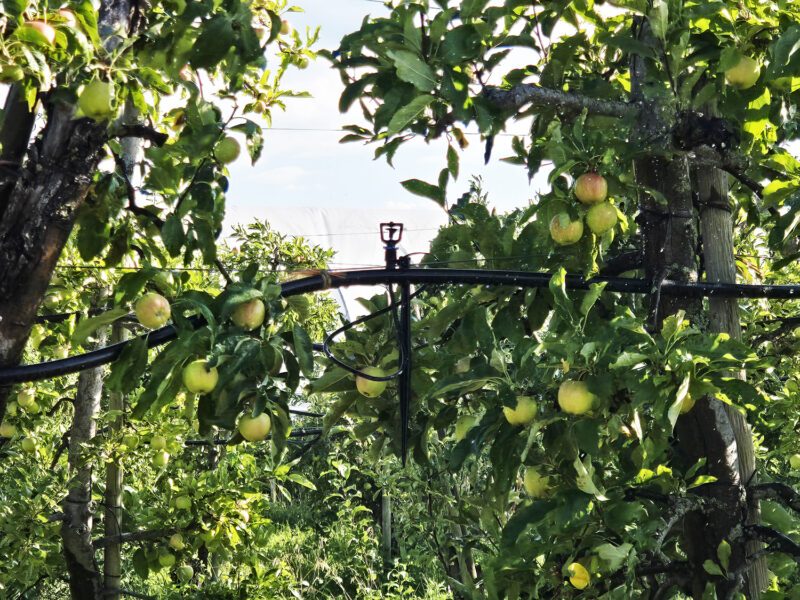
Fourteen agricultural water users served by Greater Vernon Water (GVW) who maxed out their allocations were shut down by the Regional District of North Okanagan (RDNO) in mid-July, including one of BC’s largest tree fruit growers. (Privacy laws prevented RDNO from naming affected growers.)
RDNO reduced allocations to GVW agricultural users by 70% on June 4, and shut off users who expended the 30% left to them.
RDNO activated an emergency operations centre in response to the drought on July 10, with staff working to transfer underutilized allocations to affected growers.
The BC Fruit Growers Association says the shutoffs could result in $250 million worth of losses to growers. It expressed disappointment that a support plan wasn’t developed prior to the cutbacks being announced.
“[The decision] was made without a coordinated survival plan for the orchards and farms it affects,” it says. “A regional water authority cannot turn off the water to a food-producing sector of this scale without first working through the consequences with growers and with the province.”
GVW’s main reservoir also sits within the Bessette Creek watershed. It and the Salmon River reported record-low stream flows as this issue went to press, with the province warning that irrigators could be shut off if licensees did not reduce water use.
“We’re really hoping that everyone does as much as they can to voluntarily reduce their consumption of water, understanding that there are some important dairy and corn crops there,” Water, Land and Resource Stewardship minister Randene Neill said during a media briefing on July 14. “Temporary protection orders remain available as a last resort. I know these decisions can have a strong impact on people, particularly farmers. We do not make these decisions lightly.”
While flows in Bessette Creek were holding up at press time, flows in the Salmon River were dropping despite producers shifting to irrigation schedules that will cut allocated use by more than 50%. In Westwold, producers will see reductions of more than 75% thanks to past equipment upgrades.
Producers hope the reductions show that shutting down irrigation makes little difference to the fish, instead expanding the harm of the drought rather than reducing it.
And the harm could be significant. Ranchers and farmers in the region are on the verge of harvesting their second cut but need water to take it across the finish line. Once the hay is off, water will be critical to renew pastures in advance of cattle returning home this fall.
“We’re more than willing to significantly reduce our water use, but we can’t grow feed with no water,” says Trudy Schweb of Schweb Family Cattle in the Salmon River Valley. “We can do a lot with some water, but we can’t do anything with none. When we finish cutting our second crop, it’s imperative that those freshly cut fields receive water immediately so the new growth can get started.”
Water reductions have already reduced the second cut, and a shutdown will mean less regrowth.
“We’ve already started purchasing feed because we can see the writing on the wall,” Schweb says. “The question isn’t whether we’ll need to buy feed – it’s how much we’re going to need. Until we know when the rain will come or when our cows may have to come home from pasture, there’s a tremendous amount of uncertainty.”
The uncertainty makes financial planning extremely difficult.
“With the uncertainty surrounding water shortages and grazing conditions, we don’t know if our cattle will be forced home early from summer pasture or what weights they will be when they return,” Schweb explains. “It’s almost impossible to market our cattle effectively or lock in prices for what is typically our largest payday of the year.”
She wants to see the province fast-track dam construction on Bolean Lake, as it has for critical mineral and clean energy projects. The project, backed by the BC Cattlemen’s Association, would increase stored water for release when stream flows drop.
Regular discussions with the province this year have been helpful, but Schweb says the lack of long-term solutions after four water shutdowns in the past six years shows that the province continues to treat water shortages as a year-to-year emergency rather than part of the current operating environment.
Producers across the region want to see solutions, with orchardists David Geen and John Bylands – growers with properties in Coldstream – seeking approval to draw water from a deep aquifer on a temporary basis.
While farmers are being asked to bear the brunt of shutdowns, growing residential and industrial demand is part of the issue.
“There needs to be some imaginative thinking,” says Geen. “Greater Vernon has built a lot of new houses over the past 20 years, and they’ve upgraded the chlorine plants. If you asked what they’ve done to improve the supply of water for agriculture, the answer is nada.”
Geen and Bylands are willing to pay for wells to tap water 200 feet below their properties, then hand them over to Greater Vernon Water at the end of 2027 on the condition they have first right of refusal on water from the wells in dry years.
But RDNO rejected the request on July 22, asking Geen and Bylands to provide additional information.
Neill told Country Life in BC that the province is working with growers to come up with long-term solutions.
This includes not only a dam to boost water storage at Bolean Lake, work Neill says is moving “really quickly,” but taking a look at wells and allocation sharing.
The BC Ministry of Agriculture and Food committed an additional $20 million to water storage projects at the BC Agriculture Forum in June for five community-led projects in drought-impacted watersheds with significant agricultural production, but the funds have yet to be allocated.
“They will be selected with input from sector representatives, based on water supply risk in watersheds with significant agricultural activity,” agriculture ministry staff explain.
All content on this website is copyrighted, and cannot be republished or reproduced without permission.

 Table grape growers eye opportunities