• Menu
  • Skip to primary navigation
  • Skip to main content
  • Skip to primary sidebar

Country Life In BC Logo

The agricultural news source in British Columbia since 1915

  • Headlines
  • Calendar
  • Subscribe
  • Advertise
  • About
  • Archives
  • Contact
  • Search
  • Headlines
  • Calendar
  • Subscribe
  • Advertise
  • About
  • Archives
  • Contact
  • Search

Primary Sidebar

Originally published:

SEPTEMBER 2020
Vol. 106 Issue 9

Subscribe Now!

Sign up for free weekly FARM NEWS UPDATES

Select list(s) to subscribe to


By submitting this form, you are consenting to receive marketing emails from: Country Life in BC. You can revoke your consent to receive emails at any time by using the SafeUnsubscribe® link, found at the bottom of every email. Emails are serviced by Constant Contact
Your information will not be
shared or sold ever

Stories In This Edition

Under one roof

Creating community in abundance

Farms to retain tax status

Armyworm keeps its distance this summer

Smile with your eyes

Fall back

Back 40: Finding what we need in a COVID-19 world

Viewpoint: Exports play a vital role in BC’s farm economy

Field days feeling the pinch of social distancing rules

Sidebar: Pacific Agriculture Show goes virtual

AgSafe makes changes to board structure

Makin’ hay

Metro Vancouver targets carbon-neutral future

Changes to land commission kick in this fall

Creston initiative keeps workers, town safe

Ag Briefs: Dairy industry selects new entrants

Ag Briefs: Top vet appointed

Ag Briefs: BC youth offer perspectives

Sheep producers told to bear with wildlife

Disease has sheep producers on defensive

Pandemic creates virtual season for 4-H clubs

Delta development puts agrihoods to the test

Three-tier system being floated for livestock watering

Short-term roller coaster for beef market

Beef prices up

Global outlook is bright for beef producers

Council supports efforts to improve water quality

New orchardist takes on key ministry role

Unprecedented rise in machine harvesting

Soft landings mean better blueberries

Province readers sprayer program for delivery

Wheat growers tap into heirloom grains

High-flying pans grounded by pandemic protocols

Farm Story: The right machine makes harvesting potatoes a breeze

Organic soil requirements need science, guesswork

Relay cropping checks all the boxes

Flower growers ponder COVID-19 impacts

Best practices must guide COVID-19 hiring

Woodshed: No place like home for Deborah and the dogs

Former caregiver brings donkey therapy to Island

No one leaves Abundance without a zucchini

Building community, building a future

Jude’s Kitchen: Harvest colours

More Headlines

Follow us on Facebook

Comments Box SVG iconsUsed for the like, share, comment, and reaction icons

6 days ago

... See MoreSee Less

View Comments
  • Likes: 4
  • Shares: 0
  • Comments: 0

Comment on Facebook

6 days ago

On the last day of the BC Organic Conference, Thursday, Molly Thurston of Pearl Agricultural Consulting helped growers learn how to manage bugs such as codling moth, wireworm, and rootworm in organic growing systems. Her talk alongside Renee Prasad included hands-on activities in which participants checked out various traps and examined pests under microscopes. Be sure to look for more upcoming ag events on our online calendar at www.countrylifeinbc.com/calendar/

#BCAg
... See MoreSee Less

On the last day of the BC Organic Conference, Thursday, Molly Thurston of Pearl Agricultural Consulting helped growers learn how to manage bugs such as codling moth, wireworm, and rootworm in organic growing systems. Her talk alongside Renee Prasad included hands-on activities in which participants checked out various traps and examined pests under microscopes. Be sure to look for more upcoming ag events on our online calendar at www.countrylifeinbc.com/calendar/

#BCAg
View Comments
  • Likes: 15
  • Shares: 0
  • Comments: 0

Comment on Facebook

1 week ago

Well-known organic farmer and podcaster Jordan Marr gets interviewed by Country Life in BC’s own columnist and potato mavin Anna Helmer during the opening session of the BC Organic Conference at Harrison Hot Springs yesterday. Sessions run today (Wednesday) and Thursday and include organic and regenerative growing practices and expanding and advocating for the organic sector, all under the background of the newly launched Organic BC banner.

#BCAg
... See MoreSee Less

Well-known organic farmer and podcaster Jordan Marr gets interviewed by Country Life in BC’s own columnist and potato mavin Anna Helmer during the opening session of the BC Organic Conference at Harrison Hot Springs yesterday. Sessions run today (Wednesday) and Thursday and include organic and regenerative growing practices and expanding and advocating for the organic sector, all under the background of the newly launched Organic BC banner.

#BCAg
View Comments
  • Likes: 37
  • Shares: 2
  • Comments: 1

Comment on Facebook

Interested in finding out more about this

3 weeks ago

Today, we remember those who sacrificed their lives or their well-being for our freedom. Lest we forget. ... See MoreSee Less

Today, we remember those who sacrificed their lives or their well-being for our freedom. Lest we forget.
View Comments
  • Likes: 8
  • Shares: 0
  • Comments: 0

Comment on Facebook

1 month ago

FarmFolk CItyFolk is hosting its biennial BC Seed Gathering in Harrison Hot Springs November 27 and 28. Farmers, gardeners and seed advocates are invited to learn more about seed through topics like growing perennial vegetables for seed, advances in seed breeding for crop resilience, seed production as a whole and much more. David Catzel, BC Seed Security program manager with FF/CF will talk about how the Citizen Seed Trail program is helping advance seed development in BC. Expect newcomers, experts and seed-curious individuals to talk about how seed saving is a necessity for food security. ... See MoreSee Less

Link thumbnail

BC Seed Gathering - FarmFolk CityFolk

farmfolkcityfolk.ca

Save the date for our upcoming 2023 BC Seed Gathering happening this November 3rd and 4th at the Richmond Kwantlen Polytechnic University campus.
View Comments
  • Likes: 1
  • Shares: 0
  • Comments: 0

Comment on Facebook

Subscribe | Advertise

The agricultural news source in British Columbia since 1915
  • Email
  • Facebook

Sheep producers told to bear with wildlife

Conservation officers encourage conflict avoidance

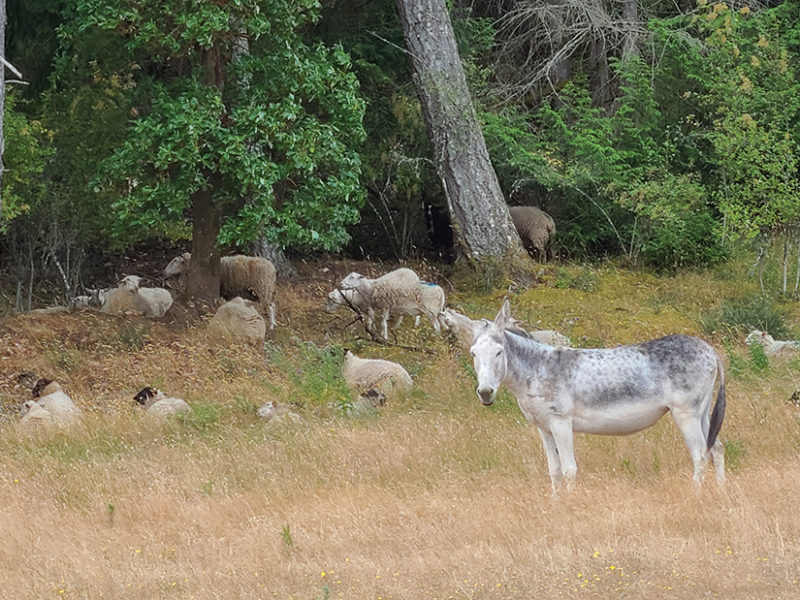
Donkeys, not dogs, work best to protect the flock from predators at Parry Bay Sheep Farm on Vancouver Island. PHOTO / PARRY BAY SHEEP FARM

September 1, 2020 byBy Barbara Johnstone Grimmer

METCHOSIN – A black bear has been killing sheep in the Metchosin area on Vancouver Island since July and unlike previous occasions, the BC Conservation Officer Service (COS) is stepping back and asking farmers to step up prevention efforts.

Twenty-one sheep from various farms have been killed to date. Ten of the bear kills were at John and Lorraine Buchanan’s Parry Bay Sheep Farm. An additional five sheep are missing.

“I believe four were chased into the ocean,” says John Buchanan. “One was found on the beach across the harbour. I don’t know yet how many of these will be paid for.”

Producers are eligible to receive compensation for most losses if it can be proven to the standard requirements for the provincial Livestock Protection Program.

Conservation officers have been called out to help but have not responded with assistance to remove the bear. The District of Metchosin sent a letter to the BC COS in mid-July and Metchosin mayor John Ranns was assured that conservation officers would dispatch dogs if a scent remained on the kill.

“Nobody has come out,” says Ranns.

A statement the BC Ministry of Environment provided Country Life in BC says the COS has been working with Metchosin farmers to minimize the number of sheep lost to bears and the number of bears killed.

“These strategies include educating farmers on best management practices regarding livestock, including installing an electric fence, locking up sheep in a barn overnight, regularly checking the condition of the herd and the use of livestock guardian dogs,” says the statement. “Proper livestock husbandry management is critical to help reduce predation and lessen livestock losses. If these practices are not followed, this can result in a wildlife conflict and the possible destruction of a bear that could have been prevented.”

The province says conservation officers have been active in Metchosin, responding to complaints and encouraging farmers to follow best practices to reduce conflicts.

“Conservation officers strongly encourage farmers to implement best practices to protect both livestock and wildlife,” the statement says. “Livestock management techniques are always encouraged to help prevent conflicts from happening in the first place.”

Donkey patrol

Buchanan has tried to comply with the recommendations, adding guardian donkeys to his flocks and electric fencing to some fields. He adds that guardian dogs would be difficult to manage in the semi-developed area of Metchosin.

“I do believe the donkeys help,” says Buchanan. “There was a cougar hanging around one field that had two small donkeys in it. That night it moved a couple of miles and killed a sheep with no donkeys present. When we had the kill and the lambs chased into the ocean in East Sooke, we moved a donkey out there. The pasture was large, and the bear came and killed one and took one away. We moved them to a smaller field and had no more problems. Now we have electric fencing there and the problem stopped.”

But the mitigation efforts aren’t cheap. Buchanan spent $2,000 to upgrade the fence and $500 on maintenance. The cost of three donkeys, feed and farrier is another $2,000. He figures it would be too expensive to electrify the entire 10 miles of fencing at all the holdings where he grazes sheep.

The Buchanans have the largest sheep flock on Vancouver Island, utilizing small leased pastures around the region, and providing infrastructure to the sheep community by running a small inspected abattoir.

“By far the biggest issue for me, though, is if we are pushed off pastures, that will reduce sheep numbers, and threaten the slaughterhouse and our ability to maintain the delivery of lamb to town. That is bad for the industry,” says Buchanan.

“On a brighter note,” he adds, “COVID-19 has increased our demand to a level that can maintain the business and allow me to buy when everybody has lambs.”

Traps better

The province’s statement adds that conservation officers rarely use tracking dogs when responding to bear conflicts, “as the circumstances in which they are effective are very limited and can pose additional safety risks to the public and officers. Live trapping using a variety of techniques is a much safer and effective option.”

The position the COS has taken has been frustrating for Ranns.

“Traps and snares have proven to not be effective in our community and run the risk of trapping bears that are not a problem,” says Ranns. “This is a problem that goes beyond the threat to our farming community. There is a concern for the public and our visitors who use our hiking trails, which are the main corridors that the bears use. These people are city people and not bear aware.”

Ranns is concerned that the bear will be back worse than ever in September, as he builds up fat stores for the winter.

Producers encountering predator kills of their flock are encouraged to call the Ministry of Environment RAPP Line for assistance at 1-877-952-7277 or #7277 on the TELUS Mobility network. To report a livestock predator loss, call 1-844-852-5788 and the Livestock Protection Program will provide verification and mitigation for cattle and sheep producers.



Related Posts

You may be interested in these posts from the same category.

BC wool value, volume drop

Ranchers watching bluetongue outbreak

Leasing farmland a vital strategy for farmers

Previous Post: « SAWP requirements waived
Next Post: Changes to land commission kick in this fall »

Copyright © 2025 Country Life in BC · All Rights Reserved