
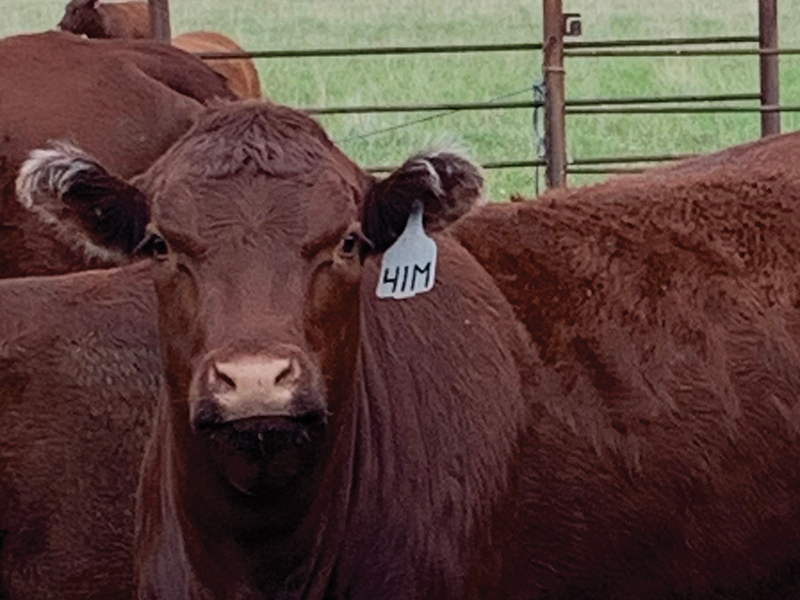
CRANBROOK – North America’s cattle markets are largely explained by simple supply and demand. When there are lots of cattle available, ranchers receive lower prices. When the herd size is smaller, prices trend higher as the market competes for a lower number of animals.
This cycle repeats every 10 to 12 years in the cattle market, Canfax executive director Brenna Grant told the BC Cattlemen’s Association annual meeting in Cranbrook, June 6-7.
The dynamic explains the current strong prices for cattle, which saw 500-pound calves command more than $5.00 a pound just after Christmas.
“I often get asked about the fundamentals that are driving this market and the prices that we currently have and are expecting for the next two years,” Grant says.
Current pricing is double the $2.25 to $2.50 calves were fetching in 2021, when the Canadian herd peaked at 3.8 million head. Producers were barely breaking even.
However, that same year, many regions of North America began experiencing hot, dry summers which led to shorter supplies and higher prices for hay and other cattle feed. Faced with expensive feed and poor prices, ranchers often chose to sell heifers rather than keep them to breed a calf. Some even liquidated portions of their main herd, fearing it would simply be too expensive to feed them.
The result has been a significantly smaller cattle herd across North America, with the Canadian herd down by approximately 9%, or 332,000 animals, to
3.3 million.
As feedlots compete for animals to fill their pens and, subsequently, packers to fill their processing lines, producers have seen higher prices for their animals.
Growing conditions for feed were better last year and grain prices have dropped, Grant points out.
This year’s corn crop is off to a good start across the continent, fuelling hopes that this year’s feed prices will again reflect long-term averages.
Producers now face the decision of whether to sell their heifer calves at a high price this fall or hold some back to breed so they will have more calves to sell next fall and possibly make even more money.
“We are now in the third year of tightening supplies, but we are not at the bottom yet,” Grant says. “We’re actually expecting to revisit the 2015 low in terms of slaughter numbers somewhere around 2027.”
The reason, she explains, is once heifer retention starts, there will be even fewer calves for sale, causing a further reduction in calves coming forward.
Grant says it is hard to pinpoint exactly when heifer retention will begin. The long-range forecast shows a hot and dry summer for most of Western Canada, and that may affect range quality and hay prices, and producers may opt to sell rather than incur the cost of feeding cows through the winter.
Also, the actual production numbers coming out of feedlots are not that low.
“We are expecting a 3.5% drop in beef production,” Grant says, explaining that feed efficiencies produce larger carcass weights in the feedlots.
But there comes a point when cattle need to go to market, and those animals are often smaller as well as being fewer in number.
Operators will also need to source more beef-on-dairy animals as well as cheaper imports to keep enough supply in the market.
“We don’t want to lose customers to pork or chicken because it’s hard to get them back once they’ve switched,” Grant says.
Yet demand for beef remains strong despite the alternatives.
“This is the highest demand level for beef since the 1980s,” Grant notes. “We are actually up in 2024. But retail prices have been increasing 7.3% a year since 2020.”
Supplies will remain tight over the next 18 to 24 months, with strong prices over the fall as feedlots compete to fill their pens.
“We are looking at average prices in the fourth quarter to be at around $5.50 to $5.70, and a number of you know that we have had sales out of BC already from $5.50 to $6.22,” Grant says. “If we do see heifer retention, we can absolutely see prices higher than that $5.60, $5.70 price range.”
Nevertheless, Grant urges producers to have risk management plans.
While the US is honouring tariff exemptions on all products under the CUSMA free trade agreement, including beef and cattle, she says the threat of tariffs creates uncertainty and prices could get “choppy.”
 Crown land conflicts reveal policy gaps