
CHILLIWACK – There’s a high school in Chilliwack where summer school has a waitlist.
“Every year, we have students transfer into our school to take the ag program,” says Sardis Secondary School agriculture program teacher Joe Massie. “And we have 100 high school students signed up for [the summer program]. We also have 40 elementary and 25 middle school [kids] and their teachers. And waiting lists.”
Kids from elementary age through to Grade 12 are clamouring for a turn to spend time working at the Sardis Secondary School farm from early July to the end of August. This eagerness to work at the farm during the dog days of summer is in addition to the popular Grade 10 to 12 agriculture programs taught during the school year.
“Curriculum-wise, lessons always stem from what’s happening in the field. Opportunities like that present themselves constantly,” Massie says. “We’ll do the lesson based on what has to be done at the farm. We try to model it after practices in the industry.”
The summer course, Sustainable Vegetable Production, runs two days a week with paid teachers. Students gain academic credits for their work to maintain and advance the five-acre farm and an existing flower greenhouse while they learn about agriculture. With middle schoolers in the summer program, it makes the transition to high school an interactive one.
“Their first entrance into high school is a casual outdoor environment,” Massie says. “It’s a very healthy way to start high school.”
Lessons include all aspects of farming from irrigation and soil health to pests, planting, fertilization and pollination.
“We don’t try to promote any one theory of growing,” he says. “We just try to show them the differences.”
With both organic and conventional farming practices in play, students learn about the processes, expectations and requirements and make their own decisions about which approach is better and in which cases.
“We show them the differences,” Massie says. “The rest is up to them. They can see it.”
The flower greenhouse, east of the school parking lot, has been on site for more than 40 years, and the farm, a little over 1.5 kilometres away, was initially purchased by the school district for a future school. It became part of the school’s teaching environment in 2014 when infrastructure – a well, irrigation systems and outbuildings – was established.
Massie and fellow agriculture program teacher Tania Toth spearheaded the efforts to turn the land, which was growing forage corn for a neighbouring dairy, into a teaching farm with fruits and vegetables. The goal now is to raise the remaining $50,000 needed to start the 30-by-80-foot modern greenhouse, scheduled to break ground at the farm site in the fall. The first growing season for the new greenhouse will be spring 2026.
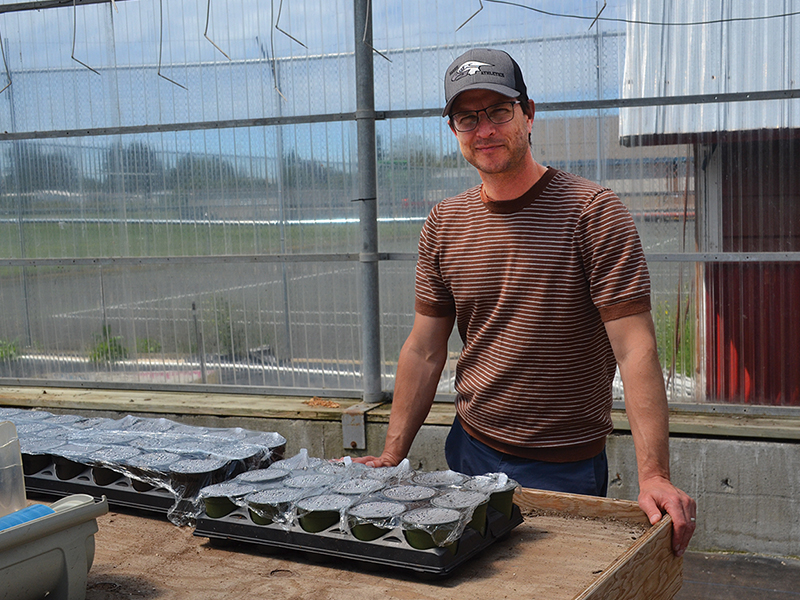
“I love teaching in the greenhouse because it’s a controlled environment,” says Massie of the existing flower greenhouse.
The new greenhouse will feature hydroponics and also propagate plants for other areas of the teaching farm.
Farming background an asset
Massie originally taught physics at Sardis Secondary but has been part of the agriculture program since 2007, about the same time Toth joined the program.
“I was raised on a dairy farm and later on a hobby farm,” he says. “Then I worked in a greenhouse as a youth. When they said, ‘Do you want to teach the agriculture program?’ I didn’t have to think too hard about it.”
Toth, winner of the 2017 BC Agriculture in the Classroom Foundation’s Outstanding Teacher award, also grew up on a family farm.
The existing greenhouse has contributed to about 30 years of flower cultivation, leading to the highly anticipated Mother’s Day sale each year. This year’s sale sold out of hundreds of hanging baskets in about three hours and raised $27,000 for the school’s agriculture program. The next plant sale will be in the fall.
“We’ll have a much bigger sale than just a pumpkin sale,” Massie says. “It’s not ‘feel sorry for us, we’re students,’ it’s, ‘we’re producing among the highest quality products.’”
Showing students what actually happens in the agriculture sector keeps Massie engaged; that and the tractor.
“I never thought I’d get to drive a tractor in my job,” he says.
In September, about 70 Grade 10 and Grade 11 Environmental Science students take over farm duties from the summer students.
“They will be running the farm, which includes harvest and sales at that point,” Massie says. “They run a CSA program.”
Winter classes are primarily theory and planning, but in spring, the process of planting begins anew with the new batch of students focused on the Mother’s Day plant sale as well as the farm.
“In February, we get all new students,” he says. “The lab is a continuation. You’re constantly passing the torch to the next group of students. Everyone is doing everything together. They’re all invested.”
Agriculture 11 and Agriculture 12 courses also include involvement at the farm and in the existing greenhouse. The new greenhouse will increase the production of greenhouse crops, such as tomatoes, peppers and cucumbers, while also enhancing education about the greenhouse industry.
There are also elementary and middle school garden plots at the farm.
Students in the agriculture programs receive fruits and vegetables to take home, and any leftover produce is donated to the Salvation Army-run Pantry food bank, where people can shop for groceries without paying.
While some students go on to careers in agriculture, Massie says that data is hard to track. Instead, he and Toth focus on providing an understanding and appreciation of farming. The students even mow the lawns.
“That’s more what we’re really aiming for,” he says. “Teaching students that farming is hard. We really think students come away with that appreciation.”
He, Toth and the other teachers involved hope for an understanding of all aspects of agriculture, including successes and failures due to external forces, the importance of healthy food, how soil contributes to food systems and the essential nature of working together. Students gain a long-term understanding of the growing side of food systems, which is often discussed in today’s culture but not well understood.
Collaboration is the key to the success of the school’s farm. Greenhouses and seed companies provide seeds and plants, while Joiner’s Corn plants an acre of corn each year.
“People are stepping forward to do tractor work. The kids, they get to see the GPS on the tractor,” he says.
The local Canadian Tire turned a problem into a win for the farm when it donated about $3,000 worth of seed potatoes. The spuds had frozen, so Massie opened the bags and students planted the ones that weren’t mouldy. Some are coming up slowly, and it’s another learning experience.
Tom Baumann, president of local ag consulting firm Expert Agriculture Team Ltd., has been a supporter of the farm for more than 10 years, sharing knowledge as well as donating hundreds of berry plants and supplies to create the berry patch.
“Our goal is to have as diverse of a farm as we can,” says Massie.
 Apple commission vote underway