
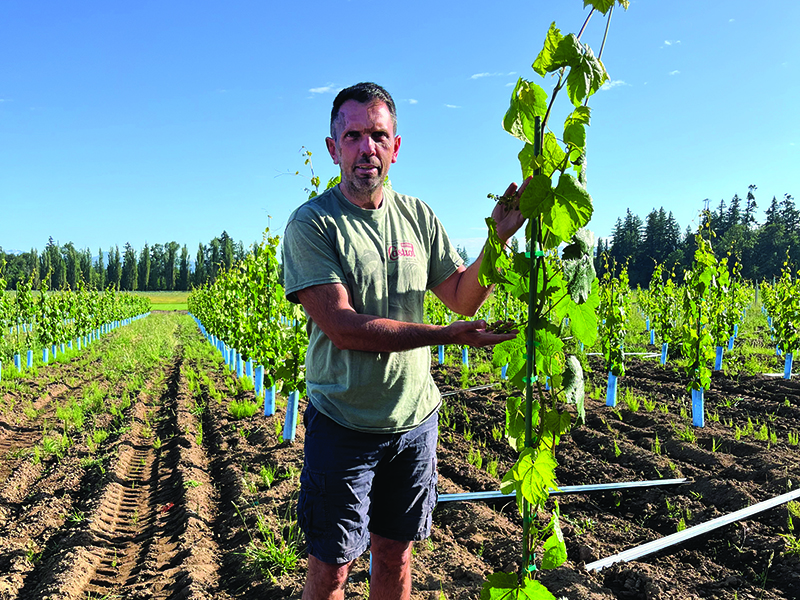
LANGLEY – Gorgi Petkov still remembers the big, juicy table grapes grown in his home country of Macedonia – and he’s on a mission to create similar varieties in BC.
Petkov, vineyard manager of Fairmeade Estate in Langley, is trialling three new table grape varieties – Ivory, Timpson and Strawberry Grape – for the Lower Mainland and Vancouver Island, saying there’s huge potential in producing local fruit.
“Canada is importing annually $1 billion in table grapes – it’s a valuable produce,” says Petkov, a professional agrologist. “The idea is to try as many varieties as possible so we can choose the best for this climate. We can choose some early ripening and some late ripening, so we can cover the market. It’s very exciting.”
Table grapes have been grown in the Okanagan since 1927, but the market has shrunk over the years as growers have turned to wine grapes. Petkov’s efforts are part of a provincewide push to reinvigorate BC’s table grape industry.
The renewed interest throughout BC has prompted the 65-year-old Okanagan Table Grape Growers Association to initiate the process to rename itself the BC Table Grape Growers Association.
Association president Jane Johnston, owner of Avoca Vineyards in Kelowna, says a provincial association will have more clout when it comes to accessing provincial funding.
“Table grapes are really taking on a bigger role for people who are farming and wanting to grow locally and eat locally,” Johnston says. “I believe table grapes, because of climate change, really has expanded to a bigger area than just the Okanagan.”
Viable option
A recent opportunity assessment, commissioned by the BC Ministry of Agriculture and Food, suggests table grapes are once again a viable option in BC, given the volatility in wine grape and tree fruit production in recent years, and concerns over food security and domestic supply.
The ministry says at this time, no decision has been made on whether the province will provide replant funding to the BC table grape industry.
“We love grapes in Canada,” says Arnica Rowan, co-owner and partner in Terroir Consulting, which conducted the report. “Demand for table grapes versus what we eat is very disparate, and there’s a huge opportunity for us to be doing local production.”
Canada imports between 97% and 99% of its table grapes from countries such as Mexico, Peru, South Africa and the US. In BC, 84% of table grapes are grown in the Okanagan-Similkameen and Thompson regions, 9% in the Lower Mainland/Fraser Valley, 5% on Vancouver Island and 2% in the Kootenays and Cariboo.
The sector is small and largely defined by legacy plantings of Sovereign Coronation, which has not kept pace with consumer expectations or global varietal innovation, Rowan told participants at an online town hall in May. Increasing competition from Ontario-grown grapes has also resulted in those grapes landing on BC shelves during peak harvest season. BC’s table grapes, meanwhile, are sold at farm stands, farmers markets and specialty stores.
The report suggests there’s potential to expand the market and replace table grapes grown elsewhere, particularly in the US. These include retail-standard green grape varieties like Timpson, Ivory and Thompson Seedless, which Rowan says is the most widely grown variety worldwide and shows potential for Vancouver Island.
Premium pink grapes such as Magenta, Vanessa and Somerset, now grown in pockets of BC, could also represent a seasonal category suited to boutique grocery, Asian retail and direct-to-consumer channels, she says.
“There’s a possibility here to potentially have a payback period around five years,” Rowan says.
Petkov and his partners have planted more than eight acres of their three varieties, sourced from Bloom Fresh in Ontario, along with some hybrid plants from the Okanagan and expect to see the fruits of their labour next year.
“We will see the grape quality in next year’s production,” he says. “If we are happy with these varieties, we can expand.”
Rebranding
Johnston says the rebranded table grape association will be a provincial voice to help kick-start the industry, raising the sector’s profile in a way the BC Grape Growers’ Association was unable to, given that most of its members are wine grape growers.
The two organizations will complement each other and share knowledge, she says.
“We need to keep with the changing times, the changing climate and the changing weather patterns that we’re subjected to here,” Johnston says.
It also hopes to raise the public profile of local table grapes.
“It’s very upsetting to our farmers and our local growers when grapes are being brought in from Ontario when they are grown right here,” she says.
Johnston invites interested growers to join the new association. The association will not be involved in buying or selling products or getting fruit to market, but it will continue to work with growers to keep prices reasonable.
“We’re really here to advocate for growers, to inform and let people in the community know we are here and we’re going to stay and get bigger and will provide us with a better return on our investment,” she says.
The province says the move will create new opportunities for local farms and food and beverage processors.
“There are opportunities for BC table-grape growers to increase both production and sales in our communities,” BC agriculture minister Lana Popham says in an emailed statement to Country Life in BC. “I’m confident through the assessment and ongoing work and commitment of BC growers, more families will enjoy the quality and flavours of BC grapes in the years to come.”
All content on this website is copyrighted, and cannot be republished or reproduced without permission.
 Drought forces Salmon River farmers to act