
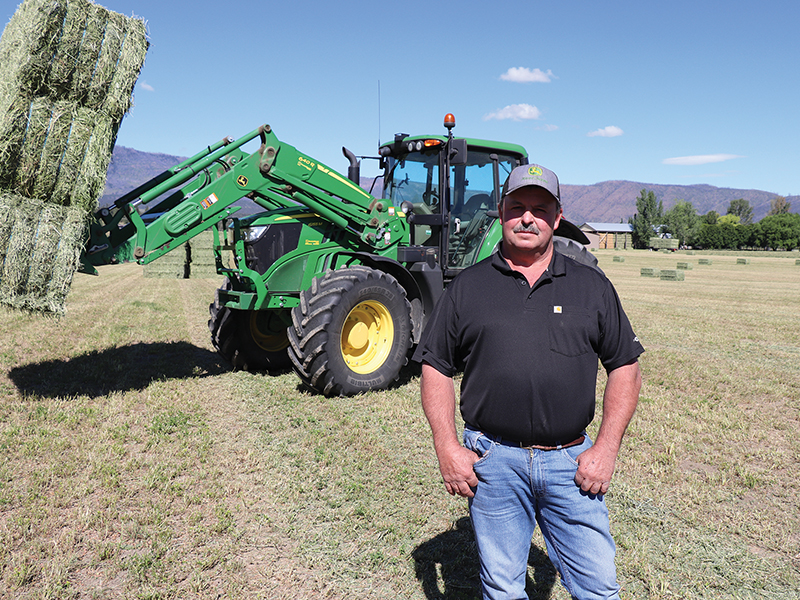
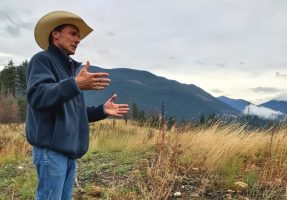
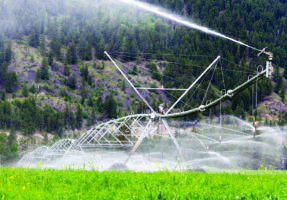
WESTWOLD – Hay producer Clay Abel knows it isn’t a matter of if, but when, the province will shut off his aquifer this summer.
It happens often, usually in mid-August, with the province arguing the water levels are too low in the Salmon River.
“I really suspect we’re going to have the same issue this year but maybe a month earlier,” says Abel, who produces 500 acres of hay. “It really is detrimental to us as growers not to have water. It’s not just for hay growers; it’s for anyone growing food.”
The South Thompson, where the Salmon River is located, entered the summer at 9% of normal, according to the province. The South Thompson was at Drought Level 3, indicating increasing dryness and drought severity in mid-June.
The ongoing drought situation has Abel and other producers taking matters into their own hands, working to find a solution to boost water levels in the Salmon River. Abel says the proposal is still being ironed out, but the intent is to seek provincial funding to collect and store water for release when it’s needed. The cost would be topped up with private funds from local producers.
Abel says he doubts the move will happen this year, but it could be in place by next summer if they get the support they require.
“We’re attempting to say to [the province], ‘if we guarantee a certain flow of water, will you leave us alone?’” Abel says. “For us to carry on as producers, we have to do something. I suspect we’re going to get nailed here. If we can get through July, we will be on borrowed time. We’ve got to find ways to get through this.”
New pilot announced
The BC government, meanwhile, has announced a pilot for “a new water scarcity level system” in select watersheds to assess, communicate and manage drought risks.
BC Ministry of Water, Land and Resource Stewardship (WLRS) water project specialist Sophie Michaelson told the Thompson-Nicola Regional District board earlier this spring that the province is working with the BC Cattlemen’s Association to explore the feasibility of shifting agricultural water use from a portion of the lower Salmon River to a central intake from Shuswap Lake near Salmon Arm.
The newly formed Salmon Arm Farmers Society board is undertaking the project.
“Low snowpack, early snowmelt and warm seasonal weather forecasts are elevating drought hazards for this upcoming season, particularly in the southern interior,” WLRS says in an email to Country Life in BC. “Taking water use off a portion of the lower Salmon River would decrease the water demand on the Salmon River. The water use from Shuswap Lake is much less likely to cause detrimental impacts.”
As of 2025, there were 870 licences on the Salmon River, its tributaries and hydraulically connected aquifers for multiple purposes such as irrigation, animal watering, domestic, industrial, commercial and waterworks, according to the province. Nearly 450 irrigation licenses accounted for more than 95% of water use by volume. Unlicensed domestic water users, both surface and groundwater, are not accounted for in these numbers.
Michaelson says the province is looking at a groundwater-surface water model to understand the flow, which is complex in the Westwold area, as well as artificial beaver dams to increase water retention and storage and riparian work.
“We’re looking to get quite a few producers off the Salmon River. We are in a feasibility study right now, but if we can get it done in 10 years, I would be happy,” she says. “I’m hoping all of these things combined can help with the water scarcity issue.”
The province says it has not yet started engagement with Salmon River water users about its plan.
A provincial pilot project is also underway in three areas along the upper and lower Nicola and Coldwater rivers to assess ways to address drought, Michaelson says. The province has designated the Koksilah and Nicola watersheds for the development of Water Sustainability Plans.
Four dry years
Ernest Moniz of HighCroft Farm on Notch Hill near Sorrento isn’t on the Salmon River but says something must be done to help farmers throughout BC.
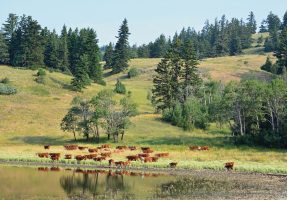
Water levels in his ponds have dropped dramatically over the past three years, forcing Moniz to truck in water for his small herd of cattle, sheep and horses. And with drought becoming a common occurrence throughout BC, he is now looking into water collection and storage for irrigation and firefighting.
“The water tables have been down three feet less in our ponds,” he says. “When we moved here years ago, there was tons of water; it was overflowing all the time. But the last four years it’s been really dry. The water tables are lower, and the wells are low as well. The water level never gets up to where it used to.”
Abel says he hopes the producers’ plan will go forward.
“We want to have water storage available to release into the system, so the salmon are happy and they don’t have to shut us down,” he says. “We’re doing our darnedest to put it back.”
All content on this website is copyrighted, and cannot be republished or reproduced without permission.


 BCAC plans farmland trust