
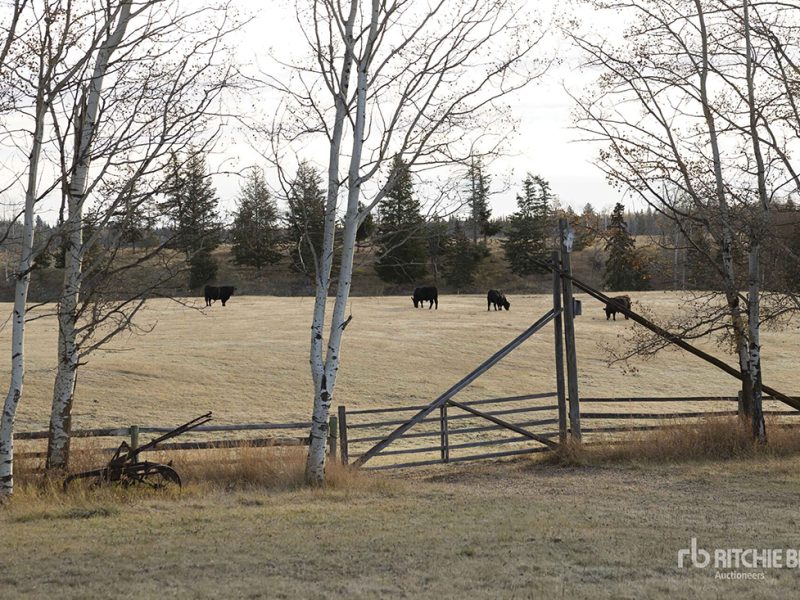
WILLIAMS LAKE – An initial offering of 12 ranches totalling more than 45,000 acres by Monette Farms, one of Canada’s largest farm operators, ended without bids – a sign, according to industry sources, that uncertainty surrounding Aboriginal title is scaring off buyers.
The offering of the properties last November through Ritchie Bros. Auctioneers Inc. was billed as “a once-in-a-lifetime opportunity to own prime ranch land,” with a Facebook video featuring drone footage of sweeping vistas in the BC interior.
Monette says it is open to a leaseback arrangement with the new owners, which would allow it to keep working the properties.
Despite the hype, Ritchie Bros. did not sell any of the properties by the initial January 9 deadline, and the properties entered a “tender by auction” process with a March 3 deadline.
Clare Furman, senior public relations manager with Ritchie Bros., says that despite the lack of sales, there has been significant interest.
“Ritchie Bros. does not typically comment on specific bid activity or negotiations during an active sales process. That said, we’ve had a lot of interest in the properties thus far and are utilizing multiple Ritchie Bros. platforms throughout the sale,” she says.
As for whether discussion and rumours surrounding Aboriginal title in BC might be spooking the market, Furman says buyers consider various factors.
“As with any real estate investment, buyers consider a range of factors, including land use, operating models and long-term stewardship,” says Furman.
However, one ranch deal is already known to have fallen through after local Indigenous groups told the prospective buyer, whose offer on the property had been accepted, that they would not endorse the transfer of the Crown licences needed to support the operation.
Under the province’s seven-year-old Declaration on the Rights of Indigenous Peoples Act, the province has a duty to consult Indigenous governments on such matters, which critics argue effectively gives them a veto in the decision-making process.
BC lawyer Thomas Isaac, a recognized authority in Aboriginal law, says it is obvious that the BC Supreme Court decision in Cowichan Tribes v. Canada, which found that Cowichan Nation has Aboriginal title over more than 700 acres of land in Richmond, has introduced great uncertainty to BC’s investment landscape.
“The fact that we now have uncertainty around indefeasible title, obviously, is not helpful to investment, given that in order to have a free market economy, you have to have the concept of indefeasible title,” says Isaac.
Isaac argues that an important feature of the Cowichan decision is that it explicitly claims to set a precedent, which he says is a highly unusual move from a lower court.
He refers to a detail in the decision that says fee-simple property does not extinguish Aboriginal title, and that core provisions of the Land Title Act (LTA) “do not apply to Aboriginal title.”
“A precedent that will follow from this case is that provincial Crown grants of fee simple interest do not extinguish nor permanently displace Aboriginal title, and ss. 23 and 25 of the LTA do not apply to Aboriginal title,” reads the last sentence in paragraph 3551 of the decision.
Isaac says the ramifications of the Cowichan decision extend well beyond Richmond.
He notes that BC is home to roughly a third of all First Nations in Canada, most of whom have not signed treaties extinguishing Aboriginal title.
This means that “about 85%” of the total area of the province not covered by treaties may be subject to Aboriginal title claims, he says.
“Pretty much every city in the province has got an assertion or an actual claim on it,” says Isaac.
The Secwépemc Nation is seeking its own declaration of Aboriginal title over its traditional territory, which includes the City of Kamloops, other municipalities and Sun Peaks resort.
In December 2025, a joint statement from Tk̓emlúps te Secwépemc and the City of Kamloops urged “calm and patience” and maintained that “the fundamentals of property ownership in Kamloops remain unchanged and day-to-day life continues as normal”.
In January, BC Cattlemen’s Association assistant general manager Elaine Russell told Country Life in BC that cattlemen hold some 200 Crown tenures within the claim area.
Another First Nation is drawing on the Cowichan decision for a new claim that encompasses private land.
In a suit filed on January 26, the Dzawada’enuxw First Nation on BC’s central coast is claiming ownership of 650 hectares around Kingcome Inlet. Most of that land is privately held by lumber producer Interfor Corp. and the Nature Trust of BC.
The Cowichan court decision recognized Aboriginal title over about 300 acres of land owned by Montrose Properties, a major Richmond landowner.
In February, Montrose asked BC Supreme Court to reopen the case, arguing that it should have been a party to the original trial.
In its application to the court, Montrose Properties stated that after the Cowichan Aboriginal title decision, it “can no longer confirm clear title to its land as required by lenders.”
Montrose noted that multiple projects had fallen through as a result of uncertainty created by Aboriginal title, including a lender backing out of a “shovel-ready” plan to build a warehouse.
It remains to be seen how the uncertainty surrounding Aboriginal title in BC will impact Monette’s attempt to sell its ranches.
The BC ranch selloff comes as Monette Farms is also seeking to offload numerous properties in the Prairies and even the US.
Monette Farms is seeking offers on 15 properties through its website. At first, Monette was soliciting bids discreetly – now, listings are visible to anyone who registers on the website.
The listings add up to roughly 129,000 acres in Saskatchewan, 49,000 acres in Manitoba, and 54,000 acres in Montana. The bidding deadline is March 2.
It is unclear how this large-scale selloff of land will impact Monette Farm’s longstanding goal of producing enough food to feed a vast portion of the world’s population.
The “About Us” section of the Monette Produce website still proclaims that “Our vision is to feed a billion people through sustainable agriculture.” Monette Produce’s LinkedIn page even attaches a date to the goal: “Join us on our path to feed One Billion people by 2030!”
Monette Farms did not reply to multiple requests from Country Life in BC for comment.
All content on this website is copyrighted, and cannot be republished or reproduced without permission.
 Farm finds resilience going with the grain