
• Menu
  • Skip to primary navigation
  • Skip to main content
  • Skip to primary sidebar

Country Life In BC Logo

The agricultural news source in British Columbia since 1915

  • Headlines
  • Calendar
  • Subscribe
  • Advertise
  • About
  • Archives
  • Contact
  • Search
  • Headlines
  • Calendar
  • Subscribe
  • Advertise
  • About
  • Archives
  • Contact
  • Search

Primary Sidebar

Originally published:

JUNE 2020
Vol. 106 Issue 6

Subscribe Now!

Sign up for free weekly FARM NEWS UPDATES

Select list(s) to subscribe to


By submitting this form, you are consenting to receive marketing emails from: Country Life in BC. You can revoke your consent to receive emails at any time by using the SafeUnsubscribe® link, found at the bottom of every email. Emails are serviced by Constant Contact
Your information will not be
shared or sold ever

Stories In This Edition

Bracing for CUSMA

Blossoming hopes

Ottawa comes under fire

ALR complaints rise, investigations on hold

Editorial: Shifting promises

Back 40: Timing perfect to advance slaughter initiatives

Viewpoint: Finding the right balance in times of stress

Berries look good amid COVID-19 concerns

Sidebar: Pollination shapes up

Poultry and hops a winning combination

Ag Briefs: Producers mourn rising young abattoir operator

AB: BC Veg eyes strategic plan

AB: Wage hike compounds challenges

AB: Former ALC chair Erik Karlsen dies

Provincial disaster assistance ‘isn’t working’

Growers plan ahead as potatoes find markets

BCTF introduces grower incentives to boost quality

Agritourism gets creative in midst of COVID-19

Biosolids project halter following harassment

Rethinking the concept for mobile abattoirs

Ranchers brand gov’t support inadequate

Dairy reduces energy costs with solar power

Ingratte heads dairy commission

Research: Dairy housing a matter of perspective

Grower harvests near-perfect Honeyscrisps

Making the shift from table to wine grapes

Abattoir meets needs of Gulf Islands farmers

Sidebar: Community spirit

Strenthenging on-farm food safety protocols

Sidebar: On-farm practices for a pandemic

Farm News: Taking refuge in The Lab

4-H sales adapt amid COVID-19 restrictions

Leafrollers can be a potential crop contaminant

Silicon control of fungal issues trialed

Not all farmers’ markets are thriving

Woodshed: Desperate times call for chivalrous measures

Flower power

Jude’s Kitchen: Home cookin’

More Headlines

Follow us on Facebook

Comments Box SVG iconsUsed for the like, share, comment, and reaction icons

7 days ago

... See MoreSee Less

View Comments
  • Likes: 4
  • Shares: 0
  • Comments: 0

Comment on Facebook

7 days ago

On the last day of the BC Organic Conference, Thursday, Molly Thurston of Pearl Agricultural Consulting helped growers learn how to manage bugs such as codling moth, wireworm, and rootworm in organic growing systems. Her talk alongside Renee Prasad included hands-on activities in which participants checked out various traps and examined pests under microscopes. Be sure to look for more upcoming ag events on our online calendar at www.countrylifeinbc.com/calendar/

#BCAg
... See MoreSee Less

On the last day of the BC Organic Conference, Thursday, Molly Thurston of Pearl Agricultural Consulting helped growers learn how to manage bugs such as codling moth, wireworm, and rootworm in organic growing systems. Her talk alongside Renee Prasad included hands-on activities in which participants checked out various traps and examined pests under microscopes. Be sure to look for more upcoming ag events on our online calendar at www.countrylifeinbc.com/calendar/

#BCAg
View Comments
  • Likes: 15
  • Shares: 0
  • Comments: 0

Comment on Facebook

1 week ago

Well-known organic farmer and podcaster Jordan Marr gets interviewed by Country Life in BC’s own columnist and potato mavin Anna Helmer during the opening session of the BC Organic Conference at Harrison Hot Springs yesterday. Sessions run today (Wednesday) and Thursday and include organic and regenerative growing practices and expanding and advocating for the organic sector, all under the background of the newly launched Organic BC banner.

#BCAg
... See MoreSee Less

Well-known organic farmer and podcaster Jordan Marr gets interviewed by Country Life in BC’s own columnist and potato mavin Anna Helmer during the opening session of the BC Organic Conference at Harrison Hot Springs yesterday. Sessions run today (Wednesday) and Thursday and include organic and regenerative growing practices and expanding and advocating for the organic sector, all under the background of the newly launched Organic BC banner.

#BCAg
View Comments
  • Likes: 37
  • Shares: 2
  • Comments: 1

Comment on Facebook

Interested in finding out more about this

3 weeks ago

Today, we remember those who sacrificed their lives or their well-being for our freedom. Lest we forget. ... See MoreSee Less

Today, we remember those who sacrificed their lives or their well-being for our freedom. Lest we forget.
View Comments
  • Likes: 8
  • Shares: 0
  • Comments: 0

Comment on Facebook

1 month ago

FarmFolk CItyFolk is hosting its biennial BC Seed Gathering in Harrison Hot Springs November 27 and 28. Farmers, gardeners and seed advocates are invited to learn more about seed through topics like growing perennial vegetables for seed, advances in seed breeding for crop resilience, seed production as a whole and much more. David Catzel, BC Seed Security program manager with FF/CF will talk about how the Citizen Seed Trail program is helping advance seed development in BC. Expect newcomers, experts and seed-curious individuals to talk about how seed saving is a necessity for food security. ... See MoreSee Less

Link thumbnail

BC Seed Gathering - FarmFolk CityFolk

farmfolkcityfolk.ca

Save the date for our upcoming 2023 BC Seed Gathering happening this November 3rd and 4th at the Richmond Kwantlen Polytechnic University campus.
View Comments
  • Likes: 1
  • Shares: 0
  • Comments: 0

Comment on Facebook

Subscribe | Advertise

The agricultural news source in British Columbia since 1915
  • Email
  • Facebook

Biosolids project halted following harassment

Protesters, vandalism tarnish ranch’s reputation

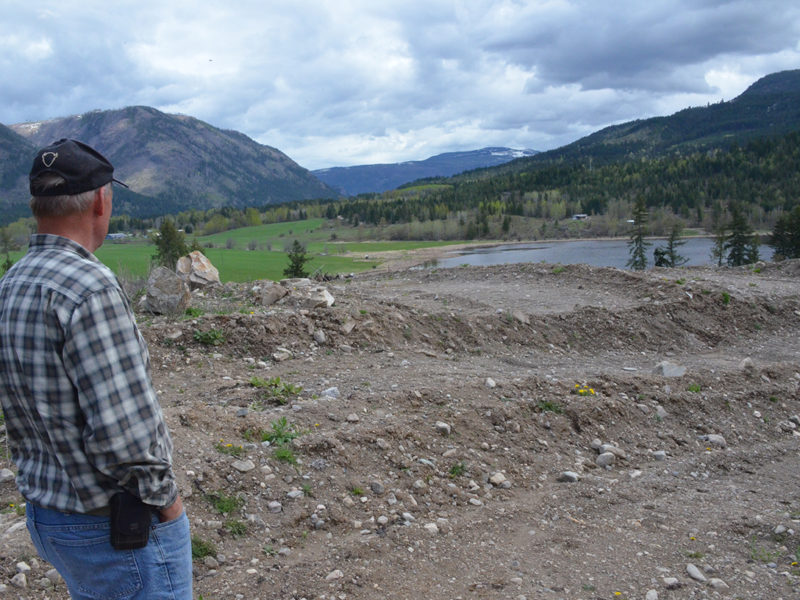
ON HOLD. Conrad Schiebel stands on the glacial till he was hoping to reclaim with biosolids. The project setbacks for Chum Lake, seen here, are 100 metres. That's more than triple the Organic Matter Recycling Regulation requirement. Photo / Tom Walker

June 1, 2020 byTom Walker

KAMLOOPS – A project to transform a logging site into productive pasture using biosolids from the city of Kamloops has been sidelined after the rancher was the target of harassment.

Conrad Schiebel of Turtle Valley Bison Ranch near Chase faced a road blockade, a social media smear campaign, defacement of his property and death threats throughout last year.

“People accused us of being environmental terrorists,” says Schiebel. “That really cuts deep.”

Schiebel says the ranch has lost income and customers, suffered damage to its reputation and neighbours have turned against it. Work to build the pasture has stopped, while Kamloops now faces the challenge of what to do with its stockpile of biosolids.

Ironically, the group harassing Schiebel is part of the very same First Nation that proposed the project in the first place.

Firebreak

During the winter of 2017-18, the ranch logged a 70-acre parcel of their land, which is privately held and outside the Agricultural Land Reserve. Schiebel aimed to build a firebreak for its current pastures and hoped the site would provide more grass for its herd of 75 bison.

“Late in 2018, we were approached by the Little Shuswap Lake Indian Band leadership to consider a biosolids application as a possible way to turn our logged area into productive pasture,” recalls Schiebel. “Both the elected council and several hereditary chiefs gave their support.”

Pasture seeding on the glacial till was completely unsuccessful in 2018 and the idea of biosolids held some promise. Schiebel spent a year researching biosolids before making a decision.

“We reviewed the practice with several agricultural, soil and water scientists as well as the BC government website on organic waste regulations,” says Schiebel. He adds that the website has high-quality, evidence-based information about the use of biosolids, which is a controlled substance under the province’s Organic Matter Recycling Regulation.

They also met with Arrow Transport, the company with the contract to manage the 19,500 wet tonnes of biosolids Kamloops produces each year, as well as an independent professional agrologist.

“They deemed our ranch as being an excellent site for this type of reclamation project,” says Schiebel. “The site has since been assessed by an independent hydrologist who also concurred that the risk to any surrounding water sources or aquifers would be extremely unlikely.”

Turtle Valley has a serious commitment to the land and its community.

“The ranch has worked diligently to implement our environmental farm plan,” notes Schiebel. “We have always worked closely with neighbouring First Nations and included them in all our farming and land development plans.”

The ranch received a permit from the province and Arrow began its deliveries in early April.

The biosolids are mixed with sawdust before being trucked to the site and deposited in a prepared trench. A backhoe combines the mixture with the glacial till before filling in the trench. The resulting soil has a 7% biosolid content.

“This isn’t just a straight surface application,” explains Schiebel.

Blockade

Area residents led by Connie Seaward began blocking the road that leads to the reclamation site on April 28, 2019 to protest the project. Arrow received an injunction against the blockade 10 days later. In turn, the protestors sought an injunction against the project. BC Supreme Court dismissed the protestors’ application against the use of the biosolids saying there was no plausible evidence to show that the biosolids would cause harm.

But Seaward’s group have certainly caused harm to the ranch. Ranch signs have been spray-painted with profanity, its vehicles and Schiebel’s RV have been paint-balled, broken glass has been thrown in the yard where its dogs run and death threats have been sprayed on nearby cliffs and a railway crossing. Schiebel figures it has cost the ranch around $100,000.

“We have lost good customers, particularly restaurants, that say they can’t be associated with all the controversy,” he says. “We had to sell off a number of our animals before maturity when things looked like they were taking a turn for the worse.”

Neighbours have not been immune to the fallout. A local contractor purchased new equipment to work on the project, but now his machines sit idle.

While local residents did not relish the idea of going to jail if they continued the blockade, that hasn’t stopped a splinter group of Shuswap Nation members from stepping in. The “Secwepemc Grassroots” reinstated the blockade in July and effectively halted the trucks. Arrow Transport, Turtle Valley and Kamloops all agreed to put the project on hold last fall.

The way a splinter group of protestors have been able to grab power from the leaders who initially proposed the project mystifies Schiebel.

“No one seems to be able to explain to us how this small group has the veto power over other First Nation representatives who were consulted and indeed introduced us to the project,” he notes.

Schiebel is equally frustrated by the fake science and vitriol that’s circulated on social media.

“The ease at which ill-informed comments or malicious attacks can now be shared is becoming a new reality for farmers and ranchers in today’s social media-driven world,” he says.

At present, the project remains idle.

“We were facing significant opposition from locals and later First Nations,” says Kamloops utility services manager Greg Wightman. “Although we were granted an injunction against the protestors blocking the road, we decided to put a pause on the project.”

The Kamloops biosolids committee has presented eight possible solutions to council. Agricultural application remains an option.

“We went through a very expensive review process to carefully outline all options,” says Wightman. “I actually presented this at a national conference and people couldn’t believe the opposition we faced in our region.”

Meanwhile, the backlog of biosolids in Kamloops continues to grow, assisted by the protestors. Sources say byproducts from local septic tanks are trucked down the road and processed and stored at the Kamloops holding facility. Every time the protestors flush, they’re adding to the problem.
Related Posts

You may be interested in these posts from the same category.

Organic matter regulations delayed

Previous Post: « Grand Forks ducks flood
Next Post: Province boosts online grants »

Copyright © 2025 Country Life in BC · All Rights Reserved