• Menu
  • Skip to primary navigation
  • Skip to main content
  • Skip to primary sidebar

Country Life In BC Logo

The agricultural news source in British Columbia since 1915

  • Headlines
  • Calendar
  • Subscribe
  • Advertise
  • About
  • Archives
  • Contact
  • Search
  • Headlines
  • Calendar
  • Subscribe
  • Advertise
  • About
  • Archives
  • Contact
  • Search

Primary Sidebar

Current Issue:

DECEMBER 2025
Vol. 111 Issue 11

Subscribe Now!

Sign up for free weekly FARM NEWS UPDATES

Select list(s) to subscribe to


By submitting this form, you are consenting to receive marketing emails from: Country Life in BC. You can revoke your consent to receive emails at any time by using the SafeUnsubscribe® link, found at the bottom of every email. Emails are serviced by Constant Contact
Your information will not be
shared or sold ever

Follow us on Facebook

Comments Box SVG iconsUsed for the like, share, comment, and reaction icons

6 days ago

... See MoreSee Less

View Comments
  • Likes: 4
  • Shares: 0
  • Comments: 0

Comment on Facebook

7 days ago

On the last day of the BC Organic Conference, Thursday, Molly Thurston of Pearl Agricultural Consulting helped growers learn how to manage bugs such as codling moth, wireworm, and rootworm in organic growing systems. Her talk alongside Renee Prasad included hands-on activities in which participants checked out various traps and examined pests under microscopes. Be sure to look for more upcoming ag events on our online calendar at www.countrylifeinbc.com/calendar/

#BCAg
... See MoreSee Less

On the last day of the BC Organic Conference, Thursday, Molly Thurston of Pearl Agricultural Consulting helped growers learn how to manage bugs such as codling moth, wireworm, and rootworm in organic growing systems. Her talk alongside Renee Prasad included hands-on activities in which participants checked out various traps and examined pests under microscopes. Be sure to look for more upcoming ag events on our online calendar at www.countrylifeinbc.com/calendar/

#BCAg
View Comments
  • Likes: 15
  • Shares: 0
  • Comments: 0

Comment on Facebook

1 week ago

Well-known organic farmer and podcaster Jordan Marr gets interviewed by Country Life in BC’s own columnist and potato mavin Anna Helmer during the opening session of the BC Organic Conference at Harrison Hot Springs yesterday. Sessions run today (Wednesday) and Thursday and include organic and regenerative growing practices and expanding and advocating for the organic sector, all under the background of the newly launched Organic BC banner.

#BCAg
... See MoreSee Less

Well-known organic farmer and podcaster Jordan Marr gets interviewed by Country Life in BC’s own columnist and potato mavin Anna Helmer during the opening session of the BC Organic Conference at Harrison Hot Springs yesterday. Sessions run today (Wednesday) and Thursday and include organic and regenerative growing practices and expanding and advocating for the organic sector, all under the background of the newly launched Organic BC banner.

#BCAg
View Comments
  • Likes: 37
  • Shares: 2
  • Comments: 1

Comment on Facebook

Interested in finding out more about this

3 weeks ago

Today, we remember those who sacrificed their lives or their well-being for our freedom. Lest we forget. ... See MoreSee Less

Today, we remember those who sacrificed their lives or their well-being for our freedom. Lest we forget.
View Comments
  • Likes: 8
  • Shares: 0
  • Comments: 0

Comment on Facebook

1 month ago

FarmFolk CItyFolk is hosting its biennial BC Seed Gathering in Harrison Hot Springs November 27 and 28. Farmers, gardeners and seed advocates are invited to learn more about seed through topics like growing perennial vegetables for seed, advances in seed breeding for crop resilience, seed production as a whole and much more. David Catzel, BC Seed Security program manager with FF/CF will talk about how the Citizen Seed Trail program is helping advance seed development in BC. Expect newcomers, experts and seed-curious individuals to talk about how seed saving is a necessity for food security. ... See MoreSee Less

Link thumbnail

BC Seed Gathering - FarmFolk CityFolk

farmfolkcityfolk.ca

Save the date for our upcoming 2023 BC Seed Gathering happening this November 3rd and 4th at the Richmond Kwantlen Polytechnic University campus.
View Comments
  • Likes: 1
  • Shares: 0
  • Comments: 0

Comment on Facebook

Subscribe | Advertise

The agricultural news source in British Columbia since 1915
  • Email
  • Facebook

Catastrophic flooding hits Fraser Valley

Photo / Facebook

November 17, 2021 byKate Ayers And Peter Mitham

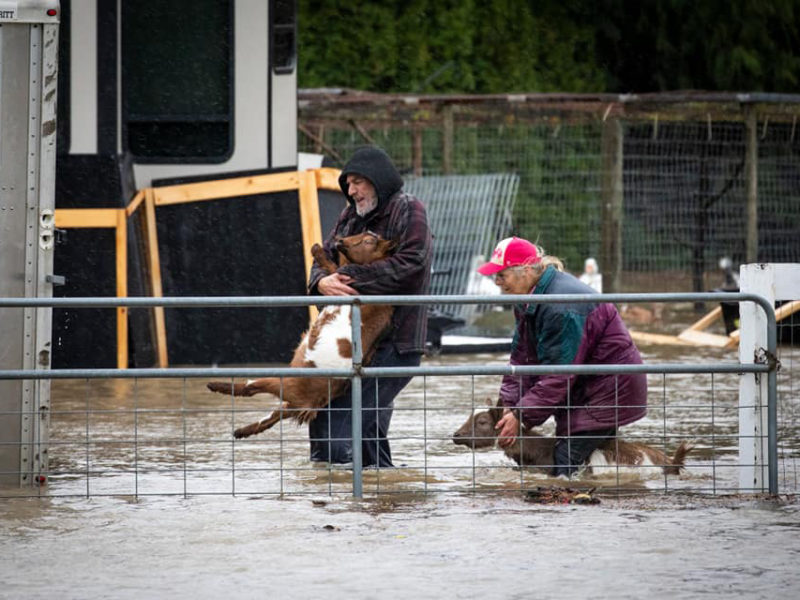
The flood waters are receding but the toll of what the province has dubbed “the worst weather storm in a century” is rising, with Abbotsford pointing to heavy losses of livestock on Sumas Prairie.

“I saw barns half-full of water,” Abbotsford Mayor Henry Braun said on Wednesday morning, following a flyover of the area on Tuesday. “I can’t imagine there are any birds left alive.”

However, he also cautioned, “We have no numbers.”

An atmospheric river dumped well over 200mm on the eastern Fraser Valley between Saturday and Monday, double what usually falls in November. It followed heavy rains in September and October which also delivered double what the region usually sees during those months.

The result was flooding, washouts and hardship for BC farmers and ranchers across the South Coast and into the Nicola Valley as rapidly rising waters inundated farms and cut critical infrastructure. Tuesday dawned with 24 highway closures in place. The BC Milk Marketing Board suspended milk pick-ups until further notice in large parts of the Fraser Valley east of Sumas Way in Abbotsford; Agassiz east of Mountain Water Harrison Way; as well as in the Interior, Prince George, Bulkley Valley and Smithers. Producers were asked to record and report volumes but then dump the milk into their manure pits. More than 80% of the province’s milk was not picked up.

On Tuesday night, Abbotsford issued an immediate evacuation order for Sumas Prairie due to waters from the Nooksack River threatening the Barrowtown pump station. The station’s four pumps were functioning at full tilt but the risk of a failure overnight demanded immediate action. Close to 200 properties are affected, many of them farms. The evacuation zone has about 300 residents.

“I know it’s hard for farmers to leave their livestock but people’s lives are more important right now than livestock or chickens,” Mayor Henry Braun said in a hastily called press conference at 9pm.

A rancher himself, Braun sympathized with farmers trying to save their livestock but said, “life is more important.” While the danger had receded by Wednesday morning, Braun made clear that it was not over as the Fraser River had to drop another metre before floodgates could be opened to relieve the pressure on Barrowtown.

At its peak on Tuesday, the Fraser River was at more than 6.3 metres.

The ongoing disruption to transportation networks has complicated matters, preventing farmers from leaving and making feed deliveries impossible. Some have left, saving their families but not their livestock.

BC Ministry of Agriculture, Food and Fisheries staff have been scrambling to secure information, working with producer groups to assess impacts and provide support. But many farmers have taken matters into their own hands, and the ministry says it hasn’t received any requests to relocate livestock.

According to the BC Egg Marketing Board, more than 60 farms are in the Sumas Prairie evacuation zone between Abbotsford and Yarrow. There are also 59 dairy farms under evacuation orders.

“We are also concerned about the fact that the Lower Mainland is cut off from the rest of the province by road,” added BC Egg’s director of marketing and communications Amanda Brittain. “The major concerns are getting feed to farms, transporting animals, and picking up finished products like eggs.”

The disruptions to the province as a whole underscore the warnings issued regarding the consequences of catastrophic spring flooding, a more familiar worry for producers.

According to the Fraser Basin Council, the direct impact to Fraser Valley agriculture of flooding similar to the 1894 freshet would approach $1 billion, with a total economic impact of more than $3 billion. While this flood is not on that scale, thanks to dyking and drainage infrastructure, the impact both within the Fraser Valley and across the province promises to be significant.
Related Posts

You may be interested in these posts from the same category.

Breathing new life into historic ranches

Comeau reappointed to milk board

Milk board undertakes review

Vet urges dairies to be vigilant against HPAI

Demand for milk, lower input costs good for dairy

Commercial egg production set to begin in Cariboo

Dairy quota rules change

Interior egg production set to rise

Dairy quota increases

BC Milk caught out

BC FIRB challenges WMP plans

Dairy demand prompts quota increase

Previous Post: « Cedar Valley licence reinstated
Next Post: BC Veg seeks commissioners »

Copyright © 2025 Country Life in BC · All Rights Reserved