• Menu
  • Skip to primary navigation
  • Skip to main content
  • Skip to primary sidebar

Country Life In BC Logo

The agricultural news source in British Columbia since 1915

  • Headlines
  • Calendar
  • Subscribe
  • Advertise
  • About
  • Archives
  • Contact
  • Search
  • Headlines
  • Calendar
  • Subscribe
  • Advertise
  • About
  • Archives
  • Contact
  • Search

Primary Sidebar

Originally published:

DECEMBER 2025
Vol. 111 Issue 11

Subscribe Now!

Sign up for free weekly FARM NEWS UPDATES

Loading form…

Your information will not be
shared or sold ever

Stories In This Edition

Title battle concerns ranchers

All hands on deck

Task force recommends ALR review

Delta grower inspires salad start-up

Editorial: We made it

Back 40: Time for a time change once and for all

Viewpoint: From desk to dirt: a writer’s farming journey

Breathing new life into historic ranches

Province lacks reconciliation roadmap

Oh, Christmas tree

Ag Brief: Federal budget kills Living Labs

Ag Brief: Food left off interprovincial trade deal

Ag Brief: Dry start to winter

Plan early, discuss often for farm succession

Dairy pushes forward with unification plans

Long growing season

Conservation program gets rebranded

Winter’s on its way

New growth envisioned for co-op’s old plant

Honey producers push back against headwinds

Beekeeper honoured with national award

Adaptive grazing fastest way to improve soil

Corn trials deliver impressive results

North Okanagan rail trail on track, but issues remain

Ready for winter

New guide offers food hubs tips to engage farmers

Farm news: Two-market weekends, too much excitement

Townhall looks to the future of agrivoltaics

Farmers ball celebrates legacy, community

BCHPA seeks risk assessments for packaged bees

Woodshed: Picnic plans raise flags for Junkyward Frank

Bursary takes edge off financial pressures

Jude’s Kitchen: Flatten your bird & BBQ it this Christmas

All content on this website is copyrighted, and cannot be republished or reproduced without permission.
More Headlines

Follow us on Facebook

Comments Box SVG iconsUsed for the like, share, comment, and reaction icons

2 days ago

Canada's mushroom growers will have to post countervailing duties next week following a US Department of Commerce determination that Canada's tax regime effectively subsidized growers, allowing them to cause "material injury" to US growers through their exports. Canada is a major exporter of mushrooms to the US, with the countries effectively operating as a single value chain thanks in part to one of the largest mushroom producers, South Mill Champs, headquartered in Pennsylvania.

#BCAg
... See MoreSee Less

Canadas mushroom growers will have to post countervailing duties next week following a US Department of Commerce determination that Canadas tax regime effectively subsidized growers, allowing them to cause material injury to US growers through their exports. Canada is a major exporter of mushrooms to the US, with the countries effectively operating as a single value chain thanks in part to one of the largest mushroom producers, South Mill Champs, headquartered in Pennsylvania.

#BCAg
View Comments
  • Likes: 2
  • Shares: 2
  • Comments: 0

Comment on Facebook

2 days ago

... See MoreSee Less

View Comments
  • Likes: 3
  • Shares: 0
  • Comments: 0

Comment on Facebook

2 days ago

The Jura Ranch near Princeton sold for nearly $5.3 million on May 12, the largest online ranch sale in BC in months, according to CLHBid.com, which handled the sale. The buyer was not named. Formerly owned by Rob and Kelly Lamoureux, which developed the successful Jura Grassfed brand, the ranch includes 2,625 deeded acres and a grazing licence totalling 83,698 acres. Originally offered at $4.2 million, the competitive bidding process delivered a higher value than the current market would suggest. Farm Credit Canada’s latest farmland value survey pointed to 1.7% decline in BC last year, which observers have attributed to tight margins and uncertainties related to Crown tenure.

#BCAg
... See MoreSee Less

The Jura Ranch near Princeton sold for nearly $5.3 million on May 12, the largest online ranch sale in BC in months, according to CLHBid.com, which handled the sale. The buyer was not named. Formerly owned by Rob and Kelly Lamoureux, which developed the successful Jura Grassfed brand, the ranch includes 2,625 deeded acres and a grazing licence totalling 83,698 acres. Originally offered at $4.2 million, the competitive bidding process delivered a higher value than the current market would suggest. Farm Credit Canada’s latest farmland value survey pointed to 1.7% decline in BC last year, which observers have attributed to tight margins and uncertainties related to Crown tenure.

#BCAg
View Comments
  • Likes: 34
  • Shares: 9
  • Comments: 4

Comment on Facebook

I sure hope it remains as farm land rather than a wind or solar installation.

Great grassland

yeah, who bought it? where are the checks and balances that ensure a ranch can continue being a ranch?

Uncertainty about crown land, aka native land grabs and unceded land claims being tossed around like it wasn't meant to destabilize the country?

4 days ago

American businessmen have quietly accumulated nearly 4,000 acres of farmland in the Robson Valley community of Dunster, sparking calls for restrictions on foreign and corporate agricultural land ownership in BC. Residents say the buy-up has driven population decline and priced out young farmers. MLAs from both parties and a UNBC professor are pointing to Quebec's new farmland protection legislation as a model BC should follo#BCAg#BCAg ... See MoreSee Less

Link thumbnail

Foreign land buyers hollow out Dunster

www.countrylifeinbc.com

DUNSTER – Purchases of swathes of farmland in the Robson Valley by wealthy American businessmen have some in BC demanding restrictions on foreign and corporate ownership of agricultural land.
View Comments
  • Likes: 24
  • Shares: 3
  • Comments: 1

Comment on Facebook

This is a serious issue in Dunster and one that has impacts for wildlife and human neighbours.

4 days ago

Representatives from Quail's Gate Winery Estate Winery in West Kelowna were panellists during the Okanagan Cultivates event held at Okanagan College's Kelowna campus on May 7. The college has been hosting events like this to help elevate conversations in the community about what's grown locally and its impact on the region's food, wine and tourism industry. The Quail's Gate panel, which included Ben Stewart, discussed the long history of grape growing and winemaking in front of a large crowd who came to listen, learn and taste products from a number of local wineries and restaurants. A new $48.8M food, wine and tourism centre is now under construction at the college to open in fall 2027. The building will have modern food labs, a student-led restaurant and café and specialized training spaces for culinary, viticultu#BCAgd tourism studies.

#BCAg
... See MoreSee Less

Representatives from Quails Gate Winery Estate Winery in West Kelowna were panellists during the Okanagan Cultivates event held at Okanagan Colleges Kelowna campus on May 7. The college has been hosting events like this to help elevate conversations in the community about whats grown locally and its impact on the regions food, wine and tourism industry. The Quails Gate panel, which included Ben Stewart, discussed the long history of grape growing and winemaking in front of a large crowd who came to listen, learn and taste products from a number of local wineries and restaurants. A new $48.8M food, wine and tourism centre is now under construction at the college to open in fall 2027. The building will have modern food labs, a student-led restaurant and café and specialized training spaces for culinary, viticulture and tourism studies.

#BCAg
View Comments
  • Likes: 8
  • Shares: 0
  • Comments: 0

Comment on Facebook

Subscribe | Advertise

The agricultural news source in British Columbia since 1915
  • Email
  • Facebook

Breathing new life into historic ranches

Food security, reconciliation drive a host of recent deals

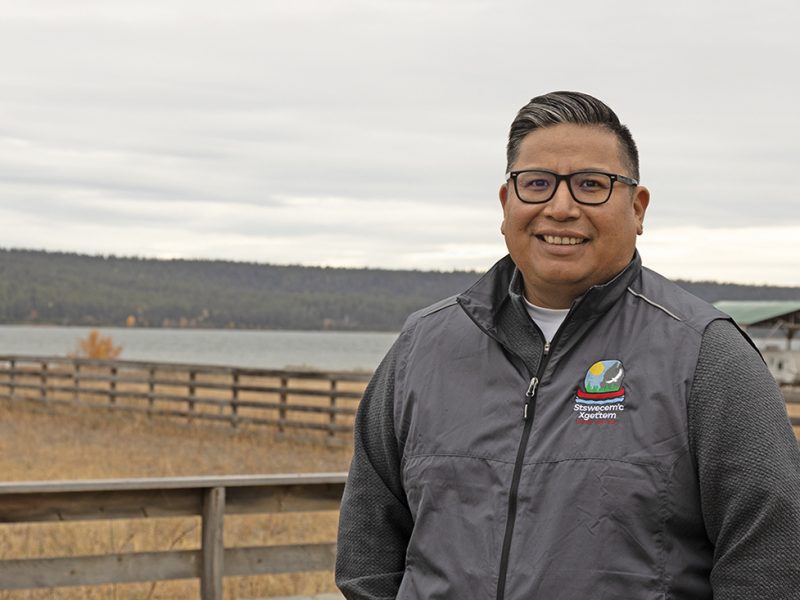
SXFN Kupki7 Hank Adams says his band is looking to diversify its Big Bar and Lac La Hache ranches. KELLY SINOSKI

December 2, 2025 byKelly Sinoski

CACHE CREEK – When the Hat Creek ranch came up for auction in August last year, Matt Pasco, chief of the Nlaka’pamux Nation Tribal Council (NNTC), was ready.

Dubbed the “Hat Creek Collection” by online auctioneer CLHBid.com, the opportunity included 74,716 acres of land offered as a single parcel. The sale included 2,387 deeded acres with the remaining acres split between grazing leases and licences, a Crown lease and a BC Hydro lease. The opening bid was $5.9 million and sold to NNTC’s economic branch, Kntam a shaytknmahh: We Help the People LP, for $8.52 million.

The ranch’s 450 head of cattle, hay and equipment cost an additional $3 million or so, according to Henry Braun, who had been a partner in the ranch lands with his late brother George, Ken Friesen and Alf Funk since 2008.

“I didn’t see that coming,” Braun says of the sale, noting that he had no idea who was bidding on the property. “We’re happy we sold it, but I didn’t know they had that kind of money.”

Pasco says his community has been preparing for the day when they could acquire the lands, part of his community’s ancestral territories. NNTC includes communities from Ashcroft through to Lytton.

Kntam a shaytknmahh also purchased the Ashcroft Ranch from Metro Vancouver in April this year for $28 million.

“We’ve been ranching for generations; this is not new to my family,” Pasco says. “We’ve quietly strategized for the opportunity to do it, and here it is. Our intention is to grow food for our community.”

The Hat Creek collection, comprised of five separate yard sites including 88 Ranch and Upper Hat Creek Ranch, was highly productive, Braun says, with three to four feet of black soil. He and his partners had run 450 cow-calf pairs and produced hay, which NNTC continues today. The Ashcroft Ranch is currently leased to Monette Farms, which has 800 cow-calf pairs, and Pasco says that won’t change.

He adds that he would like to grow potatoes on both ranches, along with vegetables and fruits, such as melons.

“Way back when, the Ashcroft area grew a lot of potatoes,” Pasco says. “We want to integrate that back into what we’re doing. I think we can sustain cattle plus grow some vegetables at the same time.”

The land sales are indicative of a growing trend in BC, which is seeing more Indigenous communities taking over BC cattle ranches. The Stswecem’c Xget’tem (Canoe Creek-Dog Creek) First Nation (SXFN) recently acquired the Easy Go Ranch in Lac La Hache, and the Okanagan Indian Band bought O’Keefe Ranch.

BC Cattlemen’s Association president Kevin Boon encourages the sale of ranches to anyone who will continue to work them, and doesn’t have a problem when new owners keep them in production.

“One of the First Nations chiefs said to me when I first came to BC that the first cowboys were Indians,” Boon says. “They have been raising cattle since cattle came to BC.”

Cariboo cattle rancher and former BC NDP MLA David Zirnhelt says many Indigenous ranchers owned cattle in the past but didn’t have enough land. As an MLA in the 1990s, he advocated for the idea of land banks – having the government buy private land for treaty negotiations. The federal government rejected the idea but accepted a ‘willing buyer, willing seller’ approach, which prevails today.

The industry waned in recent decades due to the hard work and the barriers of accessing the capital and land to operate, but interest is increasing.

“It’s positive, it creates opportunities,” Zirnhelt says. “The more food you can grow yourself, the more you can buy what you can’t raise yourself. In Secwepemc culture, their leaders talked a lot about their ranches, and their version of a ranch was a traditional territory that they used for all kinds of food and gathering.”

Under the modern treaty process, the BC Ministry of Indigenous Relations and Reconciliation (MIRR) has also bought several ranches for Northern Secwepemc te Qelmucw (NStQ) Indigenous communities in the Cariboo. These include the BC Cattle Co. for the SXFN, Bridge Creek Ranch for Tsq’escen’ (Canim Lake First Nation) and the Carpenter Mountain Ranch in 150 Mile for Xatśūll First Nation (Soda Creek Indian Band).

The lands are leased to First Nations with the intent to transfer them to the communities once an agreement is reached. The NStQ are in stage five of treaty process negotiations with the provincial and federal governments. As part of the treaty process, the province purchased the non-land assets required to operate the ranch businesses, such as livestock, equipment and/or hay inventory, depending on the ranch acquisition.

SXFN has plans to diversify its ranches, offering everything from tourism at its Big Bar Guest Ranch and Lac La Hache site to healing centres. BC Cattle Co. will continue to operate as a cattle ranch, with 600 cow-calf pairs.

SXFN Kupki7 Hank Adams says his First Nation is working with Thompson Rivers University’s regenerative agriculture program to install a floating vegetation system on one of the ponds and solar troughs, and using cultural burning to replenish overgrazed areas along the Fraser River. Plans are also in the works for a community garden and orchards, along with another greenhouse and cold storage. Plans call for training members as butchers so they can feed the community.

SFXN is also looking at training wild horses to help manage the land and reduce the impact on grasslands and rangelands.

“Historically, SXFN was known for growing the best wild potatoes in the area. Unfortunately, they plowed over them to make hayfields,” Adams says. “The community used to go all the way from the reserve to the Fraser River. That’s why it was important to get that ranch in the first place. We want to take care of ourselves. At the end of the day, it’s creating healthy beef in terms of food sovereignty and security.”

All content on this website is copyrighted, and cannot be republished or reproduced without permission.

Related Posts

You may be interested in these posts from the same category.

BC Cattlemen’s joins DRIPA challenge

Traceability reprieve for livestock

Lawsuits drive ranchers’ call for DRIPA’s repeal

Province lacks reconciliation roadmap: ranchers

Cowichan title decision creates uncertainty

Crown land conflicts reveal policy gaps

Beef herd drops

Feed available but stocks low

BC farmland values fall

BC Cherry holds AGM

Land Act changes deferred

Land Act firestorm

Previous Post: « Corn helps improve soil but fails grazing test
Next Post: $15,000 available for Shuswap projects »

© 2026 COUNTRY LIFE IN BC - ALL RIGHTS RESERVED