
• Menu
  • Skip to primary navigation
  • Skip to main content
  • Skip to primary sidebar

Country Life In BC Logo

The agricultural news source in British Columbia since 1915

  • Headlines
  • Calendar
  • Subscribe
  • Advertise
  • About
  • Archives
  • Contact
  • Search
  • Headlines
  • Calendar
  • Subscribe
  • Advertise
  • About
  • Archives
  • Contact
  • Search

Primary Sidebar

Originally published:

OCTOBER 2022
Vol. 108 Issue 10

Subscribe Now!

Sign up for free weekly FARM NEWS UPDATES

Loading form…

Your information will not be
shared or sold ever

Stories In This Edition

Greenhouse effect

Animal welfare under review

Avian influenza returns

BC Tree Fruit consolidation triggers revolt

Editorial: Sovereign realities

Back 40: Water remains a battleground in the US, BC

Viewpoint: Is agritech the tail wagging the dog?

Abattoir closure leaves producers scrambling

Canada comes up short on farm risk management

The show must go on

Ag Briefs: 4-H projects sell well at PNE

Ag Briefs: Strong growth for organics

Ag Briefs: Rate hike demands planning

Ranch suffers third natural disaster in a year

New abattoir opens in Pitt Meadows

Milk producers keeping an eye on free fatty acids

Cool season puts corn varieties to the test

BC members added to national youth council

Peace producers engage in on-farm research

Growth implants deliver big returns

Katz a keeper

Cannabis creates jobs for lean ranch operation

Post-harvest soil sampling yields input insights

Cranberry field day showcases Vasanna variety

Chilliwack tour showcases farm automation

Chilliwack blooms as Canada’s chrysanthemum capital

Grape grower has a passion for perfection

Plethora of pumpkins

Rural communities see surge in farmland sales

Farm Story: Crops prevail in spite of challenges

Woodshed: Kenneth seeks some advice on real estate

Day at the Farm delights visitors from the city

Jude’s Kitchen: Have a squish squash, very berry Thanksgiving

More Headlines

Follow us on Facebook

Comments Box SVG iconsUsed for the like, share, comment, and reaction icons

6 days ago

A BC Forest Practices Board investigation has found overgrazing has damaged grasslands in the Coutlee Range Unit near Merritt — and the range-use plan meant to prevent it was unenforceable. With complaints about overgrazing on the rise and grasslands covering just 1% of BC's land mass, the findings raise fresh questions about how the province manages one of its most vulnerable — and valuable — food-producing ecosyste#BCAg#BCAg ... See MoreSee Less

Link thumbnail

Board finds overgrazing rules unenforceable unmeasurable

www.countrylifeinbc.com

MERRITT – A BC Forest Practices Board investigation has found instances of non-compliance related to overgrazing have damaged open grasslands in the Mine pasture, part of the Coutlee Range Unit near...
View Comments
  • Likes: 6
  • Shares: 6
  • Comments: 6

Comment on Facebook

Several ranchers in recent years have gone into temporary non use on that range , so that means the grass should grow. But drought conditions/lack of rain and snow don’t allow that to happen . Dried up springs , creeks waterholes in various pastures add to over grazing where there is water , as livestock and everything else stay close to the water source . So even though less cattle are on it , over grazing appears. There is a large volume of horses on it 365 days/year which is wrong ! They pull grass right out of the ground when it’s just trying to grow ,, opens the door for weeds to grow in. That don’t help it. Aging infrastructure ( fences) laying on the ground, pipe line building , ( lack of commitment to fence maintenance) amongst all users contributes also to over grazing. Recreational atv users leaving gates open between pastures allows livestock to go back or ahead in pastures also expidites over grazing. Logging ( bcts) has no problem laying out cut locks on both sides of a fence , then it gets smashed down during logging and they don’t take responsibility to stand it back up or clean the cattle gaurds out when they are done , that happened 4 years ago on pasture 5 up there . I bet it is still not fixed . There are lots of contributing factors to the problem.

Tragedy of the commons.

I looked through the report. I saw nothing about the effects of noxious weeds on productive grasslands. This particular area is vulnerable because of the Ministry’a efforts to diversify the use of the Grasslands.

This pasture is under tremendous pressure not only from cattle but from irresponsible local residents who treat it as a landfill dumping all manner of household debris here. And don't even get me started on the mud bogging and camping in sensitive riparian areas. The feral horses are in this pasture 365 days a year just hammering it. Would sure be nice to see some enforcement action on people who are intentionally ripping up the grasslands and riparian areas. Cattle could be a valuable resource for rebuilding soils and native grasses in this area with the help of electric fencing and/or e-collars. The humans will be harder to manage.

The Forest and Range Practices Act was written by lawyers for global forest licencee shareholders. Results-based = unenforceable.

Also, can we talk about the impact of a pipeline being built through the middle of this field for multiple years?

View more comments

1 week ago

East Kootenay rancher Randy Reay is digging a new well after two natural water sources dried up on his Crown tenures. A new Living Lakes Canada assessment found 15% of mapped aquifers in the region are high-priority for monitoring, yet 80% of those go unmonitored. With over 48% of BC's provincial observation wells reporting below-normal groundwater levels, ranchers and researchers are sounding the alarm on water security. The story is in our March edition, and we've posted it to our website thi#BCAgk.

#BCAg
... See MoreSee Less

Link thumbnail

Water woes: groundwater under pressure across BC

www.countrylifeinbc.com

JAFFRAY – As a young boy growing up in the Kootenay-Boundary region, Randy Reay never expected to run out of water. But this year, in mid-February, his fields are bare. There is no snow halfway up t...
View Comments
  • Likes: 8
  • Shares: 7
  • Comments: 1

Comment on Facebook

Jaffrey is in the east Kootenays not kooteney boundary

2 weeks ago

BC farmers are bracing for prolonged higher input costs as war in the Middle East drives up fuel and fertilizer prices. Nitrogen fertilizer costs were already climbing before the Iran conflict began, with prices still roughly 60% above pre-pandemic levels. Farm Credit Canada warns that unlike 2022, strong commodity prices may not offset rising costs this time. Local suppliers expect supply challenges and further price increases ahead.

#BCAg
... See MoreSee Less

Link thumbnail

Fertilizer prices on the rise

www.countrylifeinbc.com

War in the Middle East has delivered a generational shock to energy prices, meaning BC farmers can expect a prolonged period of higher costs not just for fuel but also for fertilizer.
View Comments
  • Likes: 2
  • Shares: 1
  • Comments: 0

Comment on Facebook

2 weeks ago

... See MoreSee Less

View Comments
  • Likes: 1
  • Shares: 0
  • Comments: 0

Comment on Facebook

2 weeks ago

Cameron Stockdale is the new executive director of provincial farm safety organization AgSafeBC. Find out more in this week's Farm News Update from Country Life in B#BCAg#BCAg ... See MoreSee Less

Link thumbnail

New leadership at AgSafe BC

www.countrylifeinbc.com

Cameron Stockdale is the new executive director of provincial farm safety organization AgSafeBC, succeeding Wendy Bennett. Bennett left AgSafeBC in September 2025, following 12 years with the…
View Comments
  • Likes: 5
  • Shares: 1
  • Comments: 0

Comment on Facebook

Subscribe | Advertise

The agricultural news source in British Columbia since 1915
  • Email
  • Facebook

Chilliwack tour showcases farm automation

Better quality, better efficiency drive tech adoption

September 28, 2022 byPeter Mitham

CHILLIWACK – A better quality product with fewer workers was the common rationale for the adoption of technology at four agri-food businesses showcased during a recent tour Chilliwack Economic Partners Corp. hosted.

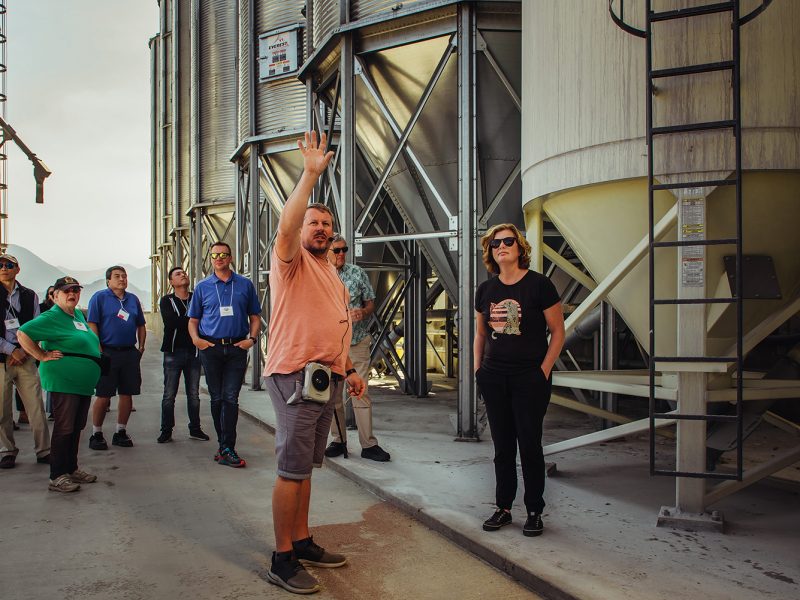
The day-long event September 9 treated more than 50 representatives of government, business and the media to tours of Dutch Heritage Greenhouse, which specializes in cut chrysanthemums; Brooknook Farms, a robotic dairy operation; MolsonCoors, whose Chilliwack brewery uses local water and hops; and Canadian Organic Feeds.

The businesses had made significant investments in their operations over the past three years, and the tour was a chance to show off the latest technology and other innovations.

MolsonCoors, which relocated its brewery to Chilliwack in 2019 from Vancouver, offered the best example of how technology is helping it do more with fewer people.

Just six of the brewery’s 100 workers brew the plant’s annual production of 100 million litres of beer. Based in a control room off the main production floor, the workers monitor signals coming from the stainless steel vats where the malt is soaked, fermented and ultimately pumped into a high-tech “flavour kitchen” for final adjustment before canning.

The majority of workers are employed in the packaging and distribution operations, themselves highly automated production lines that can fill 1,200 cases a minute.

“Everything’s automation in this brewery,” said Wenji Liu, brewery team lead.

Samples undergo regular analysis, verifying that brewing systems are delivering a consistent product. Samples are sent monthly to MolsonCoors’ corporate lab for further testing.

The brewery is situated on land excluded from the Agricultural Land Reserve to accommodate uses related to agriculture and food processing.

However, MolsonCoors also chose the site because of access to clean water and local hops. With the revival of the local hop industry in the mid-2000s, Molson began sourcing hops from the Sartori property in Lindell Beach. Now, it uses hops from several properties in beers distributed coast to coast.

Water, meanwhile, is managed like a precious resource. The brewery has invested $2 million in landscaping that requires minimal water use, among other conservation measures.

“I like to use water for beer, and that’s it,” quipped brewery general manager David Hamel.

High efficiency

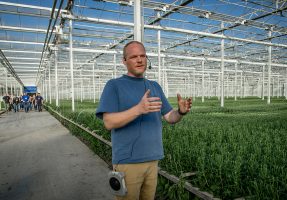
Water is also tightly managed at Dutch Heritage Greenhouse, which collects rainwater for use in its state-of-the-art greenhouse completed in 2019. Twice the size of its previous facility, it was built with automation and efficiency in mind. This extends to water use.

“We have a silo that collects rainwater, and also an irrigation ditch outside that collects rainwater. So in this greenhouse, even though we’re constantly irrigating, we actually use less than the annual rainfall,” co-owner Lukas Breugem told the tour.

Water and resource conservation is also in play at Brooknook Farms, where Mark Ricka showcased an expansion completed last year. Purchased in 2015 with a view to making the leap to robotic milking, the dairy keeps close tabs on milk quality. While the DeLaval robots gather information on individual cattle and send alerts to Ricka, the dairy also employs simple strategies such as pre-cooling milk to ensure freshness and save energy in the bulk tank.

During the precooling process, heat transfers from milk to water destined for the hot water boiler, reducing the energy requirement there, too.

The final stop on the tour, Canadian Organic Feeds, showed off its new feed mill built in the former Agropur plant on Yale Road. Purchased in 2017, the former butter and ice cream plant was converted and three-ton silos handling seven feed ingredients were erected.

Overseen by owners Darren and Jen Jansen and three workers, the roller mill can be programmed for a specific grind at a set time. Grains can be milled overnight, for example, so workers can prepare mixes the next morning.

This has made for an efficient operation that distributed to farms as far east as the Kootenays as well as through local businesses including Otter Co-op.

Building on the dairy’s former retail operation, the feed mill has opened an ice cream parlour in response to locals who didn’t want to lose their favourite hangout.

Chilliwack MLA Dan Coulter, representing the provincial government, noted that technology was a common element helping each business adapt, and underscored the BC NDP’s support for agritech promoting as part of its economic strategy.

“Agritech is going to become an ever more important part of agriculture,” he said.
Related Posts

You may be interested in these posts from the same category.

Chilliwack showcases farm automation

Previous Post: « Plant health centre breaks ground
Next Post: Strong growth for farmland values »

Copyright © 2026 Country Life in BC · All Rights Reserved