• Menu
  • Skip to primary navigation
  • Skip to main content
  • Skip to primary sidebar

Country Life In BC Logo

The agricultural news source in British Columbia since 1915

  • Headlines
  • Calendar
  • Subscribe
  • Advertise
  • About
  • Archives
  • Contact
  • Search
  • Headlines
  • Calendar
  • Subscribe
  • Advertise
  • About
  • Archives
  • Contact
  • Search

Primary Sidebar

Current Issue:

APRIL 2026
Vol. 112 Issue 4

Subscribe Now!

Sign up for free weekly FARM NEWS UPDATES

Loading form…

Your information will not be
shared or sold ever

Follow us on Facebook

Comments Box SVG iconsUsed for the like, share, comment, and reaction icons

11 hours ago

A new national beef code of practice is open for public comment until June 12. Developed by NFACC and the Canadian Cattle Association, the draft addresses pain management, weaning, nutrition, lameness and end-of-life care.

#BCAg
... See MoreSee Less

Link thumbnail

New beef practices open for comment

www.countrylifeinbc.com

A new national code of practice for beef producers is open for public comment. “The public comment period is an important opportunity for producers across Canada to review the draft code and provide...
View Comments
  • Likes: 1
  • Shares: 0
  • Comments: 0

Comment on Facebook

4 days ago

The BC Ministry of Health has approved $4.25 million for the BC Farmers Market Nutrition Coupon Program, administered by the BC Association of Farmers Markets, for 2026. The funding is even with last year, and follows on $12 million provided in 2022-24. The funding is a cornerstone of BCAFM, providing eligible low-income, pregnant and senior individuals with $27 a week for purchases of locally grown produce at more than 100 participating farmers markets in 92 communities across BC. Funding has increased seven-fold since the program launched in 2012.

#BCAg
... See MoreSee Less

The BC Ministry of Health has approved $4.25 million for the BC Farmers Market Nutrition Coupon Program, administered by the BC Association of Farmers Markets, for 2026. The funding is even with last year, and follows on $12 million provided in 2022-24. The funding is a cornerstone of BCAFM, providing eligible low-income, pregnant and senior individuals with $27 a week for purchases of locally grown produce at more than 100 participating farmers markets in 92 communities across BC. Funding has increased seven-fold since the program launched in 2012.

#BCAg
View Comments
  • Likes: 957
  • Shares: 355
  • Comments: 115

Comment on Facebook

It provides for more than produce. It includes, eggs, meat and honey!

Good program. Additionally, I toured the Kelowna Food bank yesterday. They are serving about 12,000 people a month. Lots are working people.

I have seen people at the Saanichton markets asking if vendors take the coupons and being embarrassed when the vendor says no. Are there signs that are placed on the tables so people know who is part of the program and who is not?

“While it’s unfortunate that programs like this are necessary, I’m grateful they exist to support families and local farmers.”

What exactly is this and how does it work? I've never heard of it before. How does this get applied to us who it's intended to help?

Food stamps?

This should be made a little more accessible, especially for seniors

Christy Sakai its a week and if you to the markets you can get a small bag of carrots 5bucks, a few potatoes, usually a bag of apples are 5 bucks, and in summer you have fruit choices. Yes doesn't seem like alot but it could be stretched at the markets and remember its a week so really ypu going to use the whole bag of carrots in a week, probably not so you have something for the next week. Heads of lettuce 5 bucks. Every little bit does help when it comes to supporting local farmer and family.

This program has helped me afford local produce, as a senior. I am grateful for the assistance and eat a healthier diet.

I have been a working poor and 🙏👍for recognizing the people who deserve a bit of help as they are doing the best they can 😘👍

It is illegal for me to grow a garden . We can all afford to eat if we can grow.

This sounds a little more complicated to enroll in than it needs to be. A lot of people probably never heard of it, I only did because I read this post.

How does a senior apply?

On my smalltown the food bank puts your name in a lottery for this Seniors included in lottery

Glad to see this continue. With the increase in cost of living, this program should be increasing, not staying even with last year. Our local food bank is inundated with need.

Here are the general qualifications: Income Threshold: Generally for lower-income households. Some specific, local programs have identified a threshold of $27,000 or less for a single person or under $50,000 per year for a household. Targeted Groups: Participants must be seniors/elders, pregnant individuals, or families with children under 19. Participant Requirements: In addition to income, participants must: Participate in a food literacy program (e.g., cooking, gardening, or food budgeting). Be able to travel to a participating market to shop for themselves. Allocation: Because demand is high, coupons are often prioritized for new participants each year. Important Information: Coupons are not handed out by the BC Farmers' Markets directly. You must connect with a local community partner (such as a food bank, community centre, or neighbourhood house) to apply.

I did not know until now! I only find out that in Squamish woman centre, they give out vouchers, but there is long waiting list. I never got it. It would be good,if every low income family with children get them. Seniors as well.

So how does one receive this?

Have you got an email yet?

Please if you have these coupons do not be embarrassed to use them they are a good as anyone's money to a grower! I would agree it is a slippery slope to have people pay with government coupons but Remember large scale agriculture is subsidized in this country in way that dwarfs this little program. We are all in a sense are paying with coupons at the big supermarket. As a small scale grower grower I can tell you when you see the higher prices at the farmers market, no one is getting rich off you. That is the true cost of food. Yes that should scare you

This is great if you're a senior over 65 or pregnant. Doesn't help PWD low income. Why not hand out food stamps or something along with your small PWD income? I don't qualify because I don't meet the senior age requirement and I ain't gonna be pregnant any time soon... so 🤷 I'm glad this does exist and hope it help out for others. That would be great!

How about lower taxes

I didn’t know that the program existed

All programs help, but Loaves and Fishes is free to all and provide food across Vancouver Island. Check it out.

It is such an important program! A win win!

View more comments

1 week ago

KPU researcher Naomi Robert is partnering with Oregon State University's Dry Farming Collaborative to test drought-resilient growing practices across Vancouver Island and the Gulf Islands. Working with three market gardeners, the study found tomatoes and zucchini thrived without irrigation. With droughts intensifying across the Pacific Northwest, dry farming offers BC growers practical tools to adapt to a changing climate. The full story appears in our April edition. tinyurl.com/d2fzs#BCAg#BCAg ... See MoreSee Less

KPU researcher Naomi Robert is partnering with Oregon State Universitys Dry Farming Collaborative to test drought-resilient growing practices across Vancouver Island and the Gulf Islands. Working with three market gardeners, the study found tomatoes and zucchini thrived without irrigation. With droughts intensifying across the Pacific Northwest, dry farming offers BC growers practical tools to adapt to a changing climate. The full story appears in our April edition. https://tinyurl.com/d2fzs9x6

#BCAg
View Comments
  • Likes: 22
  • Shares: 5
  • Comments: 0

Comment on Facebook

2 weeks ago

A Maple Ridge dairy producer has been fined $7,512, had his licence suspended for three months, and faces quota restrictions for two years after an undercover investigation confirmed raw milk was sold directly from the farm on three separate occasions.

#BCAg
... See MoreSee Less

Link thumbnail

Maple Ridge farm fined for raw milk sales

www.countrylifeinbc.com

Raw milk remains off the table for dairy producers, with the BC Milk Marketing Board (BCMMB) taking action against a Maple Ridge producer for illicit sales. An undercover investigation of Maple Ridge...
View Comments
  • Likes: 57
  • Shares: 93
  • Comments: 229

Comment on Facebook

Unpasteurized milk is sold in Europe. It's the only milk certain cheeses can be made from.

Europeans used raw milk to make cheese for millenia, the farmer should sue them back on cultural grounds and a charter violation.

A person can shoot up government drugs in a playground but milk is the issue. 🙄

Is there a go fund me?

Raised on raw milk and I wouldn’t have had it any other way. My immune system is top notch compared to all others raised on corn syrup baby formula. Make it make sense!

When i was on the farm we would drink milk right from the cow in a bottle then drink and never got sick.

Ohh the milk moffia at it again I see

So whose the rat? lol one of the ppl who bought the raw milk? 🤦🏻‍♀️

I grew up in the 60’s with raw milk, cream and butter the farm shipped cream. One day the cream was rejected do too much bacteria. It wasn’t kept cool enough. That was the first of government control I experienced. Ok so the cream went back to the farm and made the best sourdough bread, ice cream and the cats came from heavens green acres for a treat of stale bread soaked in that very cream.

If the farmer sold shares in his farm so all these people owned part of the farm. Then it’s their milk . And don’t have to buy anything

Yet the government can supply cigarettes, alcohol, weed and hard drugs. Makes sense. 🙄

leave him the hell alone! if someone wants to buy raw milk at their own risk, let them. At least they can see where the milk came from

I would love my own cow so I could get raw milk

I love the back in the day story’s . Please remember those stories were of grandpa drinking his own cow’s milk. You still have the right to buy cows and drink their milk raw. Go ahead and do it….

As the government sells alcohol and cigarettes 🤡

Free drugs good raw milk bad 🤣

Just identify as first nations and say it's a cultural thing . Then it becomes legal

Guy up the road sells milk raw here too

Raised on our own milk, so were my kids. Got told my kids would not be as Intelegent because of it 😂 they are adults and doing very well. The problem lays in the consumer handling of product after pick up. when milking at home its in a stainless steel pail, sifted, into glass containers, then in fridge to cool down. People picking up, put jn car drive off for an hour or more, then in fridge. This is the problem, bactia grows in the heat. Then they drink that evening when still warm, get sick, blame farm milk. Go to grocery store buy a jug, it last 2weeks after due date ...yummy. ( tested this therory) Id rather have fresh milk and properly handle it. Everything is so regulated,

I have mixed opinions here. I think that people should be able to get unpasteurized milk( I was raised on it and raised my own family with our own milk cow..) However in this day and age people are so inclined to sue for most anything it seems like the dairy farmers need some kind of protection against that? They could lose their businesses over legal procedures. Maybe that is a positive thing about the milk boards…

Some comments seem to be missing the point of the article. NO ONE was sick from the milk. It’s all about money. “By selling milk outside the regulated system, where revenues are pooled, the board claimed Stuyt had cost producers as a whole $195,185 and ordered him to repay this amount. It also ordered Stuyt to pay $33,266 to cover the cost of BCMMB’s investigation and hearings into the matter. The BC Dairy Association, which stood as an intervenor in the appeal before FIRB, said illicit raw milk sales are a direct threat to supply management.”

Communist Canada. If people want raw milk they should be able to buy raw milk. It’s all about control ….

You mean sold real milk, unadulterated, whole milk

That's just sad, but drugs are fine

To each their own. If people want to buy resh milk im sure they know the consequences involved. Maybe the people take it home, seperate the cream and pasturize it them selves. We drank milk at my aunts house off the cow but it was heated to 72’ (Pasturized )

View more comments

2 weeks ago

A draft update to the Code of Practice for the Care and Handling of Beef Cattle is now open for public comment until June 12. The code, one of 14 animal care codes developed and maintained by the National Farm Animal Care Council, is undergoing a routine 10-year review. "Your feedback will help shape the industry's guide to cattle welfare for the next decade," says Canadian Cattle Association policy manager Jessica Radau, urging producers to weigh in. For more information, visit tinyurl.com/58a3u9fz.

#BCAg
... See MoreSee Less

A draft update to the Code of Practice for the Care and Handling of Beef Cattle is now open for public comment until June 12. The code, one of 14 animal care codes developed and maintained by the National Farm Animal Care Council, is undergoing a routine 10-year review.  Your feedback will help shape the industrys guide to cattle welfare for the next decade, says Canadian Cattle Association policy manager Jessica Radau, urging producers to weigh in. For more information, visit https://tinyurl.com/58a3u9fz.

#BCAg
View Comments
  • Likes: 5
  • Shares: 4
  • Comments: 1

Comment on Facebook

I sat in the webinar yesterday by the Canadian Cattle Association. My initial concern was that this would be another "play" into the government's hands. It has been worked on by people that are actually in the Beef industry from Cow calf to feedlot. The thrust is an update of the 2013 Code of Practice which was reviewed in 2018. The changes are more a move from "left to the producers discretion" to clearer directions regarding pain management, proper transport of animals which are impaired and keeping cattle in in good condition. Much of what is recommended is what producers who care about animal husbandry already do. The important part is to GIVE THEM FEEDBACK good, bad or otherwise. The document is about 60 pages long, and I ran it through CHAT to see what had been changed. It is important to understand that the PUBLIC is invited to comment on the draft not just producers. Think about it... do you really want the public influencing how you manage your cattle. If you think that this is just one of those things, I have been following Bill 22 in Alberta which will grant the SPCA a proactive roll in entering farms and checking on animals. When I asked CHAT how the new bill relates to the Cattle Code, it came back that the Code although not a regulation will be able to be used as a guide by producers for backup in dealing with the SPCA regarding cattle conditions, sick animal handling etc. Take the time.... Go onto the Canadian Cattle Association website and speak to those parts that you wish to input.

Subscribe | Advertise

The agricultural news source in British Columbia since 1915
  • Email
  • Facebook

Corn helps improve soil but fails grazing test

Living Labs test at Devick’s Ranch provides interesting Results

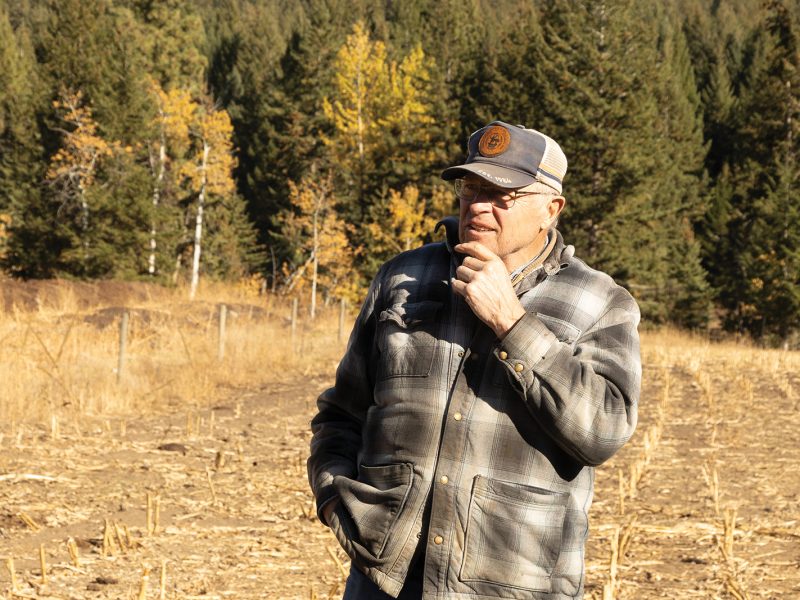
Paul Devick of Devick's Ranch in Heffley Creek was keen to see if corn, which has proven effective at improving soil health, could provide winter grazing for his beef herd. Mixed results led him to back off corn for grazing. Photo | KELLY SINOSKI

November 19, 2025 byKelly Sinoski

HEFFLEY CREEK – Growing corn has proven beneficial in regenerating the soil at Devick’s Ranch in Heffley Creek but not in extended grazing.

Paul Devick and his son Alex have been experimenting with corn and multiple cover crops for three years as part of the BC Living Lab program to develop best management practices to address climate change challenges. The five-year federal-provincial project supports research to investigate greenhouse gas emissions, carbon sequestration, soil health and species diversity, while considering land management as well as the economic and social aspects of the practices.

The Devicks hosted a field day on October 15 to showcase their work on two separate fields. Visitors included program member partners from the BC Cattlemen’s Association, BC Forage Council and students from Thompson River University’s regenerative agriculture program, along with BC Living Lab researchers.

“We got involved with Living Labs because we always like to experiment and try new things and find it exciting,” says Paul Devick. “The biggest draw for us was growing corn and whether it could grow in our climate and our elevation. It worked well for us; we got good yields. The idea of corn grazing was also an interest of ours; we wanted to try it but because of the size of our operation and the amount of cropland, it didn’t work for us.”

Winter grazing can be costly to cattle operations and is subject to major fluctuations from climate change-driven weather events such as drought, fire and flooding, according to the BC Forage Council. Corn as a standing crop for fall-winter grazing is a beneficial management practice (BMP) in the BC Living Lab program. Other BMPs include winter barley and fall rye for extended fall or spring grazing, and bale grazing.

The Devicks started their Living Lab project three years ago by growing corn and multi-crops such as radishes, turnips, clover and triticale on a 22.5-acre field. Researchers took initial soil samples from the site, which included a cleared section of forest and open grassland, to get a baseline on soil quality and health as well as organic carbon. The south end of the site was then divided into four pieces, with corn at the north end.

In the first year, the entire site was grazed by 250 head of cattle who were turned into a new section each week. The cows were fed hay in the morning before being turned into the corn, but despite this, Devick says it didn’t fully work for them: they experienced cow deaths from acidosis – or grain overload – as well as loss of yield.

“They’d go in there and pig out like crazy on the first day. It might be that our cows aren’t used to eating corn, too – like, ‘Ooh here’s a candy shop, let’s go,’” he says. “When we turned them in there, we made sure they were full, too; we were feeding them hay at the same time. We still had a huge amount of waste. There were corn stocks and most of this is stubble the cattle have stomped down. We even found cobs on the ground the cattle didn’t use. It was disheartening.”

Ranches in Quesnel and Grand Forks have found success in winter grazing on corn and relay cover crops, keeping their cows grazing for over a month, says Mike Witt, a professional agrologist working with the Devicks. The Devicks only had enough grazing for a week – and for just a portion of their herd, which includes 950 cow-calf pairs and yearlings.

“It just didn’t quite work for their operation,” says Witt. “It’s important to know what each operation’s constraints are, as well as their goals. They were too land-constrained to grow enough corn to graze the entire herd. … [Ideally] we would have more access to land and stretch things out for a couple of weeks to make the routine a little bit better.”

As a “living” lab, the program is continually evolving as producers establish data points for regional variability and test different combinations of cover crops to see what works best. The Devicks haven’t decided what to plant on that field next year although they say their corn-grazing days are over.

Yet they intend to continue growing corn for silage on another 35-acre depleted alfalfa field, mainly because it has high yield and has proven to be effective at improving soil health.

Corn was already grown on the second field, tilled for two passes, and will now be planted with fall rye for grazing in the spring. Alex Devick says they will likely do one more round of corn before turning the field back to alfalfa.

“We will continue on with the corn for breaking a field that’s depleted, or aged out, to get it back to a natural state,” he says. “This seems to be a great way to get it back to high-producing fields. We have minimal acres here so that’s why we need to have maximum production. It just loosens the soil and aerates it and becomes very fertile ground. It’s improving the soil from all the stubble, creating organic mass and spreading it all around. It creates a nice seedbed and that’s what alfalfa loves.”

Paul Devick adds they will also consider growing tall fescue after hearing about its benefits from Shabtai Bittman, a research scientist with Agriculture and Agri-Food Canada. Bittman suggested tall fescue is more drought-resistant and persistent than orchard grass, providing a slightly higher yield and better regrowth.

The Devicks continue to try new things: they unveiled their new seeding tool – a drone that can seed 100 pounds per flight.

“It’s a real time-saver, fuel-saver. It’s always fun to try something new and work on these types of things,” Paul Devick says. “It’s all part of experimenting. We learnt something today about the fescue, so we’ll try it. We’re looking for improvements all the time.”


All content on this website is copyrighted, and cannot be republished or reproduced without permission.
Related Posts

You may be interested in these posts from the same category.

Lawsuits drive ranchers’ call for DRIPA’s repeal

Federal budget kills Living Labs

Investment foundation grows

Peace producers engage in on-farm research

Previous Post: « Province lacks reconciliation roadmap: ranchers
Next Post: Breathing new life into historic ranches »

© 2026 COUNTRY LIFE IN BC - ALL RIGHTS RESERVED