• Menu
  • Skip to primary navigation
  • Skip to main content
  • Skip to primary sidebar

Country Life In BC Logo

The agricultural news source in British Columbia since 1915

  • Headlines
  • Calendar
  • Subscribe
  • Advertise
  • About
  • Archives
  • Contact
  • Search
  • Headlines
  • Calendar
  • Subscribe
  • Advertise
  • About
  • Archives
  • Contact
  • Search

Primary Sidebar

Originally published:

FEBRUARY 2026
Vol. 112 Issue 2

Subscribe Now!

Sign up for free weekly FARM NEWS UPDATES

Loading form…

Your information will not be
shared or sold ever

Stories In This Edition

Hitting pause

Big crop, low returns for cherries

Smoky notes

Cultivating good employees hinges on trust, respect

Editorial: Communication well(ness)

Back 40: Climate’s new normal demands collaboration

Viewpoint: Transparency starts with listening

Reclassification sparks farm definition debate

Driediger Farms property sells to Berryhill Foods

Ag Briefs: Agrivoltaic pilot approved in South Okanagan

Ag Briefs: Mushroom allegations fought

Ag Briefs: Beef herd could expand

BC-Washington group to tackle border flooding

Multiple flood events take toll on soil health

Watershed planning seeks farmer input

Mink breeders end court challenge

Pemberton carrot grower automates

Federal nematode ban ends for Central Saanich

Building a coalition for climate advocacy

Small-scale producers tackle biosecurity issues

Program wrangles up new ranch hands

New farming model pilots of Salt Spring

Vineyard reset opens door for more resarch

Meadery revives historic ranch in East Kootenays

Growers learn to make heads and tails of pests

Hot berries deliver cool data to cranberry growers

Farm finds resilience going with the grain

Experience makes multiple lambs viable

Farm Story: Soft ground, solid work as winter turns to mush

Skeena Fresh delivers greens in northwest

Woodshed: Frank schemes while romance blooms by river

New Siberia Farm celebrates hundred years

Jude’s Kitchen: Air-fry some healthy snacks for your sweetie

More Headlines

Follow us on Facebook

Comments Box SVG iconsUsed for the like, share, comment, and reaction icons

5 hours ago

Berryhill Foods Inc. is expanding into fresh berries by acquiring Driediger Farms' main Langley processing plant and 78-acre property for $23.3 million. The frozen berry processor will operate the farm and build on the Driediger legacy. Rhonda Driediger, whose family has farmed the property since 1959, will support the new owners during the first year before pursuing other ventur#BCAg#BCAg ... See MoreSee Less

Berryhill Foods Inc. is expanding into fresh berries by acquiring Driediger Farms main Langley processing plant and 78-acre property for $23.3 million. The frozen berry processor will operate the farm and build on the Driediger legacy. Rhonda Driediger, whose family has farmed the property since 1959, will support the new owners during the first year before pursuing other ventures.

#BCAg
View Comments
  • Likes: 11
  • Shares: 1
  • Comments: 1

Comment on Facebook

Good to hear👏

1 day ago

The BC Peace River Grain Industry Development Council is seeking nominations to fill two positions on its board. The council is responsible for disbursing $350,000 in levies collected annually for field crop production projects and research in BC’s Peace region. Nomination deadline is March 1; election will take place at the council’s agm in early summer.

#BCAg
... See MoreSee Less

The BC Peace River Grain Industry Development Council is seeking nominations  to fill two positions on its board. The council is responsible for disbursing $350,000 in levies collected annually for field crop production projects and research in BC’s Peace region. Nomination deadline is March 1; election will take place at the council’s agm in early summer.

#BCAg
View Comments
  • Likes: 2
  • Shares: 1
  • Comments: 0

Comment on Facebook

2 days ago

BC Blueberry Council executive director Sudeshna Nambiar says trust in agricultural organizations is built on transparency and accountability. Growers facing rising costs and uncertainty want straight answers about how decisions are made and realistic results, not just promises. Practical, grower-led programming and clear communication about what works—and what doesn't—build credibility and strengthen agriculture's voice beyond the farm gate. She penned our Viewpoint in this month’s edition of Country Life in BC. We found it refreshing.

BC Blueberries
#BCAg
... See MoreSee Less

BC Blueberry Council executive director Sudeshna Nambiar says trust in agricultural organizations is built on transparency and accountability. Growers facing rising costs and uncertainty want straight answers about how decisions are made and realistic results, not just promises. Practical, grower-led programming and clear communication about what works—and what doesnt—build credibility and strengthen agricultures voice beyond the farm gate. She penned our Viewpoint in this month’s edition of Country Life in BC. We found it refreshing.

BC Blueberries 
#BCAg
View Comments
  • Likes: 9
  • Shares: 0
  • Comments: 0

Comment on Facebook

4 days ago

Do you have what it takes to build the new province’s new Plant and Animal Health Centre in Abbotsford? The province is inviting candidates to submit qualifications via BC Bid by April 13, with a short list of builders set for release in June. An integrated design-build process will construct the lab, which is expected to cost no more than $400 million. The BC Ministry of Infrastructure is leading the project, which is set to break ground in 2027 and take four years to build. The province purchased the site of the new lab on January 29 for $27.8 million.

#BCAg
... See MoreSee Less

Do you have what it takes to build the new province’s new Plant and Animal Health Centre in Abbotsford? The province is inviting candidates to submit qualifications via BC Bid by April 13, with a short list of builders set for release in June. An integrated design-build process will construct the lab, which is expected to cost no more than $400 million. The BC Ministry of Infrastructure is leading the project, which is set to break ground in 2027 and take four years to build. The province purchased the site of the new lab on January 29 for $27.8 million.

#BCAg
View Comments
  • Likes: 7
  • Shares: 0
  • Comments: 2

Comment on Facebook

27 million could have started alot of small scale and infrastructure for local food producers.

now those who complained about the lack of increase in the agricultural portion of the latest provincial budget should understand just where some of their taxpauers $$$ are going.

5 days ago

Cultivating good employees requires the same attention as other farm tasks, business coach Trevor Throness told Mainland Milk Producers at their annual general meeting last month. He outlined four worker categories based on attitude and productivity, with "brilliant jerks" – highly productive but disruptive employees – posing unique challenges. Good workers are attracted to the best workplace cultures, he told producers, not recruited. It’s a cool take on the labour challenges facing BC’s agricultural sector and it appears in the print edition of Country Life in BC this month.

#BCAgriculture
... See MoreSee Less

Cultivating good employees requires the same attention as other farm tasks, business coach Trevor Throness told Mainland Milk Producers at their annual general meeting last month. He outlined four worker categories based on attitude and productivity, with brilliant jerks – highly productive but disruptive employees – posing unique challenges. Good workers are attracted to the best workplace cultures, he told producers, not recruited. It’s a cool take on the labour challenges facing BC’s agricultural sector and it appears in the print edition of Country Life in BC this month.

#BCAgriculture
View Comments
  • Likes: 15
  • Shares: 0
  • Comments: 0

Comment on Facebook

Subscribe | Advertise

The agricultural news source in British Columbia since 1915
  • Email
  • Facebook

Farm finds resilience going with the grain

Diversification key to organic farm’s long-term success

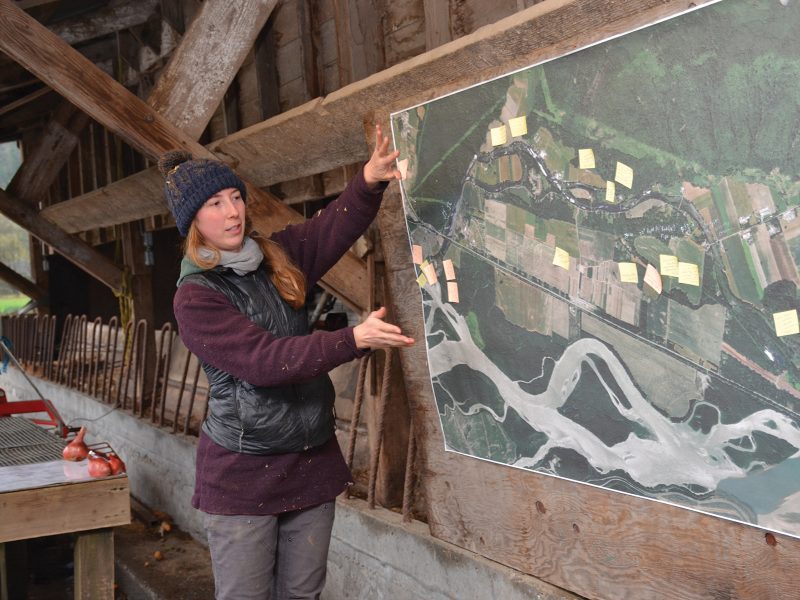
Hannah Exley shows a map with Cedar Isle Farm's grain fields. The natural swale of the farmland and the variation in soil types makes it impossible to have large growing areas on the 94-acre farm. Photo | Ronda Payne

February 1, 2026 byRonda Payne

AGASSIZ – A family-run mixed organic farm on Seabird Island highlights the potential for grain and other crops in the Fraser Valley, and the importance of diversification to long-term resilience.

“This is the start of the really fertile valley floor land that runs all the way to Delta,” says Hannah Exley, daughter of Jim Grieshaber-Otto and Diane Exley, owners of Cedar Isle Farm in Agassiz. “The grain is probably the thing we’re known for. That’s only part of the farm.”

Exley spoke about the farm’s history to BC Organic Conference participants on November 27.

“In the early 1970s, my grandparents moved to Canada from Minnesota,” she says. “This was largely blackberries back then.”

An abandoned dairy farm, the property featured the picturesque setting Grieshaber-Otto’s parents – then in their 50s – were seeking for an organic farm. Beef cows, chickens, a flock of sheep – primarily for wool – and willow for basket-making got them started. Grains were a natural part of the mix to feed the animals.

“They weren’t so into making it into a viable farm,” explains Exley. “We’ve had to reframe that idea and get into making money.”

As her parents took over the farm, they kept chickens, geese and ducks, but dropped beef production in 2009 when the market was poor. Grieshaber-Otto, who holds a doctorate in agricultural botany, started looking into new grain options.

Recognizing that wheat varieties grown on the Prairies weren’t a good fit for the eastern Fraser Valley, he wanted to find grain varieties suited to Seabird Island that would also be good for making bread.

“Grain really has been bred for climates that are dry,” says Exley. “And for yield.”

Grieshaber-Otto had a small combine and had grown wheat for the animals since he was a kid. He initially focused on Marquis, a winter wheat bred in Canada in the early 20th century for the Prairies. It still makes up the majority of the 30 acres of grain the farm grows.

“It makes the most amazing bread,” says Exley. “People say it reminds them of the bread their grandparents made, which makes sense because it’s the same wheat.”

More than ten years ago, as part of Grieshaber-Otto’s exploration of alternatives, the farm joined a participatory plant breeding program through the University of Manitoba. It involved planting a university-developed cross, selecting promising kernels and sending those back to the university.

“In the first year of a wheat cross, there is a lot of variation,” says Exley, noting height, overall look, colour and size of head among the variables. “Without even trying, we were starting to breed wheat for this area.”

She says that within 10 years, they ended up with a landrace of wheat that they didn’t have to think about developing. Now, PPB Fraser Red is a standard winter wheat Cedar Isle grows.

Exley says it takes minimal threshing, as it “just jumps out of the head.”

“It grows especially well right here, but it’s also okay in Manitoba,” she says.

The third main wheat grown at Cedar Isle is Skagit 1109, another winter wheat and one that is more resistant to rust than most. It was bred at the Washington State University Breadlab in Burlington, Washington, and is in high demand by bakers.

Together, the three varieties account for 80% of the grain grown at Cedar Isle, which also grows rye, oats, and barley.

Tommy’s Whole Grain and Bad Dog Bakery, both in Vancouver, are regular customers which take large volumes of wheat to produce their organic breads. In addition to direct sales to bakery customers, the farm has a thriving community-shared agriculture (CSA) program.

But even with locally adapted varieties, grain growing isn’t easy. Wheat wants moisture up to June, then it needs dry conditions. This decade’s relatively dry summers have helped the crop.

Weeds are also a significant challenge and drive the farm’s crop rotations. Wild brassicas are a significant problem during mild winters.

“Every year you grow grain, you get more weeds,” she says. “You have to integrate grain into your broader system. The first year you plant grain, it does much better than year four.”

Between years three and five, the grain fields are rotated into organic forage crops such as alfalfa, clover and mixed grasses. The forage crops supply local farms and have allowed the family to create collaborative relationships with two nearby dairies in particular.

“They have more manure than they can deal with and we have more land than we can fertilize, so that works really well for us,” Exley says.

Some forage is also sold to horse farms, and the organic straw is popular both on and off-farm.

The forage crops balance out the unforgiving nature of grain when the weather doesn’t cooperate.

“If the forage is happy, the grain is wet, so something is happy, something isn’t,” she says. “The grain dries out well most years.”

Recognizing nature’s pluses and minuses led Exley to suggest adding vegetables to the farm’s mix. It’s not that the family hadn’t grown vegetables for their own consumption, but they’d not done anything on a commercial scale.

But Exley has found success with her addition to the farm’s production – mostly brassicas, alliums and root vegetables.

“I started doing vegetables a few years ago, supplying CSAs. On the face of it, it makes a lot of sense,” she says. “Some days of the week are really veggie-intensive. I really focus on spring and fall, but that’s easier said than done.”

If the weather has delayed wheat production and she’s busy harvesting root vegetables, she can end up juggling both sides of the operation – a tough act for a family-run farm. An awareness of labour and thoughts about expanding the vegetable crops led to a discussion of farm succession planning.

“It is always daunting to think about what the coming years will look like, but we are confident that we can make it work and evolve as needed,” says Exley. “As a family, we’ve built a diversified, direct-market organic operation over three generations, and we believe it can weather new challenges in the seasons to come.”

Related Posts

You may be interested in these posts from the same category.

Previous Post: « Avian influenza returns

Copyright © 2026 Country Life in BC · All Rights Reserved