
• Menu
  • Skip to primary navigation
  • Skip to main content
  • Skip to primary sidebar

Country Life In BC Logo

The agricultural news source in British Columbia since 1915

  • Headlines
  • Calendar
  • Subscribe
  • Advertise
  • About
  • Archives
  • Contact
  • Search
  • Headlines
  • Calendar
  • Subscribe
  • Advertise
  • About
  • Archives
  • Contact
  • Search

Primary Sidebar

Originally published:

MARCH 2023
Vol. 109 Issue 3

Subscribe Now!

Sign up for free weekly FARM NEWS UPDATES

Loading form…

Your information will not be
shared or sold ever

Stories In This Edition

The right cut

Health labs to be rebuilt

Kale acreage on fast track

Province makes bid to protect Surrey farmland

Editorial: Collective wisdom

Back 40: Full-time, part-time, or time well spent?

Viewpoint: A lifetime of safe farming is never an accident

Farmers question regenerative ag agenda

Growers flood back to Tradex for ag show

Ag Briefs: Spring bird migration raise fears of AI’s return

Ag Briefs: TJ Schur to lead IAF

Trust lacking between well owners, province

Champions of agriculture

Future uncertain for new varieties council

Here’s looking at you

Council takes delinquent growers to court

Extension service hopes for stronger supports

Blueberry growers focus on qualify

Researchers home in on emerging blueberry viruses

Viticulture show draws record attendance

Butcher hub moves ahead after three years

Snug as bugs

Ducks Unlimited pilot helps ranch manage water

Livestock response unit called into action

Farmland Advantage funding extended

Sidebar: Watershed moment

Soil carbon only part of the green equation

Sidebar: Organic compost a government priority

Filling a market for fresh corn in Chase

On-farm trials address nutrient challenges

Automation is revolutionizing dairy farming

UBC research advances dairy herd health

Farm Story: As winter fades into spring, mud follows

Preparing for a  low-emissions future

Show time

Dead canopies from last year concern growers

Woodshed: Problems stack up for Kenneth at the new farm

BC-made mushroom innovation in the works

Jude’s Kitchen: Irish spring fun in the kitchen

More Headlines

Follow us on Facebook

Comments Box SVG iconsUsed for the like, share, comment, and reaction icons

6 days ago

A BC Forest Practices Board investigation has found overgrazing has damaged grasslands in the Coutlee Range Unit near Merritt — and the range-use plan meant to prevent it was unenforceable. With complaints about overgrazing on the rise and grasslands covering just 1% of BC's land mass, the findings raise fresh questions about how the province manages one of its most vulnerable — and valuable — food-producing ecosyste#BCAg#BCAg ... See MoreSee Less

Link thumbnail

Board finds overgrazing rules unenforceable unmeasurable

www.countrylifeinbc.com

MERRITT – A BC Forest Practices Board investigation has found instances of non-compliance related to overgrazing have damaged open grasslands in the Mine pasture, part of the Coutlee Range Unit near...
View Comments
  • Likes: 6
  • Shares: 6
  • Comments: 6

Comment on Facebook

Several ranchers in recent years have gone into temporary non use on that range , so that means the grass should grow. But drought conditions/lack of rain and snow don’t allow that to happen . Dried up springs , creeks waterholes in various pastures add to over grazing where there is water , as livestock and everything else stay close to the water source . So even though less cattle are on it , over grazing appears. There is a large volume of horses on it 365 days/year which is wrong ! They pull grass right out of the ground when it’s just trying to grow ,, opens the door for weeds to grow in. That don’t help it. Aging infrastructure ( fences) laying on the ground, pipe line building , ( lack of commitment to fence maintenance) amongst all users contributes also to over grazing. Recreational atv users leaving gates open between pastures allows livestock to go back or ahead in pastures also expidites over grazing. Logging ( bcts) has no problem laying out cut locks on both sides of a fence , then it gets smashed down during logging and they don’t take responsibility to stand it back up or clean the cattle gaurds out when they are done , that happened 4 years ago on pasture 5 up there . I bet it is still not fixed . There are lots of contributing factors to the problem.

Tragedy of the commons.

I looked through the report. I saw nothing about the effects of noxious weeds on productive grasslands. This particular area is vulnerable because of the Ministry’a efforts to diversify the use of the Grasslands.

This pasture is under tremendous pressure not only from cattle but from irresponsible local residents who treat it as a landfill dumping all manner of household debris here. And don't even get me started on the mud bogging and camping in sensitive riparian areas. The feral horses are in this pasture 365 days a year just hammering it. Would sure be nice to see some enforcement action on people who are intentionally ripping up the grasslands and riparian areas. Cattle could be a valuable resource for rebuilding soils and native grasses in this area with the help of electric fencing and/or e-collars. The humans will be harder to manage.

The Forest and Range Practices Act was written by lawyers for global forest licencee shareholders. Results-based = unenforceable.

Also, can we talk about the impact of a pipeline being built through the middle of this field for multiple years?

View more comments

1 week ago

East Kootenay rancher Randy Reay is digging a new well after two natural water sources dried up on his Crown tenures. A new Living Lakes Canada assessment found 15% of mapped aquifers in the region are high-priority for monitoring, yet 80% of those go unmonitored. With over 48% of BC's provincial observation wells reporting below-normal groundwater levels, ranchers and researchers are sounding the alarm on water security. The story is in our March edition, and we've posted it to our website thi#BCAgk.

#BCAg
... See MoreSee Less

Link thumbnail

Water woes: groundwater under pressure across BC

www.countrylifeinbc.com

JAFFRAY – As a young boy growing up in the Kootenay-Boundary region, Randy Reay never expected to run out of water. But this year, in mid-February, his fields are bare. There is no snow halfway up t...
View Comments
  • Likes: 8
  • Shares: 7
  • Comments: 1

Comment on Facebook

Jaffrey is in the east Kootenays not kooteney boundary

2 weeks ago

BC farmers are bracing for prolonged higher input costs as war in the Middle East drives up fuel and fertilizer prices. Nitrogen fertilizer costs were already climbing before the Iran conflict began, with prices still roughly 60% above pre-pandemic levels. Farm Credit Canada warns that unlike 2022, strong commodity prices may not offset rising costs this time. Local suppliers expect supply challenges and further price increases ahead.

#BCAg
... See MoreSee Less

Link thumbnail

Fertilizer prices on the rise

www.countrylifeinbc.com

War in the Middle East has delivered a generational shock to energy prices, meaning BC farmers can expect a prolonged period of higher costs not just for fuel but also for fertilizer.
View Comments
  • Likes: 2
  • Shares: 1
  • Comments: 0

Comment on Facebook

2 weeks ago

... See MoreSee Less

View Comments
  • Likes: 1
  • Shares: 0
  • Comments: 0

Comment on Facebook

2 weeks ago

Cameron Stockdale is the new executive director of provincial farm safety organization AgSafeBC. Find out more in this week's Farm News Update from Country Life in B#BCAg#BCAg ... See MoreSee Less

Link thumbnail

New leadership at AgSafe BC

www.countrylifeinbc.com

Cameron Stockdale is the new executive director of provincial farm safety organization AgSafeBC, succeeding Wendy Bennett. Bennett left AgSafeBC in September 2025, following 12 years with the…
View Comments
  • Likes: 5
  • Shares: 1
  • Comments: 0

Comment on Facebook

Subscribe | Advertise

The agricultural news source in British Columbia since 1915
  • Email
  • Facebook

Filling a market for fresh corn in Chase

Brothers follow a passion for growing and selling sweet corn

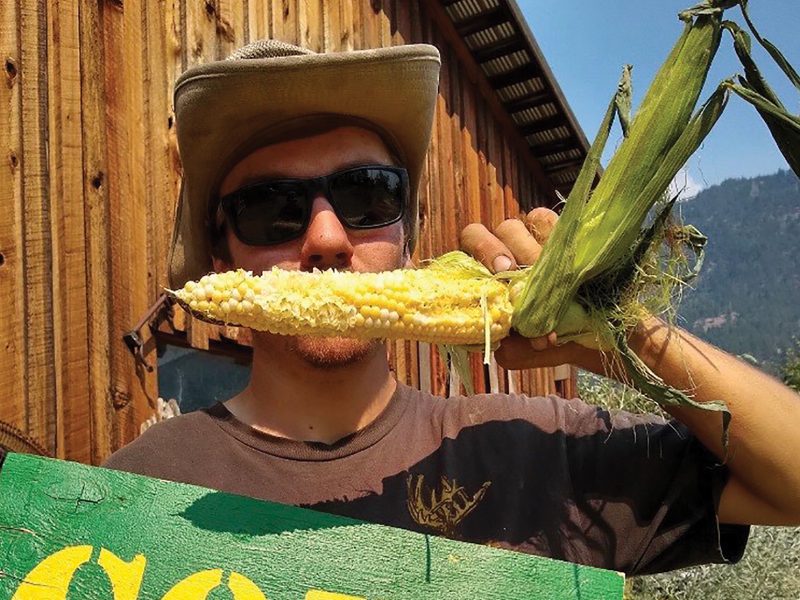
Lewis Burkholder has a passion for growing, marketing and eating corn, and with his brother Vincent he’s turned that passion into a viable farm enterprise. SUBMITTED

March 1, 2023 byTracey Fredrickson

CHASE – Who hasn’t tucked into a cob of sweet, juicy corn during a warm summer harvest? It was even better if you could buy it at a roadside stand, freshly picked and direct from the farmer.

Many such memories began in the Village of Chase, on the shores of Little Shuswap Lake in the South Thompson River Valley. Here some of the best agricultural soil in the province has supported several generations of farmers in growing world-renowned corn. As the locals say, “There are two seasons in Chase: corn season and waiting for corn season.”

Inspired by their own childhood growing up in the community, brothers Lewis Burkholder, now 25, and Vincent, 28, have become one of the main corn producers in the area in just three seasons.

One of those farms, Pete Murray’s Corn Farm, was the go-to place for corn in Chase when the brothers were in their teens, selling most of its product through a market stand on the Trans-Canada Highway.

“When I was 11, all I wanted to do when I got out of school was join my older brother working at Pete Murray’s Corn Farm,” recalls Lewis.

By the time Lewis was in high school, he had joined his brother working at Murray’s after school and on weekends. They both went on to university; Vincent earned a degree in mechanical engineering and Lewis studied business, majoring in marketing.

When Murray decided to retire in 2019, the brothers embraced their passion for farming with a vision of starting their own corn farm. They began leasing the 30 acres that Murray farmed, and gradually secured additional land from other nearby farms.

By the time a new generation of Murrays took over the Murray farm late last year, the Burkholders had secured 32 acres – enough land to grow on their own.

“Pete has been an incredible mentor for us on the growing side of things, teaching us which tools he liked to use and what varieties we would grow,” says Lewis.

With their complementary business skills and the ability to work well together (which not all brothers do) the Burkholders created a formal business partnership with the goal of providing “the most delicious corn available to the people of Chase, Kamloops and the Shuswap.” They take pride in the fact their corn is never sprayed, non-GMO, hand-picked daily and sold direct to the public during from August to mid-October.

“During our first season in 2020 there were so many unknowns due to COVID,” says Vincent. “We made enough money to stay motivated for a second season, and just kept on going. We knew that if we were going to be career farmers, we needed to grow the business.”

The community was there to support them.

Incredibly inventive

Tristan Cavers, whose grandfather helped pioneer the area’s corn industry, is the fourth-generation operator of Golden Ears Farm in Chase. He and his wife Michelle provided the brothers with mentoring and old tools and equipment that could be reused, repaired or modified to bring the Burkholders’ cultivation methods up to date.

“These guys have been incredibly inventive,” says Cavers. “They were fortunate to have a viable business model to work from and turned it into something where there is a long-term future. They’ve always stayed ahead of the curve.”

The brothers also worked with Thiessen Tillage, specialists in weed control for small to medium-sized farms.

“Ryan Thiessen introduced us to finger weeders, which have turned out to be one of the most valuable tools we use,” says Lewis. Finger weeders are designed specifically for in-row cultivation and used to uproot small, emerging weeds. The ground engaging the steel drive plate turns the flexible polyurethane “fingers” at a fast speed, flicking out weeds at the hair stage.

“Finger weeders changed the game for us,” Lewis adds. “We went from having patches of weeds that could barely be penetrated to virtually none at all.”

The brothers attend up to eight farmers markets a week including Kamloops, Scotch Creek and Sorrento, but faced with a significant hurdle when construction on the Trans-Canada Hwy closed the exit where Murray’s farm stand had stood for years, removing a major marketing location.

“Up to that point, our business strategy was based on the cash we had in hand and the loan we had for the season,” says Vincent. “Everything was based on the budget. But when we realized our most important sales site was going to disappear, we had to quickly pivot.

They began selling their corn and some other vegetables at a store in downtown Chase and strategized how to sell more corn to the Kamloops marketplace. They purchased a five-ton truck, added a refrigeration system and had “Burkholder Bros. Corn Farm” emblazoned on both sides, creating an eye-catching mobile farmstand they could locate wherever they wanted.

“It worked out well to have one of us at the truck handling sales,” adds Lewis. “It’s part of the experience we provide around our corn. People like to hear how we got into this and how it all came together. We’re still working on a more permanent location in Chase, but the mobile unit was critical to making the sales we needed.”

They were warmly welcomed by the Tk’emlups te Secwepemec in Kamloops during the 2022 season and set up at the truck at the Tk’emlups Petro-Canada station on Hwy 5 during August and September.

“Being there allowed us to bring fresh-picked produce to the people of Kamloops every day of the week, something that isn’t available anywhere else in town,” says Vincent.

Three years in, the brothers have grown their business revenue by 50%, with the most intensive work – and sales – taking place from August to mid-October.

The rest of the year is spent managing the farm and prepping for the upcoming season. The seasonality of corn also allows them to take time off in the winter and do some off-farm work to keep cash flowing.

The greatest challenge facing the farm today is finding good seasonal workers.

“We need people with skills such as the ability to manage themselves and others, work in less-than-ideal weather and conduct high-energy sales when Vincent and I are on the road doing the markets,” Lewis says.

Naturally, part of being a good corn picker is knowing the right time to pick the corn.

“When we’re out in the field training, we sample everything,” Lewis says. “I tell them, ‘When you bite into the corn, it needs to feel like an explosion of sweetness in your mouth.”

That sweetness is due to the high sugar content of corn, so one might wonder if corn is good for our bodies. In fact, sweet corn has a number of nutrients including lutein and zeaxanthin, two phytochemicals that can promote healthy vision, B vitamins, iron, protein and potassium.

“And I am sure it is good for your mental health because it is so tasty!” Lewis adds.

Related Posts

You may be interested in these posts from the same category.

Previous Post: « AI response in spotlight
Next Post: Rail corridor approval delayed »

Copyright © 2026 Country Life in BC · All Rights Reserved