• Menu
  • Skip to primary navigation
  • Skip to main content
  • Skip to primary sidebar

Country Life In BC Logo

The agricultural news source in British Columbia since 1915

  • Headlines
  • Calendar
  • Subscribe
  • Advertise
  • About
  • Archives
  • Contact
  • Search
  • Headlines
  • Calendar
  • Subscribe
  • Advertise
  • About
  • Archives
  • Contact
  • Search

Primary Sidebar

Originally published:

APRIL 2026
Vol. 112 Issue 4

Subscribe Now!

Sign up for free weekly FARM NEWS UPDATES

Loading form…

Your information will not be
shared or sold ever

Stories In This Edition

Scaling up

BC Veg expands across province

Farmland values drop

Farmers doubt watershed plan will deliver

Editorial: Out of eden

Back 40: Unintended consequences

Viewpoint: The industrialized food system has failed us

Cannabis tops BC crop cash receipts

Fertilizer, fuel costs soar amid Iran conflist

Ag Briefs: AgSafeBC looks forward with new leadership

Ag Briefs: Seed potatoes in focus

Ag Briefs: Qualicum Beach farmers recognized

District says bigger farms should pay more

BC egg industry eyes HPAI vaccine program

HPAI answers are blowin’ in the wind

Site C fund grows Peace agriculture sector

Sidebar: Genesis of a fund

Vegetable levy broadens to all storage crops

BC beef herd boasts lowest open rates

WestGen charts confident growth

Dairy panel explores roads to profitability

Strong turnout for fruit growers election

Sidebar: Rebound

Bumper cherry crop tests industry capacity

BC research scientists safe from AAFC cuts

Patience, planning key to successful replant

Sidebar: By the numbers

Young farmers find strength in the struggle

KPU study explores dry farming potential

Farm Story: Row covers derail perfectly good seed potato plan

Diverse career paths showcased at dairy summit

Woodshed: Gladdie’s 100th birthday reveals how love began

Storage crops key to Headwind Farm expansion

Jude’s Kitchen: Refresh winter fare with spring sprouts

All content on this website is copyrighted, and cannot be republished or reproduced without permission.
More Headlines

Follow us on Facebook

Comments Box SVG iconsUsed for the like, share, comment, and reaction icons

1 day ago

A draft update to the Code of Practice for the Care and Handling of Beef Cattle is now open for public comment until June 12. The code, one of 14 animal care codes developed and maintained by the National Farm Animal Care Council, is undergoing a routine 10-year review. "Your feedback will help shape the industry's guide to cattle welfare for the next decade," says Canadian Cattle Association policy manager Jessica Radau, urging producers to weigh in. For more information, visit tinyurl.com/58a3u9fz.

#BCAg
... See MoreSee Less

A draft update to the Code of Practice for the Care and Handling of Beef Cattle is now open for public comment until June 12. The code, one of 14 animal care codes developed and maintained by the National Farm Animal Care Council, is undergoing a routine 10-year review.  Your feedback will help shape the industrys guide to cattle welfare for the next decade, says Canadian Cattle Association policy manager Jessica Radau, urging producers to weigh in. For more information, visit https://tinyurl.com/58a3u9fz.

#BCAg
View Comments
  • Likes: 3
  • Shares: 1
  • Comments: 1

Comment on Facebook

I sat in the webinar yesterday by the Canadian Cattle Association. My initial concern was that this would be another "play" into the government's hands. It has been worked on by people that are actually in the Beef industry from Cow calf to feedlot. The thrust is an update of the 2013 Code of Practice which was reviewed in 2018. The changes are more a move from "left to the producers discretion" to clearer directions regarding pain management, proper transport of animals which are impaired and keeping cattle in in good condition. Much of what is recommended is what producers who care about animal husbandry already do. The important part is to GIVE THEM FEEDBACK good, bad or otherwise. The document is about 60 pages long, and I ran it through CHAT to see what had been changed. It is important to understand that the PUBLIC is invited to comment on the draft not just producers. Think about it... do you really want the public influencing how you manage your cattle. If you think that this is just one of those things, I have been following Bill 22 in Alberta which will grant the SPCA a proactive roll in entering farms and checking on animals. When I asked CHAT how the new bill relates to the Cattle Code, it came back that the Code although not a regulation will be able to be used as a guide by producers for backup in dealing with the SPCA regarding cattle conditions, sick animal handling etc. Take the time.... Go onto the Canadian Cattle Association website and speak to those parts that you wish to input.

2 days ago

According to the BC River Forecast Centre, the Okanagan snowpack stood at just 58% of normal on April 1 — the lowest reading since measurements began in 1980 — raising concerns about drought conditions in the region this summer. The rest of the province sits at 92% of normal.

#BCAg
... See MoreSee Less

According to the BC River Forecast Centre, the Okanagan snowpack stood at just 58% of normal on April 1 — the lowest reading since measurements began in 1980 — raising concerns about drought conditions in the region this summer. The rest of the province sits at 92% of normal.

#BCAg
View Comments
  • Likes: 3
  • Shares: 0
  • Comments: 0

Comment on Facebook

3 days ago

At her first AGM as executive director of BC Meats, held Saturday in Abbotsford, Jennifer Busmann spoke about her strong ties to agriculture and her optimism for the organization's future. Busmann has cattle of her own and came to the role with existing relationships with members and the board of directors that helped her feel integrated from the start. She stepped into the position in Februa#BCAg#BCAg ... See MoreSee Less

At her first AGM as executive director of BC Meats, held Saturday in Abbotsford, Jennifer Busmann spoke about her strong ties to agriculture and her optimism for the organizations future. Busmann has cattle of her own and came to the role with existing relationships with members and the board of directors that helped her feel integrated from the start. She stepped into the position in February.

#BCAg
View Comments
  • Likes: 6
  • Shares: 0
  • Comments: 0

Comment on Facebook

5 days ago

Shannon Wiggins of Headwind Farm in North Saanich is this year's Mary Forstbauer Grant recipient from the BC Association of Farmers Markets. The $500 grant will help Wiggins expand her plot at Sandown Centre for Regenerative Agriculture, growing more storage crops to extend her harvest season. Wiggins credits farmers markets with inspiring her own farming journey and commitment to building community through food. Congratulations!

tinyurl.com/45bdd#BCAg#BCAg
... See MoreSee Less

Shannon Wiggins of Headwind Farm in North Saanich is this years Mary Forstbauer Grant recipient from the BC Association of Farmers Markets. The $500 grant will help Wiggins expand her plot at Sandown Centre for Regenerative Agriculture, growing more storage crops to extend her harvest season. Wiggins credits farmers markets with inspiring her own farming journey and commitment to building community through food. Congratulations!

https://tinyurl.com/45bddtw8

#BCAg
View Comments
  • Likes: 49
  • Shares: 2
  • Comments: 3

Comment on Facebook

Wahoo! Congrats Shannon! I love your produce. Can’t wait for the radishes 🫜

Congratulations!

Well done!! 🩷🩷🩷

7 days ago

New farmers can avoid costly mistakes by learning from those who've been there. At a Young Agrarians mixer in Penticton, five BC farmers shared hard-won lessons on pricing, pivoting, relationships and burnout. From coyote losses to business burnout, their message was clear: set prices that reflect true costs, make decisions quickly and don't let farming define your worth. Myrna Stark Leader's story appears in our April e-edition, now available to view online at: tinyurl#BCAg2uw53vvm

#BCAg
... See MoreSee Less

New farmers can avoid costly mistakes by learning from those whove been there. At a Young Agrarians mixer in Penticton, five BC farmers shared hard-won lessons on pricing, pivoting, relationships and burnout. From coyote losses to business burnout, their message was clear: set prices that reflect true costs, make decisions quickly and dont let farming define your worth. Myrna Stark Leaders story appears in our April e-edition, now available to view online at: https://tinyurl.com/2uw53vvm

#BCAg
View Comments
  • Likes: 15
  • Shares: 0
  • Comments: 0

Comment on Facebook

Subscribe | Advertise

The agricultural news source in British Columbia since 1915
  • Email
  • Facebook

KPU study explores dry farming potential

Growers seek drought resilience

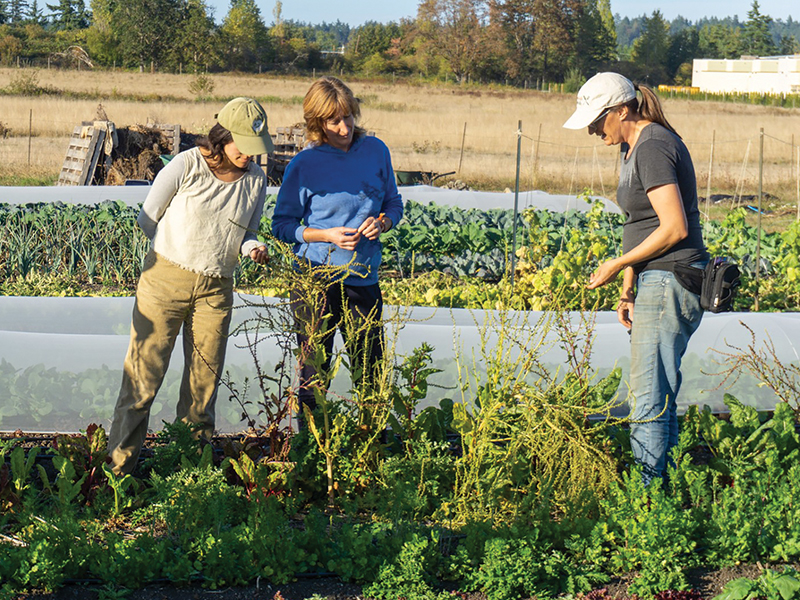
Dry farming practices that reduce reliance on irrigation are gaining ground among BC market gardeners adapting to increasingly frequent summer droughts. Submitted photo

April 1, 2026 byKate Ayers

COMOX VALLEY – Research on dry farming practices in the Comox Valley is helping an international study foster more resilient production systems.

“We need a very large set of tools to adapt to climate change. We know it’s not going anywhere, and we know that droughts are going to become increasingly a source of stress on farmers, both from a production standpoint and from a mental health standpoint,” says Naomi Robert, senior research and extension associate at KPU’s Institute for Sustainable Food Systems, who is leading the research. “Dry farming is one of those tools.”

Based in the Comox Valley, Robert and her team partnered with the Dry Farming Collaborative at Oregon State University to learn how to apply dry farming practices locally in response to the severe drought that hit the Pacific Northwest in 2023.

The objective of dry farming is to retain soil moisture for as long as possible by investing in soil health, using drought-tolerant species, spacing plants appropriately and mulching to prevent evaporation and weed emergence. It is best practiced in areas that have a cool wet season followed by a warm dry season.

Robert worked with three market gardeners last year to determine dry farming approaches that are appropriate for Vancouver and Gulf islands soils: Skye Larmour of Salt Spring Island’s Golden Maple Farm, Jaclyn Kirby of Yellow Boot Farm in Black Creek and FarmFolk CityFolk’s Lisa Willott at the Sandown Centre for Regenerative Agriculture in North Saanich.

Dry farming is nuanced, depending on the farm site and resources available. Some of the best sites are those with soils able to hold moisture; sandy and stony soils are less suitable.

For some growers, dry farming may mean no irrigation for the entire growing season. For others, it may mean strategic or reduced irrigation use.

The common thread for all three producers participating in the study is a desire for practical, full-farm approaches to drought management.

The well at Golden Maple Farm never ran dry when Larmour was growing up, but the occurrence has become commonplace in recent seasons.

When temperatures soared above 40°C during the 2021 heat dome, she realized the farm needed to adapt to a new reality.

“I thought a lot about how do we adjust to this situation, and I came to believe that a forward-looking perspective would be to learn how to grow within water constraints,” she says. “I began the journey of researching dry farming and irrigation, and the biology of plant water use and techniques to stretch water further.”

In 2024, Larmour also launched Tardigrade Seeds to provide climate-adapted crops and help growers find new varieties that perform in a changing climate.

Larmour’s research led her to KPU’s dry farming trial. She was eager to take part, knowing the support of others would be critical to the strategic integration of dry farming practices on her farm.

On-farm trials for Robert’s study began last May. Participating growers each planted the same tomato, winter squash, zucchini and dry bean varieties as part of a replicated trial. Each site had a weather station and eight soil moisture sensors to collect data at one, two, three and four feet deep.

“We can see how soil moisture changes throughout the season,” Robert says. “The top part of your soil dries out almost completely by a certain date depending on the site, usually sometime in July. But by then, the crop’s [roots] are deep enough so that they can access the moisture at depth.”

Kirby shares a well with the landowners at Yellow Boot Farm, so irrigation is not a viable option.

“Dry farming just makes sense in our area,” Kirby says.

For the little water she needs, Kirby credits the landowners for installing a rainwater capture system. But without irrigation, succession plantings are not feasible in dry-farmed systems.

“It does lower … the amount of crop that we actually harvest, but it also lowers our labour,” Kirby says.

One of the most interesting findings was that tomatoes and zucchini thrived without irrigation.

“The tomatoes did way better than I thought they would,” says Willott of her experience in North Saanich. “Zucchinis are quite wet; [they] have a lot of water in them, and they did great.”

Throughout the season, regular weeding was crucial to preserve crop-available water.

Willott laid down paper mulch, Larmour invested in landscape fabric and Kirby hand-weeded each week to keep the weeds at bay.

One year of data raised questions around fertility, variety selection and developing place-based guidelines for dry farming on the West Coast.

Side-dressing dry-farmed crops with granulated organic fertilizer could mean the nutrients aren’t accessible once surface moisture is depleted. Growers would like to know if a liquid foliar application would work instead.

Robert hopes to continue replicated trials this year to dive deeper into some of these research questions.

All content on this website is copyrighted, and cannot be republished or reproduced without permission.
Related Posts

You may be interested in these posts from the same category.

KPU genomics lab expands

Pilot program bridges the extension gap for Gulf Island farmers

Genomics lab expands service to local growers

Previous Post: « BC greenhouse growers join forces

© 2026 COUNTRY LIFE IN BC - ALL RIGHTS RESERVED