• Menu
  • Skip to primary navigation
  • Skip to main content
  • Skip to primary sidebar

Country Life In BC Logo

The agricultural news source in British Columbia since 1915

  • Headlines
  • Calendar
  • Subscribe
  • Advertise
  • About
  • Archives
  • Contact
  • Search
  • Cart
  • Checkout
  • Headlines
  • Calendar
  • Subscribe
  • Advertise
  • About
  • Archives
  • Contact
  • Search
  • Cart
  • Checkout

Primary Sidebar

Originally published:

MAY 2019
Vol. 105 Issue 5

Subscribe Now!

Sign up for free weekly FARM NEWS UPDATES

Loading form…

Your information will not be
shared or sold ever

Stories In This Edition

Caribou recovery plan has ranchers worried

What on earth?

Opposition slams ALC bill

Sidebar: Protection & pushback

Global rhubarb glut hits home for BC growers

Editorial: Truth in labelling

Back Forty: So you don’t believe in climate change

Viewpoint: Don’t blame the cows for global warming

Ag council’s lobbying efforts produce results

Learning a new skill

Foundation’s nest egg for funding projects increases

Greenhouse growers see rebound in acreage

Province will hold the line on piece rates

New CEO aims to kindle team spirit at co-op

Shrinking hog industry faces disease threats

FIRB decision prompts rethink of pricing scheme

Beekeepers see potential in technology transfer

AgSafe markes quarter century

Raspberries hit hard by harsh February

Good deal

Blueberry growers anxious for new varieties

Biological controls for pests in demand

Sidebar: Pesticides in play

Growers urged to focus on fresh

Westgen celebrates 75 years of excellence

Top seller was no-show at Holstein sale

Spring show attracts exhibitors from Quebec

Cheesemakers unite to grow niche market

Range use permits under greater scrutiny

Sidebar: Range use plans go digital

Market Musings: Top bulls sell for top dollar at spring sales

Grapegrowers share sustainability objectives

Grape specialist honoured for dedication

Hazelnut production expands across BC

Sidebar: Pest pressures

Supporters take to AITC’s Sips & Sprouts

Research: Cultured meat fails to impress researchers

UAVs undergo testing for pesticide delivery

Sustainability goes beyond saving farmland

Father and daughter roll with the last of the steel wheels

Woodshed: Susan Henderson is warming to country life

Farm initiative puts heart back in agriculture

Wannabe: Farming is more than just a job

Surplus, cull fruit finds new purpose as tasty snacks

Jude’s Kitchen: Special food for special moms

All content on this website is copyrighted, and cannot be republished or reproduced without permission.
More Headlines

Follow us on Facebook

Comments Box SVG iconsUsed for the like, share, comment, and reaction icons

7 hours ago

... See MoreSee Less

View Comments
  • Likes: 1
  • Shares: 0
  • Comments: 0

Comment on Facebook

13 hours ago

Forty-six regions in BC are eligible to participate in the federal livestock tax deferral program, announced yesterday, more than anywhere else in the country. The program allows producers who downsize their breeding herds by 15% to defer reporting the proceeds until the following year, when they buy replacement stock. But after multiple years of drought, the BC beef herd is cruising 25-year lows and some producers are calling for more support to maintain and rebuild their herds. For more, see: [www.countrylifeinbc.com/bc-leads-livestock-tax-deferrals/]

#BCAg
... See MoreSee Less

Forty-six regions in BC are eligible to participate in the federal livestock tax deferral program, announced yesterday, more than anywhere else in the country. The program allows producers who downsize their breeding herds by 15% to defer reporting the proceeds until the following year, when they buy replacement stock. But after multiple years of drought, the BC beef herd is cruising 25-year lows and some producers are calling for more support to maintain and rebuild their herds. For more, see: [https://www.countrylifeinbc.com/bc-leads-livestock-tax-deferrals/]
 
#BCAg
View Comments
  • Likes: 20
  • Shares: 7
  • Comments: 0

Comment on Facebook

4 days ago

After weeks and weeks of no moisture, there's rain in Kelowna today. While much more moisture is needed over the coming weeks and months to reduce drought conditions and the air smells of wet campfire, the slow, steady rain is very welcome for fruit grower#BCAg#BCAg ... See MoreSee Less

After weeks and weeks of no moisture, theres rain in Kelowna today. While much more moisture is needed over the coming weeks and months to reduce drought conditions and the air smells of wet campfire, the slow, steady rain is very welcome for fruit growers. 

#BCAg
View Comments
  • Likes: 7
  • Shares: 0
  • Comments: 0

Comment on Facebook

5 days ago

The first Delta Farmland and Wildlife Trust Grassland Set-aside Variety Trial Field Day was held at Delta's family-owned Tecarte Farms, August 27. Co-owner Bill Bates and DFWT executive director Christine Schmalz welcomed more than 35 people to view seven acres planted to different grassland blends specifically chosen to rejuvenate the soil and support the farm's blueberries. For the Bates family, it was time to try something different following the decline of the field's blueberry bushes over the past several years. "We tried everything, and nothing worked," says Bates. The blueberries were removed in May and the grassland crops planted about a week later.

#BCAg
... See MoreSee Less

The first Delta Farmland and Wildlife Trust Grassland Set-aside Variety Trial Field Day was held at Deltas family-owned Tecarte Farms, August 27. Co-owner Bill Bates and DFWT executive director Christine Schmalz welcomed more than 35 people to view seven acres planted to different grassland blends specifically chosen to rejuvenate the soil and support the farms blueberries. For the Bates family, it was time to try something different following the decline of the fields blueberry bushes over the past several years. We tried everything, and nothing worked, says Bates. The blueberries were removed in May and the grassland crops planted about a week later.

#BCAgImage attachmentImage attachment
View Comments
  • Likes: 17
  • Shares: 1
  • Comments: 0

Comment on Facebook

5 days ago

Bessette Creek is the latest watershed hit with a temporary fish protection order this year as the province moves to protect returning Chinook salmon. A total of 131 surface and groundwater users must cease drawing water immediately, with forage producers, greenhouses and nurseries impacted. "Declining flows in Bessette Creek reached record lows in early July 2026 and have remained below the minimum level required to support fish population survival," says the province. Bessette producers have embraced voluntary cutbacks, scheduled irrigation and other measures to reduce water use, and are also waiting on funding to boost water storage infrastructure. They're the second group of producers hit with a provincial order this year. Salmon River irrigators were told to top watering earlier this month following a reprieve to address wildfire risk. Growers in both the Salmon River and Bessette watersheds are urging the province to support new water storage infrastructure in advance of next year.

#BCAg
... See MoreSee Less

Bessette Creek is the latest watershed hit with a temporary fish protection order this year as the province moves to protect returning Chinook salmon. A total of 131 surface and groundwater users must cease drawing water immediately, with forage producers, greenhouses and nurseries impacted. Declining flows in Bessette Creek reached record lows in early July 2026 and have remained below the minimum level required to support fish population survival, says the province. Bessette producers have embraced voluntary cutbacks, scheduled irrigation and other measures to reduce water use, and are also waiting on funding to boost water storage infrastructure. Theyre the second group of producers hit with a provincial order this year. Salmon River irrigators were told to top watering earlier this month following a reprieve to address wildfire risk. Growers in both the Salmon River and Bessette watersheds are urging the province to support new water storage infrastructure in advance of next year.

#BCAg
View Comments
  • Likes: 7
  • Shares: 1
  • Comments: 3

Comment on Facebook

There is a problem... having lived in the salmon river ( silver creek ) area, I remember a fish biologist telling family members that salmon only "survive" in high iron content creeks, they do not "thrive".... salmon river ( silver creek ) is a very high iron content, would stain clothes brown when i would use bleach... So don't expect high salmon numbers off of that creek , even in ideal situations...

I just wish they would take an interest in CHASE CREEK....went bone dry...100% of trout abd other species died...smell was terrible from rotting fish. Understand this has happened many times in the past. Chase Irrigation District totally responsible for this disaster. Now fishermen are complaining about major drop in water levels at Pillar Lake.

They could not mismanage things worse than they have. It's impossible for them to. The fact that farmers that we need for our animals are now suffering the consequences our governments have not protected us from, is absolutely fucking wild.

Subscribe | Advertise

The agricultural news source in British Columbia since 1915
  • Email
  • Facebook

Grapegrowers share sustainability objectives

Joint meeting of grape council, growers association highlights common ground

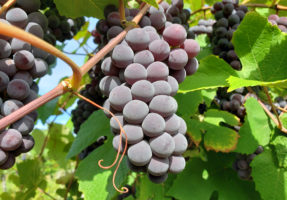
Nk'Mip grapes

April 30, 2019 byTom Walker

PENTICTON – It was an all-wine grapes meeting when the two groups that represent the sector met together for the first time in Penticton in early April. Kathy Malone, winemaker at Hillside Winery in Naramata and chair of the BC Wine Grape Council (BCWGC) tipped her glass to the BC Grapegrowers’ Association (BCGA) for hosting a joint event.
“We thank the BCGA for teaming with us,” says Malone.
BCWGC funds research and education through a $10 per ton levy collected from wineries on all grapes processed that are grown in mainland BC. Malone reviewed the work of six committees, including those overseeing health and safety, lab proficiency, and research and development. The work of the sustainability committee received special mention.
“Sustainable Wine Growing BC is one of the initiatives that we are most proud of,” says Malone. “We are at the tipping point to be able to offer sustainability certification.”
The program has been in development for 10 years, with Sustainable Wine Growing BC now offering self-assessment tools that develop sustainable practices for vineyards, wineries and winery hospitality.
Sustainable Wine Growing BC administrator Katie Pease outlined a pilot project planned for this year.
“We are taking those assessment tools and turning them into certification standards,” she says. “Customers care about sustainable practices and they are increasingly choosing them in the marketplace.”
She anticipates launching the full certification program in 2020.
Virus-free
Oliver grower Hans Buchler, chair of the Canadian Grapevine Certification Network, provided an overview of the network’s program to develop a supply of certified virus-free grapevine material for propagation.
“The industry in Canada is mature enough to be able to pool our resources for this project,” notes Buchler. The network includes the BC Wine Grape Council, Grape Growers of Ontario, Grape Growers Association of Nova Scotia and the Quebec Winegrowers Association.
“We are all focusing on improving the sustainability of the sector,” says Buchler.
BCGA president Mason Spink, winemaker at Dirty Laundry Vineyard in Summerland, described the association’s education and lobbying activities.
“We have a very strong board that does a lot of work on your behalf behind the scenes,” says Spink, noting that the association is run by volunteers.
BCGA grower days have been well-attended, with recent workshops on pruning, canopy management, spray programs and soil optimization.
One of the key programs BCGA administers is the successful starling control program.
BCGA administrative officer and starling program administrator Tyrion Miskell gave an overview of the new funnel trap being piloted in the North Okanagan to capture birds wintering in local dairy barns. The trap allows birds to be caught by the hundreds, with entire flocks eliminated rather than just a few birds at a time via conventional trapping. The program has captured 834,019 birds to date.
Miskell took the opportunity to appeal for more grower donations to support the program.
“Just because we are not seeing as many birds doesn’t mean the program is not important,” she says. “If we weren’t trapping, we estimate there would be over a million birds in the valley now.”
Western Agriculture Labour Initiative manager Veronica Moreno updated growers on changes to temporary farm worker programs. A representative from Service Canada also spoke to the group via teleconference.
Spink notes there are now over 50 vineyards that rely on labour from the Seasonal Agriculture Worker Program and he expects that will increase.
New awards
BCGA has established two new awards this year, recognizing viticulturalist of the year and lifetime achievement.
“We are excited to announce these awards and hope that they help to spur the level of quality across the industry,” says BCGA director John Bayley. “These are the people who are responsible for the day-to-day activities that grow the grapes. We hope that it will become a bit of a benchmark for the industry.”
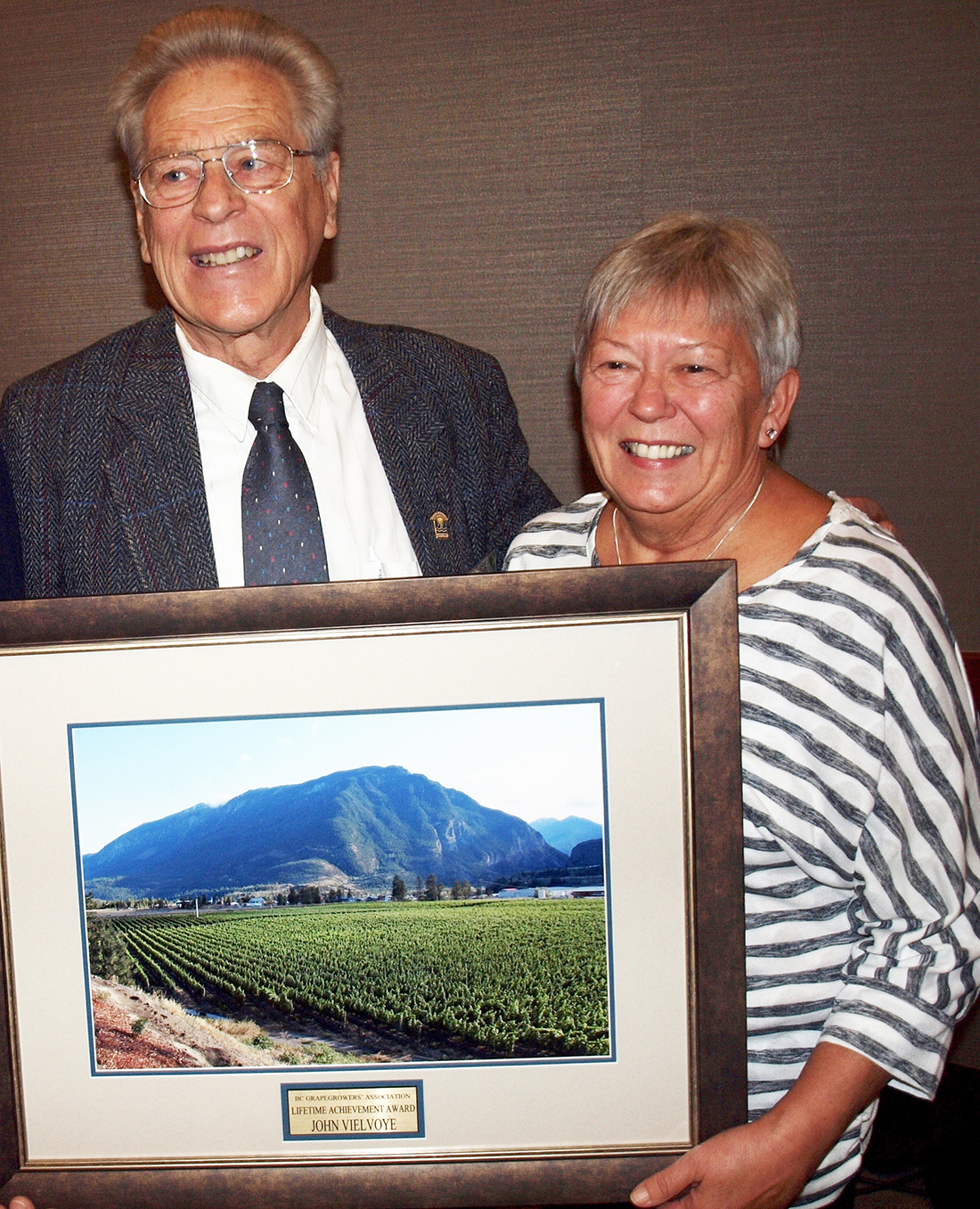
BCGA is accepting nominations for viticulturalist of the year until May 31. The award will be presented at the annual meeting next spring. The province’s former grape industry specialist, John Vielvoye, received the first lifetime achievement award at the April 4 meeting.
An afternoon workshop on grower relations and contract negotiation featured a panel discussion between two growers and two winery owners chaired by Sandra Oldfield, former winemaker and CEO of Tinhorn Creek Vineyards and now a consultant to the BC beverage industry.
“We have been trying for a long time to get a grower contract workshop,” says Miskell. “When Sandra approached me about it, the timing was great.”
A good contract begins with a long-term trusting relationship, says Naramata grower Rod King.
“You need to work on that relationship for a win-win,” says King. “That includes conversations between the winery and the vineyard on a regular basis.”
Industry lawyer Mark Hicken gave an overview of the laws governing grower contracts. Al Steele, vineyard manager for Dutton Ranch in Sebastopol, California, talked about the importance of long term relationships when he addressed the audience via videoconference.
“This is a small industry,” warns Steele. “You know over time who you want to deal with.”

All content on this website is copyrighted, and cannot be republished or reproduced without permission.
Related Posts

You may be interested in these posts from the same category.

Vineyards enter new year with recovery in sight

Warm winter stalls icewine

Phylloxera found on Vancouver Island

Growers, wineries welcome sustainability launch

Cold snap hits Okanagan fruit growers

Wineries reopen amid COVID-19

Top grape grower recognized

Icewine harvest begins

Autumn showers dampen harvest

Grape diversification in play

Clean plants build confidence

Grape growers honoured

Previous Post: « Grape specialist honoured for dedication
Next Post: Protest sends warning signal »

© 2026 COUNTRY LIFE IN BC - ALL RIGHTS RESERVED