
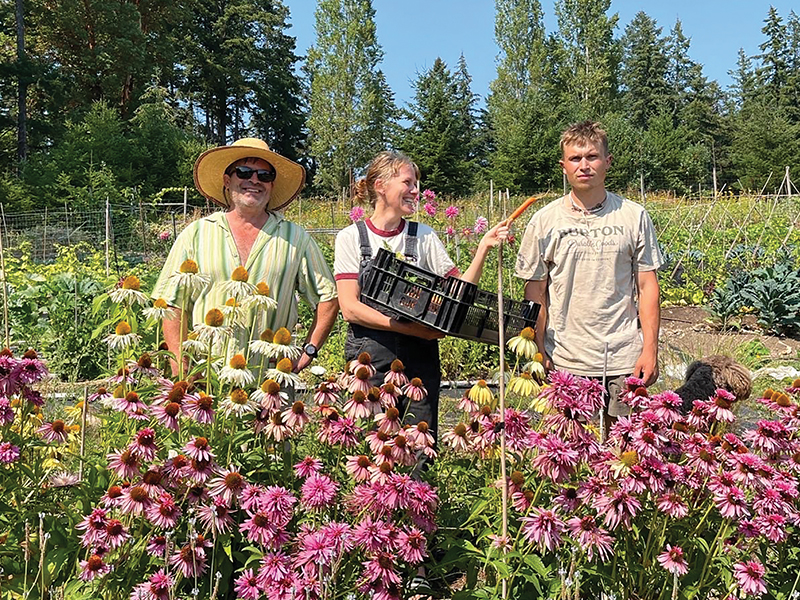
THETIS ISLAND – When Elisabeth and Noah Bond bought the only vineyard on Thetis Island in 2014, they looked forward to uncorking a new phase of life in the wine industry.
“We were always into food and sustainability, but really hadn’t grown food before,” says Elisabeth. “We thought it would be cool to have a vineyard!”
In reality, too many grapes had been planted on the 10-acre property, but not enough to be financially viable. After two years working the vineyard, the couple turned their attention to growing food as Jollity Farm.
Living on an island with less than 400 residents, many of whom made regular ferry trips to Vancouver Island to stock up on food and supplies, the Bonds realized they could help improve food security on Thetis if they could grow more food.
Elisabeth, a graphic designer and artist, and Noah, a former draftsman and painter, were aware of co-operatives through their involvement with artist collectives, shared land ownership and co-op housing. Through Jollity Farm they pursued a food co-op model with two other local farms where members would pool their resources and share labour, marketing and distribution tasks. The new Thetis Island Farm
Co-operative would ensure produce could be purchased at a fair price, and any excess food could be made into value-added products.
The couple’s vision for an agricultural co-op was supported by the Federal Investment Readiness Program, which helps social purpose organizations overcome barriers to accessing financing. Education and training for co-op members was provided through credit union Vancity, and the Canadian Worker Co-op Federation provided development and technical support. As the co-op was preparing to launch, however, COVID-19 emerged and the initiative was put on hold.
The couple purchased a van and refocused their efforts on a delivery program to help local residents get their food and supplies.
“It kept the farm operating during COVID,” Bond points out.
A pause after the pandemic gave co-op directors and members time to realign their goals and visions. Meanwhile, the Bonds’ son Finn, who had moved away and trained to be a mechanic, returned to Jollity in 2021 to support his parents in growing the farm.
“The fact that Finn came back to work with us after never showing any interest in farming – it was the succession plan many farmers hope for,” Bond says.
Summer 2023 was a major turning point. The family could see their market garden model on a small island would never be profitable enough to create three income streams. This prompted them to look for ways to reach more customers. When Nic’s Café, a well-known café and bookstore near the Chemainus ferry terminal came up for sale, the Bonds acted quickly.
“We had dreamed of having a little Chemainus farm shop, but in the past when vacant storefronts became available for rent, the numbers just didn’t work,” says Bond. “Nic’s had a commercial kitchen to process value-added foods and a great location close to the Chemainus ferry that runs five times a day to Thetis and Penelakut Islands. This meant fresh food could easily be transported and potentially available at both the farm and the café.”
On purchasing the café, the Bonds renovated the shop with commercial equipment and stocked the fridges and shelves with food from their farm and those of others. Every week, they travel from Thetis Island to the Saanich Peninsula, making as many as 20 stops at small-scale farms and artisan food producers to pick up products.
“If a local artisan comes to us with a product that has an agriculture connection – soap made from wild-harvested ingredients, or wool dyed with locally grown flowers – we will look at carrying it,” Bond says.
Recently they secured additional space next to the café, doubling the room available for seating and retail products. They also installed a certified processing kitchen on the farm to increase production of value-added products such as washed salad greens, pickles and preserves.
Finn has been officially installed as lead farmer and farm hand. Elisabeth is farm administrator in charge of managing orders, marketing and communication, and Noah is responsible for systems and maintenance. Noah also manages the flow of a rotational grazing and rearing program in partnership with a local family, volunteer farm workers and co-op members raising livestock.
The Jollity Farm Co-operative was officially registered in April 2024, becoming separate from the Thetis Island Farm Co-operative. The main difference between the two is that the Jollity Farm
Co-op is a for-profit, family-based social enterprise focused on growing produce and creating value-added foods. The Thetis Island co-op is a non-profit focussed on meeting the unique needs and food security challenges on Thetis Island.
“I think the simplicity of our smaller model is part of our success,” Elisabeth says.
The Jollity Farm Market & Café’s regular customers include plenty of seniors who stop in to enjoy nutritious food made from seasonal local ingredients, and frozen ready-made take-home meals like soups and stews. Nothing goes to waste in this kitchen.
The Jollity co-op model is not all about food, however. The couple provides mentoring to young farmers starting up on Thetis. They also offer a profit-sharing option where Jollity pays new operators as they raise their own animals to provide some financial relief as their ventures get going.
It has also been innovative with its growing methods. In 2021, the farm retrofitted its 100-square-foot greenhouse with an aquaponics system to reduce water use and grow lettuce year-round.
“It’s amazing to grow so much lettuce without worrying about drought,” says Bond.
With support from the Environmental Farm Plan and the Investment Agriculture Foundation of BC, Jollity also received funding to create larger and improved ponds and watering systems.
The farm has structural designs for an agrivoltaic system, a technique still in its infancy where crops and/or livestock are grown under solar panels that protect them from excessive heat and reduce evaporation. Jollity is looking at working with other co-ops to design and build agrivoltaic structures that co-op members would invest in.
Jollity Farm has evolved from the vineyard the Bonds originally bought, and the changes continue.
“By the time we complete the expansion of the two retail spaces in Chemainus we will have found our life balance: running a sustainable venture, generating a living wage, and inspiring others to do the same,” says Bond. “We do better together.”
All content on this website is copyrighted, and cannot be republished or reproduced without permission.
 Stabilization initiative yet to bear fruit