• Menu
  • Skip to primary navigation
  • Skip to main content
  • Skip to primary sidebar

Country Life In BC Logo

The agricultural news source in British Columbia since 1915

  • Headlines
  • Calendar
  • Subscribe
  • Advertise
  • About
  • Archives
  • Contact
  • Search
  • Headlines
  • Calendar
  • Subscribe
  • Advertise
  • About
  • Archives
  • Contact
  • Search

Primary Sidebar

Originally published:

JULY 2024
Vol. 110 Issue 7

Subscribe Now!

Sign up for free weekly FARM NEWS UPDATES

Loading form…

Your information will not be
shared or sold ever

Stories In This Edition

Disaster fund denied

Liquid gold

BC Millk halts deductions

Watering exemptions extended

Editorial: Who stands on guard for thee?

Back 40: Redefining labour as a technological problem

Viewpoint: Extension needs to be a two-way conversation

Stabilization initiative yet to bear fruit

Industry first as mushroom workers unionize

Ag Brief: High cost stall South Okanagan food hub

Ag Brief: Supply management limits food inflation

Orchard industry bids farwell to a staunch leader

Persistent drought conditions have ranchers on edge

Lacklustre season expected for berries

Island Trust turns 50

Land Act, water issues aired at Cattlemen’s AGM

Eye-to-eye

Grasslands tour puts spotlight on common ground

Telkwa producers step up to provide slaughter services

Sidebar: Dieleman family feels feed, labour crunch

Tour showcases sustainability of Abbotsford farms

Agritech company aims for the stars

Embracing regenerative cattle ranching

It’s not what, it’s how you spread it

Farm Story: A rake’s progress has no end

Ranchers follow beavers for water storage solutions

Woodshed: New beginnings for Kenneth, and for Deborah

Mary Forstbauer grant funds new farmer’s dreams

Jude’s Kitchen: Patio food for summer

All content on this website is copyrighted, and cannot be republished or reproduced without permission.
More Headlines

Follow us on Facebook

Comments Box SVG iconsUsed for the like, share, comment, and reaction icons

11 hours ago

A new national beef code of practice is open for public comment until June 12. Developed by NFACC and the Canadian Cattle Association, the draft addresses pain management, weaning, nutrition, lameness and end-of-life care.

#BCAg
... See MoreSee Less

Link thumbnail

New beef practices open for comment

www.countrylifeinbc.com

A new national code of practice for beef producers is open for public comment. “The public comment period is an important opportunity for producers across Canada to review the draft code and provide...
View Comments
  • Likes: 1
  • Shares: 0
  • Comments: 0

Comment on Facebook

4 days ago

The BC Ministry of Health has approved $4.25 million for the BC Farmers Market Nutrition Coupon Program, administered by the BC Association of Farmers Markets, for 2026. The funding is even with last year, and follows on $12 million provided in 2022-24. The funding is a cornerstone of BCAFM, providing eligible low-income, pregnant and senior individuals with $27 a week for purchases of locally grown produce at more than 100 participating farmers markets in 92 communities across BC. Funding has increased seven-fold since the program launched in 2012.

#BCAg
... See MoreSee Less

The BC Ministry of Health has approved $4.25 million for the BC Farmers Market Nutrition Coupon Program, administered by the BC Association of Farmers Markets, for 2026. The funding is even with last year, and follows on $12 million provided in 2022-24. The funding is a cornerstone of BCAFM, providing eligible low-income, pregnant and senior individuals with $27 a week for purchases of locally grown produce at more than 100 participating farmers markets in 92 communities across BC. Funding has increased seven-fold since the program launched in 2012.

#BCAg
View Comments
  • Likes: 957
  • Shares: 355
  • Comments: 115

Comment on Facebook

It provides for more than produce. It includes, eggs, meat and honey!

Good program. Additionally, I toured the Kelowna Food bank yesterday. They are serving about 12,000 people a month. Lots are working people.

I have seen people at the Saanichton markets asking if vendors take the coupons and being embarrassed when the vendor says no. Are there signs that are placed on the tables so people know who is part of the program and who is not?

“While it’s unfortunate that programs like this are necessary, I’m grateful they exist to support families and local farmers.”

What exactly is this and how does it work? I've never heard of it before. How does this get applied to us who it's intended to help?

Food stamps?

This should be made a little more accessible, especially for seniors

Christy Sakai its a week and if you to the markets you can get a small bag of carrots 5bucks, a few potatoes, usually a bag of apples are 5 bucks, and in summer you have fruit choices. Yes doesn't seem like alot but it could be stretched at the markets and remember its a week so really ypu going to use the whole bag of carrots in a week, probably not so you have something for the next week. Heads of lettuce 5 bucks. Every little bit does help when it comes to supporting local farmer and family.

This program has helped me afford local produce, as a senior. I am grateful for the assistance and eat a healthier diet.

I have been a working poor and 🙏👍for recognizing the people who deserve a bit of help as they are doing the best they can 😘👍

It is illegal for me to grow a garden . We can all afford to eat if we can grow.

This sounds a little more complicated to enroll in than it needs to be. A lot of people probably never heard of it, I only did because I read this post.

How does a senior apply?

On my smalltown the food bank puts your name in a lottery for this Seniors included in lottery

Glad to see this continue. With the increase in cost of living, this program should be increasing, not staying even with last year. Our local food bank is inundated with need.

Here are the general qualifications: Income Threshold: Generally for lower-income households. Some specific, local programs have identified a threshold of $27,000 or less for a single person or under $50,000 per year for a household. Targeted Groups: Participants must be seniors/elders, pregnant individuals, or families with children under 19. Participant Requirements: In addition to income, participants must: Participate in a food literacy program (e.g., cooking, gardening, or food budgeting). Be able to travel to a participating market to shop for themselves. Allocation: Because demand is high, coupons are often prioritized for new participants each year. Important Information: Coupons are not handed out by the BC Farmers' Markets directly. You must connect with a local community partner (such as a food bank, community centre, or neighbourhood house) to apply.

I did not know until now! I only find out that in Squamish woman centre, they give out vouchers, but there is long waiting list. I never got it. It would be good,if every low income family with children get them. Seniors as well.

So how does one receive this?

Have you got an email yet?

Please if you have these coupons do not be embarrassed to use them they are a good as anyone's money to a grower! I would agree it is a slippery slope to have people pay with government coupons but Remember large scale agriculture is subsidized in this country in way that dwarfs this little program. We are all in a sense are paying with coupons at the big supermarket. As a small scale grower grower I can tell you when you see the higher prices at the farmers market, no one is getting rich off you. That is the true cost of food. Yes that should scare you

This is great if you're a senior over 65 or pregnant. Doesn't help PWD low income. Why not hand out food stamps or something along with your small PWD income? I don't qualify because I don't meet the senior age requirement and I ain't gonna be pregnant any time soon... so 🤷 I'm glad this does exist and hope it help out for others. That would be great!

How about lower taxes

I didn’t know that the program existed

All programs help, but Loaves and Fishes is free to all and provide food across Vancouver Island. Check it out.

It is such an important program! A win win!

View more comments

1 week ago

KPU researcher Naomi Robert is partnering with Oregon State University's Dry Farming Collaborative to test drought-resilient growing practices across Vancouver Island and the Gulf Islands. Working with three market gardeners, the study found tomatoes and zucchini thrived without irrigation. With droughts intensifying across the Pacific Northwest, dry farming offers BC growers practical tools to adapt to a changing climate. The full story appears in our April edition. tinyurl.com/d2fzs#BCAg#BCAg ... See MoreSee Less

KPU researcher Naomi Robert is partnering with Oregon State Universitys Dry Farming Collaborative to test drought-resilient growing practices across Vancouver Island and the Gulf Islands. Working with three market gardeners, the study found tomatoes and zucchini thrived without irrigation. With droughts intensifying across the Pacific Northwest, dry farming offers BC growers practical tools to adapt to a changing climate. The full story appears in our April edition. https://tinyurl.com/d2fzs9x6

#BCAg
View Comments
  • Likes: 22
  • Shares: 5
  • Comments: 0

Comment on Facebook

2 weeks ago

A Maple Ridge dairy producer has been fined $7,512, had his licence suspended for three months, and faces quota restrictions for two years after an undercover investigation confirmed raw milk was sold directly from the farm on three separate occasions.

#BCAg
... See MoreSee Less

Link thumbnail

Maple Ridge farm fined for raw milk sales

www.countrylifeinbc.com

Raw milk remains off the table for dairy producers, with the BC Milk Marketing Board (BCMMB) taking action against a Maple Ridge producer for illicit sales. An undercover investigation of Maple Ridge...
View Comments
  • Likes: 57
  • Shares: 93
  • Comments: 229

Comment on Facebook

Unpasteurized milk is sold in Europe. It's the only milk certain cheeses can be made from.

Europeans used raw milk to make cheese for millenia, the farmer should sue them back on cultural grounds and a charter violation.

A person can shoot up government drugs in a playground but milk is the issue. 🙄

Is there a go fund me?

Raised on raw milk and I wouldn’t have had it any other way. My immune system is top notch compared to all others raised on corn syrup baby formula. Make it make sense!

When i was on the farm we would drink milk right from the cow in a bottle then drink and never got sick.

Ohh the milk moffia at it again I see

So whose the rat? lol one of the ppl who bought the raw milk? 🤦🏻‍♀️

I grew up in the 60’s with raw milk, cream and butter the farm shipped cream. One day the cream was rejected do too much bacteria. It wasn’t kept cool enough. That was the first of government control I experienced. Ok so the cream went back to the farm and made the best sourdough bread, ice cream and the cats came from heavens green acres for a treat of stale bread soaked in that very cream.

If the farmer sold shares in his farm so all these people owned part of the farm. Then it’s their milk . And don’t have to buy anything

Yet the government can supply cigarettes, alcohol, weed and hard drugs. Makes sense. 🙄

leave him the hell alone! if someone wants to buy raw milk at their own risk, let them. At least they can see where the milk came from

I would love my own cow so I could get raw milk

I love the back in the day story’s . Please remember those stories were of grandpa drinking his own cow’s milk. You still have the right to buy cows and drink their milk raw. Go ahead and do it….

As the government sells alcohol and cigarettes 🤡

Free drugs good raw milk bad 🤣

Just identify as first nations and say it's a cultural thing . Then it becomes legal

Guy up the road sells milk raw here too

Raised on our own milk, so were my kids. Got told my kids would not be as Intelegent because of it 😂 they are adults and doing very well. The problem lays in the consumer handling of product after pick up. when milking at home its in a stainless steel pail, sifted, into glass containers, then in fridge to cool down. People picking up, put jn car drive off for an hour or more, then in fridge. This is the problem, bactia grows in the heat. Then they drink that evening when still warm, get sick, blame farm milk. Go to grocery store buy a jug, it last 2weeks after due date ...yummy. ( tested this therory) Id rather have fresh milk and properly handle it. Everything is so regulated,

I have mixed opinions here. I think that people should be able to get unpasteurized milk( I was raised on it and raised my own family with our own milk cow..) However in this day and age people are so inclined to sue for most anything it seems like the dairy farmers need some kind of protection against that? They could lose their businesses over legal procedures. Maybe that is a positive thing about the milk boards…

Some comments seem to be missing the point of the article. NO ONE was sick from the milk. It’s all about money. “By selling milk outside the regulated system, where revenues are pooled, the board claimed Stuyt had cost producers as a whole $195,185 and ordered him to repay this amount. It also ordered Stuyt to pay $33,266 to cover the cost of BCMMB’s investigation and hearings into the matter. The BC Dairy Association, which stood as an intervenor in the appeal before FIRB, said illicit raw milk sales are a direct threat to supply management.”

Communist Canada. If people want raw milk they should be able to buy raw milk. It’s all about control ….

You mean sold real milk, unadulterated, whole milk

That's just sad, but drugs are fine

To each their own. If people want to buy resh milk im sure they know the consequences involved. Maybe the people take it home, seperate the cream and pasturize it them selves. We drank milk at my aunts house off the cow but it was heated to 72’ (Pasturized )

View more comments

2 weeks ago

A draft update to the Code of Practice for the Care and Handling of Beef Cattle is now open for public comment until June 12. The code, one of 14 animal care codes developed and maintained by the National Farm Animal Care Council, is undergoing a routine 10-year review. "Your feedback will help shape the industry's guide to cattle welfare for the next decade," says Canadian Cattle Association policy manager Jessica Radau, urging producers to weigh in. For more information, visit tinyurl.com/58a3u9fz.

#BCAg
... See MoreSee Less

A draft update to the Code of Practice for the Care and Handling of Beef Cattle is now open for public comment until June 12. The code, one of 14 animal care codes developed and maintained by the National Farm Animal Care Council, is undergoing a routine 10-year review.  Your feedback will help shape the industrys guide to cattle welfare for the next decade, says Canadian Cattle Association policy manager Jessica Radau, urging producers to weigh in. For more information, visit https://tinyurl.com/58a3u9fz.

#BCAg
View Comments
  • Likes: 5
  • Shares: 4
  • Comments: 1

Comment on Facebook

I sat in the webinar yesterday by the Canadian Cattle Association. My initial concern was that this would be another "play" into the government's hands. It has been worked on by people that are actually in the Beef industry from Cow calf to feedlot. The thrust is an update of the 2013 Code of Practice which was reviewed in 2018. The changes are more a move from "left to the producers discretion" to clearer directions regarding pain management, proper transport of animals which are impaired and keeping cattle in in good condition. Much of what is recommended is what producers who care about animal husbandry already do. The important part is to GIVE THEM FEEDBACK good, bad or otherwise. The document is about 60 pages long, and I ran it through CHAT to see what had been changed. It is important to understand that the PUBLIC is invited to comment on the draft not just producers. Think about it... do you really want the public influencing how you manage your cattle. If you think that this is just one of those things, I have been following Bill 22 in Alberta which will grant the SPCA a proactive roll in entering farms and checking on animals. When I asked CHAT how the new bill relates to the Cattle Code, it came back that the Code although not a regulation will be able to be used as a guide by producers for backup in dealing with the SPCA regarding cattle conditions, sick animal handling etc. Take the time.... Go onto the Canadian Cattle Association website and speak to those parts that you wish to input.

Subscribe | Advertise

The agricultural news source in British Columbia since 1915
  • Email
  • Facebook

Stabilization initiative yet to bear fruit

Orchardists leaving the sector as extreme weather grinds margins

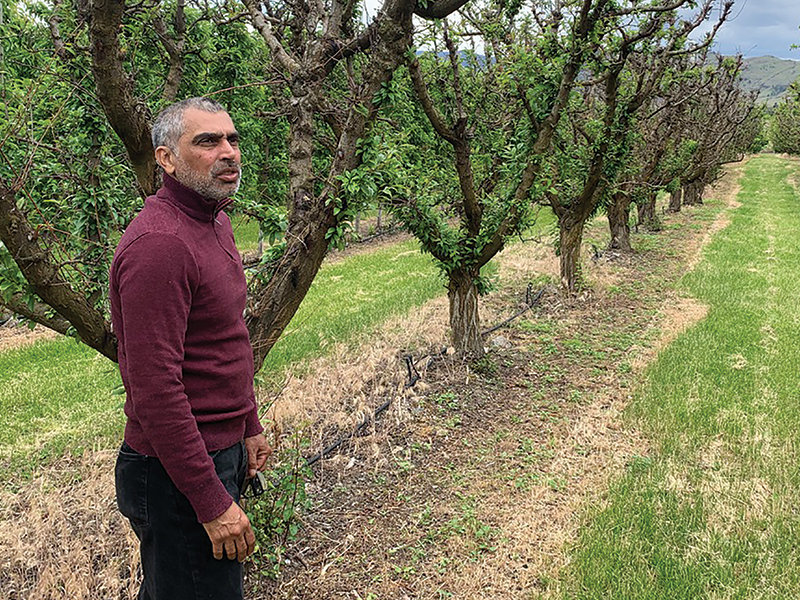
Oliver orchardist Pinder Dhaliwal stands next to a row of trees struggling to push a full canopy after successive years of extreme weather. | TOM WALKER

July 2, 2024 byTom Walker

OLIVER – The deep black of dying plum trees stands in stark contrast to the vibrant green of the adjacent cherries in Pinder Dhaliwal’s orchard in Oliver.

Yet on closer inspection, many of the cherry branches have little if any fruit and several branches are dying. The nearby peach trees have no fruit at all and many are struggling to push a full canopy of leaves.

Across the orchard, a row of apple trees appears to be doing fine, but multiple cracks in the bark just above the graft union are an open invitation to pests and pathogens.

It’s a grim scene, and Dhaliwal’s orchard is but one of hundreds of orchards and vineyards across the Okanagan, Similkameen and Creston valleys blasted by successive years of extreme weather.

The cumulative effects of the 2021 heat dome, back-to-back freeze events and a bloom-killing spring frost this year have been devastating for fruit farmers in BC.

“This has brought the industry to its knees,” says BC Fruit Growers Association president Peter Simonsen.

Dhaliwal’s family have been fruit growers since 1981, and have steadily diversified their business with apples, cherries, plums, peaches and, more recently, grapes.

A farmstand direct-markets the tree fruits, part of a business plan designed to mitigate the risks of farming.

But the effort is no match for Mother Nature.

“Our grape buds froze during the January cold event and we will have no grapes this year,” Dhaliwal says.

Woodpeckers are already finding insects in the plum trees and Dhaliwal says he will need to remove and replant them.

“All our work will go into rehabilitating the other trees and vines to support them to get back to health and hopefully have a reduced crop next year,” he says. “But we just don’t know if the trees will survive through the heat of the summer.”

The existential threat facing the industry has been a long time coming.

Six years ago, the province established the Tree Fruit Industry Competitiveness Fund, a precursor to the Tree Fruit Industry Stabilization Initiative launched in 2021 that resulted in 19 recommendations.

The initiative, led by the province’s former tree fruit and grape specialist Adrian Arts, convened various committees to work through the recommendations. Growers and industry stakeholders took on some initiatives while others fell to the BC Ministry of Agriculture and Food.

With much of the committee work completed, the initiative is winding down.

The province did not make Arts available for this story, despite repeated requests, but the ongoing challenges facing growers underscore the fact the industry is even less stable than it was six years ago, with the number of growers falling dramatically.

“That has a lot to do with what Mother Nature has thrown at us over the last several years in combination with inflation, a huge apple crop in the US last year and the timing of the cherry crops,” says BCFGA general manager Melissa Tesche.

She says much of the committee work focused on data collection, extension, new varieties, labour and cross-commodity communication and collaboration.

“These have all been positive initiatives that support the industry,” she says. “If the last two years had been good crop years, we would be having a different conversation. Unfortunately, extreme weather challenges have continued to pummel crops and almost every grower I have talked to is thinking about getting out of farming.”

The rush for the exits is a question of financial survival.

“The individual grower is no better off; actually, they are worse off than they were three years ago,” Simonsen says.

No money for reinvestment

This has left fewer dollars available for participating in the Perennial Crop Renewal Program the province launched last year.

“It is one of the most generous programs we have ever had,” says Tesche. “But taking advantage of the program requires that growers have funds on hand to reinvest, and you can only reinvest when you have a profit. It’s been a long time since growing fruit was profitable.”

Some growers accessed funds for pull-outs last year and some planting took place this spring, but the program is quite prescriptive on varieties.

The cherry and grape industries have been told to revise the market assessment reports required to secure funds for planting. This means most won’t likely be planting before next spring.

A number of recommendations from the stabilization initiative were never actioned, such as financial support for fruit farmers.

Simonsen says he realizes that government dollars are stretched and that there are many priorities including health care and housing, but he notes that BC funding for agriculture is a lower proportion of the sector’s GDP than for any other province in Canada at just 2.5% last year.

Indeed, a BC Agriculture Council analysis of Statistics Canada data indicates the national average is 11.3%, led by Saskatchewan at 26.5%.

“Just to tie with New Brunswick, which has the next lowest share of government investment, the budget for BC’s Ministry of Agriculture and Food would need to be increased by roughly 45.7% or $59.5 million,” BCAC states. “That would represent an increase from $130.1 million in the 2024-25 budget to $189.6 million in 2025-26.”

Simonsen notes that Washington apple growers, who sell twice as much fruit in Canada as Canadian growers do, received a $2,000 support payment last year and will likely see additional support this year.

“Washington growers were impacted by the same freeze events as those in BC and the governor has declared a state of emergency in Okanogan County just across the border,” he says.

Business risk management programs, which provincial staff regularly encourage farmers to access, get a failing grade from industry.

“The current programs were designed for occasional bad years, not multiple climate disasters in a row,” notes Tesche. “Successive years of loss have resulted in declining reference margins and reduced pay-outs.”

She believes a climate resilience and recovery fund could complement existing programs, a role AgriRecovery funds have not fulfilled.

“AgriRecovery funds have not been triggered for any of the recent climate disasters,” Tesche says. “Not for the heat dome of 2021, nor the back-to-back cold snaps following. It is imperative that growers are able to access adequate financial relief after extreme weather events.”

Cold comfort

Crop insurance has also been cold comfort. The most affordable programs have a deductible of 50%, a loss that must be experienced across all farm sites rather than specific blocks.

This makes it more difficult for growers who mitigate risk with orchards at various locations to secure compensation.

“If one block in Summerland is wiped out by hail, you don’t get to claim that specific loss,” Dhaliwal says.

Dhaliwal’s orchard has a silver lining as the sun glints off a cordon of lush vines at the margins with maturing grape clusters.

“Those are table grapes,” Dhaliwal explains. “At least we will have something to sell in the fruit stand.”

All content on this website is copyrighted, and cannot be republished or reproduced without permission.
Related Posts

You may be interested in these posts from the same category.

Cherry growers focus on labour

Federal budget kills Living Labs

BC Tree Fruits relaunch

Cherry bonanza no jubilee

Showdown looms over co-op’s surplus

Algoma comes to BC

Arts leads BCFGA forward

Tesche leaving BCFGA

United front for fruit growers

Apple growers discuss marketing commission

Growers Supply property sold

BC Fruit Growers list test orchard

Previous Post: « Berry growers on lookout for rose stem girdler
Next Post: Gulf Island entrepreneurs eye food security »

© 2026 COUNTRY LIFE IN BC - ALL RIGHTS RESERVED