• Menu
  • Skip to primary navigation
  • Skip to main content
  • Skip to primary sidebar

Country Life In BC Logo

The agricultural news source in British Columbia since 1915

  • Headlines
  • Calendar
  • Subscribe
  • Advertise
  • About
  • Archives
  • Contact
  • Search
  • Headlines
  • Calendar
  • Subscribe
  • Advertise
  • About
  • Archives
  • Contact
  • Search

Primary Sidebar

Originally published:

November 2016
Vol. 102 Issue 11

Subscribe Now!

Sign up for free weekly FARM NEWS UPDATES

Loading form…

Your information will not be
shared or sold ever

Stories In This Edition

Hazelnut growers optimistic

Animal welfare bill defeated

David Schmidt honored with lifetime achievement award

Ag council recognizes civic support for farming

Urban farm seeks stable footing

This could be final harvest for Site C dam opponents

Kelowna cracks down on ALR abuse

Water workshop for farmers

Agri-food bankruptcies on low side

New roles at ministry

Early snow downgrades Peace harvest

$2.5 invested in Peace flood

BC farms stay focused on safety

Worker dies

Ranchers square off against wood rustlers

New hires to investigate ALR complaints

Opportunity as Western feelot closes

Forage trial in Central Interior

Good planning essential

Genomics will help build a better beef herd

Mobile juicer initiative inspires community outreach

K&M has different approach

Fruit growers offered incentive for safety training

Honey producers urged to stand up

Honey prices spiral down

Zombie bees

Making a case for biosolids

Saving rural areas from sludge

Biosolids: Are they safe?

Money for composting

Serotinin for milk fever

Preparing for next year’s weeds

Vineyard owners are creative

Abattoir cashing in

Room for expansion – hops

More Headlines

Follow us on Facebook

Comments Box SVG iconsUsed for the like, share, comment, and reaction icons

2 hours ago

BC Supreme Court has blocked an attempt by remaining BC Tree Fruits Cooperative members to amend a rule that would have excluded former members from receiving their share of the co-op’s remaining assets. In her ruling, Justice Miriam Gropper called the bid to amend Rule 125, which would allow 32% of the surplus to be distributed among former members based on tonnage shipped to the co-op during its last six years of operation, “oppressive and unfairly prejudicial.” The co-op closed in July 2024, and remaining assets are estimated at between $12 and $15 million.

#BCAg
... See MoreSee Less

BC Supreme Court has blocked an attempt by remaining BC Tree Fruits Cooperative members to amend a rule that would have excluded former members from receiving their share of the co-op’s remaining assets. In her ruling, Justice Miriam Gropper called the bid to amend Rule 125, which would allow 32% of the surplus to be distributed among former members based on tonnage shipped to the co-op during its last six years of operation, “oppressive and unfairly prejudicial.” The co-op closed in July 2024, and remaining assets are estimated at between $12 and $15 million.

#BCAg
View Comments
  • Likes: 2
  • Shares: 4
  • Comments: 0

Comment on Facebook

1 day ago

From our Country Life in BC family to yours, HAPPY FAMILY DAY!

Photo by Liz Twan

#BCAg
... See MoreSee Less

From our Country Life in BC family to yours, HAPPY FAMILY DAY!

Photo by Liz Twan

#BCAg
View Comments
  • Likes: 10
  • Shares: 1
  • Comments: 1

Comment on Facebook

🥰🐮🩷

3 days ago

Full-time students employed in BC agriculture during the summer season are eligible to apply for a bursary of up to $3,000. The bursary, administered by the Investment Agriculture Foundation, aims to increase youth and domestic seasonal worker employment in the ag sector. Funding is awarded on a first-come, first-serve basis. More information is available at tinyurl.com/5ef6pe3m

#BCAg IAF
... See MoreSee Less

Full-time students employed in BC agriculture during the summer season are eligible to apply for a bursary of up to $3,000. The bursary, administered by the Investment Agriculture Foundation, aims to increase youth and domestic seasonal worker employment in the ag sector. Funding is awarded on a first-come, first-serve basis. More information is available at https://tinyurl.com/5ef6pe3m

#BCAg IAF
View Comments
  • Likes: 13
  • Shares: 11
  • Comments: 0

Comment on Facebook

4 days ago

BC fruit and vegetable farmers are being asked to share their views on farming technology in a 10-minute survey from Royal Roads University and the University of the Fraser Valley. The survey looks at how fruit and vegetable farmers are adopting emerging farming technologies -- such as digital tools, “controlled environment agriculture systems” (greenhouses) and agri-genomics (DNA analysis) -- to cope with changing climate conditions. The survey takes about 10 minutes to complete, and participants will be eligible to win an assortment of $50-$200 gift cards.

insights.kaianalytics.com/s3/PAS2026
... See MoreSee Less

BC fruit and vegetable farmers are being asked to share their views on farming technology in a 10-minute survey from Royal Roads University and the University of the Fraser Valley. The survey looks at how fruit and vegetable farmers are adopting emerging farming technologies -- such as digital tools, “controlled environment agriculture systems” (greenhouses) and agri-genomics (DNA analysis) -- to cope with changing climate conditions. The survey takes about 10 minutes to complete, and participants will be eligible to win an assortment of $50-$200 gift cards. 

https://insights.kaianalytics.com/s3/PAS2026
View Comments
  • Likes: 5
  • Shares: 1
  • Comments: 0

Comment on Facebook

4 days ago

The District of Coldstream is proposing the creation of farm property tax subclasses to distinguish between small-scale and large-scale farm operations. Currently, all farms are classified as Class 9 regardless of size or infrastructure needs. The district argues larger farms require more municipal services and should be taxed accordingly. It plans to pitch its proposal at the Southern Interior Local Government Association convention in Revelstoke at the end of April. Support there could escalate the discussion to the Union of BC Municipalities convention next September in Vancouver.

#BCAg
... See MoreSee Less

The District of Coldstream is proposing the creation of farm property tax subclasses to distinguish between small-scale and large-scale farm operations. Currently, all farms are classified as Class 9 regardless of size or infrastructure needs. The district argues larger farms require more municipal services and should be taxed accordingly. It plans to pitch its proposal at the  Southern Interior Local Government Association convention in Revelstoke at the end of April. Support there could escalate the discussion to the Union of BC Municipalities convention next September in Vancouver. 

#BCAg
View Comments
  • Likes: 12
  • Shares: 2
  • Comments: 11

Comment on Facebook

Which municipal services do they require more of? Even larger farms typically still have only one or possibly two dwellings. Most have their own well and septic, and I suppose it depends on location, but most rural properties don't have garbage pick up either. And whether 20 driveways or one join the road, the cost to plow that road is the same. I no longer live within a municipality so of course there could be costs I've overlooked that are contributing to the District's proposal.

Large farms put more back into the community too.

The larger farms are the only farms paying wages, allowing people to spend money in their communities, the beauty of a network of small business. Small farms more often then not, is a single transaction, a hobby. Large- buy feed, raise cow, calf is born, sell calf, pay wage(support livlihoods), buy fence posts, buy more feed and so forth. Feeding the community. Small- Buy feed, raise cow, kill cow, eat cow.

And this is why farmers left California. British Columbia is no different

I am not sure how to post the actual Resolution that Council Pat Cochrane put forward but here is the link to the special meeting they are holding to pass the resolution: www.coldstream.ca/government-bylaws/news-alerts/notice-special-council-meeting-3.

Why not find ways to bring in more business's and audit municipal spending and regulate short term rentals (because Coldstream has essentially zero places to stay technically, insane) instead of raising taxes arbitrarily because "bigger costs more"

Attending that meeting, they claimed that “large farms” use more municipal services, yet Cochrane consistently stated he was going after “smaller estate properties not actively farming.” This is not only contradictory but misinformed. It would take him but three door knocks before he learned that the “estate farms” not actively farming are typically leased to a larger conglomerate to maintain farm classification. “Rural living at its finest,” though it seems not a soul on council is well-versed in this wheelhouse. What’s worse is that they somehow don’t think it’s necessary to bring in a single subject expert before blindly tossing around recommendations and solutions to problems that don’t really exist—or at least not as they perceive them. Don’t get me started on their rhetoric comparing the value of class 9 properties to other residential classes, when even my 12 year old understands that the values are drastically different when one property can be subdivided, and an ALR property cannot. Forever to the left of the point.

They want to tax a large farm more? Do people realize that farmers aren't becoming rich. Also, a small or hobby farm isn't contributing much to the local economy or community. This doesn't make sense. If we don't support our farmers. We need them. We can't import all our food.

What bs. I can't do a water and sewer hook up for an agricultural building, (a farm vegie stand) on a 160 acre farm in downtown Kelowna because there is already one at the far end of the lot for the principal residence. What extra infrastructure would they be talking about. Our irrigation is by licensed ground water well put in, powered and serviced by me. Any change in tax code should be on farm estates that do bogus farm gate sales at the minimum requirement, not viable commercial farming enterprizes that employ and contribute economic benefits to so many other businesses

Instead of increasing property taxes on large farms, I think governments need to revise the threshold needed for a property to qualify for farm status. That threshold has not changed in over 20 years and many non farmers are taking advantage of the ridiculously low threshold that was intended for real farmers.

And then you tax the farmers more and wonder why food prices keep going up. Why is it that the only thing government does is find more reasons and ways to tax people?

View more comments

Subscribe | Advertise

The agricultural news source in British Columbia since 1915
  • Email
  • Facebook

Hazelnut growers optimistic

November 1, 2016 byDavid Schmidt//  Leave a Comment

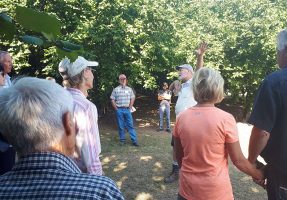
CHILLIWACK – The BC hazelnut industry has bottomed out, BC Hazelnut Growers’ Association director Thom O’Dell told a large group of current and potential new growers at the hazelnut field day at Helmut Hooge’s farm in Chilliwack in September.

Once flourishing in the Fraser Valley, hazelnut growers started falling on hard times when Eastern Filbert Blight invaded just over a decade ago. Since then, many long-standing orchards have been removed and the remainder are heavily infected with the incurable disease.

Seeing the writing on the wall, five (now four) Fraser Valley growers and one on Hornby Island worked with O’Dell to bring in six new EFB-resistant varieties from Oregon in tissue culture. Helped by a grant from the Investment Agriculture Foundation of BC, the growers planted the first of the new trees in 2011 and another set in 2013 in a trial to see how they would perform.

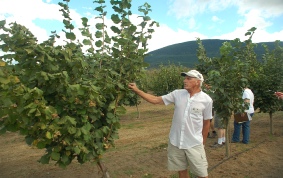
Hooge is one of the participants in the trial and now has 230 Yamhill, 200 Jefferson and 70 Sacajawea trees as well as a few Eta, Theta and Gamma pollinators in his orchard.

“Every fourth tree in every third row is a pollinator,” Hooge said.

He stressed the trees are “resistant” but not immune to the disease, saying pruning can keep the disease at bay, if not eliminate it altogether.

“We started seeing some EFB in the new trees in 2013,” O’Dell reported, telling growers to apply an approved fungicide on young trees after bud break and prune out and burn any affected limbs.

Hooge has followed that strategy and his new trees show few signs of EFB despite being located right next to his heavily infected Barcelona orchard.

Both he and O’Dell say they have already learned a lot about managing the new varieties, including how and when to plant them. That was obvious in Hooge’s orchard as the 2013 plantings appear to be more vigorous and productive than the 2011 plantings, despite being two years younger.

Although this has been a good year for production, growers wrestled with what to do with their nuts. Because so many of the infected orchards have been uprooted, there were not enough nuts for John Vandenbrink, who has the only remaining commercial-scale nut dryer in the area, to run his dryer this year. Instead, most growers sent their nuts to Hooge for drying, used other small-scale dryers or shipped their nuts to Oregon for drying.

New growers

In the meantime, O’Dell and the other BCHGA directors are doing all they can to interest new growers.

“We received an agriculture enhancement grant from the Abbotsford Foundation and are partnering with the University of the Fraser Valley and a farm in Abbotsford to make the general public more aware of hazelnuts,” BCHGA president Neal Tebrinke said.

O’Dell said hazelnuts are ideal for small acreages, claiming “you can get enough nuts from two acres to get your farm status.”

Denise Parker of MNP concurred, saying hazelnuts could “help fund a farming lifestyle” and preserve farm status for capital gains exemption. She presented an enterprise budget prepared in July 2015 which suggests that even though growers can expect losses in the first three years, that will level out as the orchard comes into production. By year 20, growers will have generated a total gross margin of $40,000 per acre based on current prices.

O’Dell believes prices will only improve, noting there is a “growing (worldwide) demand for all nuts.”

There may even be an option for potential new growers who are interested in hazelnuts but may not have the time or expertise to plant and/or manage the orchard.

Custom services

James and Anthony Dick, who have years of experience growing cedar hedging, are planting five acres of hazelnuts on their own property this fall and will then offer that service to other growers.

“We have the equipment to prep and plant an orchard and will purchase harvesting equipment to offer custom work services on a per hour basis,” they said.

Related Posts

You may be interested in these posts from the same category.

Oregon hazelnut optimism inspires BC growers

Sheep

New year, new funding

Hazelnut growers await new production guide

Hazelnut growers get replant funding

Previous Post: « David Schmidt honored with lifetime achievement award
Next Post: David Schmidt honored with lifetime achievement award »

Reader Interactions

Leave a Reply Cancel reply

You must be logged in to post a comment.

Copyright © 2026 Country Life in BC · All Rights Reserved