
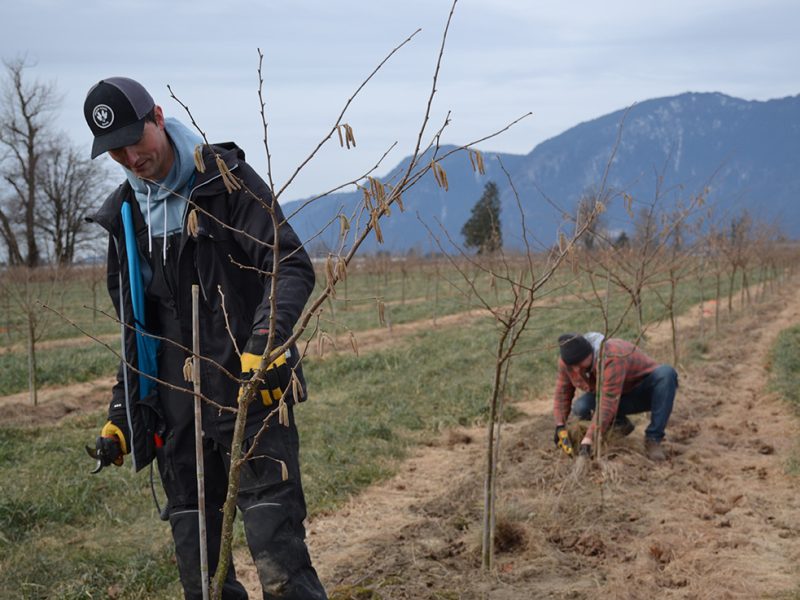
ABBOTSFORD – Production volumes are rising as BC hazelnut orchards mature following replanting with varieties resistant to Eastern Filbert Blight.
“We’re about 10 years in after replanting … and we’re starting to see a lot of good yields,” says Steve Hope, co-owner of Fraser Valley Hazelnuts in Chilliwack, who delivered the hazelnut market outlook during the Lower Mainland Horticultural Conference at the Pacific Agriculture Show in Abbotsford, January 24. “Now we’re starting to see the fruits of all that labour.”
Hope credits the BC Hazelnut Renewal Program for the resurgence, but it has been far from an instant recovery.
In the early 2000s, BC produced about 2.5 million pounds of hazelnuts. In 2024, growers gathered 272,000 pounds. The largest harvest of the past 16 years, it remained a far cry from the volumes of yore.
Still, the pace of growth since 2020 is encouraging.
Fraser Valley Hazelnuts, the only commercial processing facility in BC, handles about 85% of the province’s hazelnuts. It received 35,000 pounds in 2020.
“That was the first year where we saw the majority of our intake be from the new varieties,” Hope says.
The volume of nuts from new, resistant varieties doubled in 2021 to 72,810 pounds, and in 2022, Fraser Valley Hazelnuts received 116,000 pounds then 148,000 pounds in 2023.
“We are definitely on the up trend in BC,” he says. “With 500 or so acres planted and starting to produce, we expect these numbers are going to start growing by 10% to 15% to 30% year-over-year depending on where we get with weather and … farming practices.”
Recovery has brought the challenge of expanding processing lines to accommodate both current harvests as well as future volumes.
“When we went from 40,000 to 100,000 pounds it was overnight and we struggled to keep up,” says Hope. “We’ve had 35% to 50% growth year-over-year for the past three and we’re expecting the same to continue. What we have to do now is try to figure out what we’re going to do with these nuts.”
Fraser Valley Hazelnuts is providing a local option for growers, who used to ship more than half their crop to Oregon. This is helping Fraser Valley growers see a better return, especially important when farm properties average $100,000 an acre.
BC growers sell hazelnuts in one of three ways: farmgate, which can see in-shell nuts fetch $6 to $10 a pound; receiving stations like Fraser Valley Hazelnuts, which pays market prices plus a bonus and takes on the risk of selling; or marketing the nuts independently.
“There have been a lot of success stories about people marketing their own product,” says Hope. “It’s time-consuming. It could be potentially expensive, but there could be good return that way.”
Fraser Valley Hazelnuts has been undertaking business development to grow domestic markets and maximize grower returns, but international forces are also helping.
“Luckily for us, this year, Turkey had a terrible crop,” Hope says.
As the largest region in the world producing hazelnuts, Turkey is the key influence on global prices. Production in 2024 was 25% lower than expected, at less than 600,000 tons.
“It’s driven up the market price,” Hope says, noting that BC pricing is based off Oregon. “We get a price roughly in October or November and that’s your base field price. Then they release a bonus price once all the processing is done in Oregon and shipped to their prospective customers. We get a bonus price in February or March. It leaves us, as a processor, in a guessing game.”
According to the Amity, Oregon-based Hazelnut Bargaining Association, 2024 field prices averaged US$1.14 per pound, 25% higher than in 2023.
Weather-related events and stink bug issues have hampered hazelnuts in Turkey and Italy, and if that trend continues, it will push BC grower returns higher.
Hope says Fraser Valley Hazelnuts sent about a quarter of its nuts to Oregon last year but is trying to open up more local markets to maximize returns. Buy BC promotions have also highlighted the product for consumers.
“In the past few years, we’ve been paying between 5% and 15% more than what the market rate is to our farmers because we’ve been able to keep it local,” he says.
While local markets are great, Hope is aware that as nut volumes increase, those markets may not be prepared to take on the full crop. Expanding local opportunities may not always line up with the crop.
“If we have an issue with too much of a crop, for us to send nuts down to Oregon is a great avenue.”
In-shell nuts are about 15% of the BC market, raw or roasted kernels are about 60% and 25% is value-added products like chocolate-covered hazelnuts or providing the nuts as an ingredient.
If Turkish yields recover, there will be an increased focus on selling filberts within the province.
“The outlook is good. The industry is growing. The demand has never been higher,” Hope says.
The biggest challenge Hope sees is getting retailers to accept buying BC-grown nuts at $6 a pound, which they can sell for $9 a pound, as opposed to Turkish nuts that come in at $3 a pound and sell for $6 a pound.
All content on this website is copyrighted, and cannot be republished or reproduced without permission.

 Summer school cultivates future farmers