
• Menu
  • Skip to primary navigation
  • Skip to main content
  • Skip to primary sidebar

Country Life In BC Logo

The agricultural news source in British Columbia since 1915

  • Headlines
  • Calendar
  • Subscribe
  • Advertise
  • About
  • Archives
  • Contact
  • Search
  • Headlines
  • Calendar
  • Subscribe
  • Advertise
  • About
  • Archives
  • Contact
  • Search

Primary Sidebar

Originally published:

MAY 2025
Vol. 111 Issue 4

Subscribe Now!

Sign up for free weekly FARM NEWS UPDATES

Loading form…

Your information will not be
shared or sold ever

Stories In This Edition

Farmers Institute Act to be revamped

The big picture

Tariff turbulence buffets investment

Reminiscences of a honeyed career

Editorial: A helpful hint

Back 40: Farm size matters less than hard truths

Viewpoint: Beekeepers find themselves in sticky situation

BCAC boosts advocacy role, increases fees

Lettuce eat local

Operational review will guide AgSafe’s strategic plan

Farmers welcome elimination of BC’s carbon tax

Ag Briefs: fresh for Kids delivers nutritious foods to schools

Ag Briefs: Denman Island farmers supported

Ag Briefs: Potato acreage declines in 2025

BC dairies face price drop as production surges

Sweet reward

Interior growers on the lookout for armyworm

Landowners push back against rail trail plans

US trade tensions could impact raspberry trials

New berries continue to look promising

BC holds course on Columbia River Treaty

Speaking up for agriculture in treaty negotiations

Kelowna abattoir fills critical processing gap

Regional meat cluster boosts supply chain

Tech tackles tough terrain for BC ranchers

Farm Story: Breaking seasonal stereotypes one chore at a time

Bee shosrtage stings BC honey producers

High hopes for new pear variety

Putting technology to the test

Hazelnuts benefit from strategic pruning

Woodshed: There’s the stickers, and there’s the boomers

O’Keefe Ranch focus of a new book

Jude’s Kitchen: We’re eating BC and loving it

More Headlines

Follow us on Facebook

Comments Box SVG iconsUsed for the like, share, comment, and reaction icons

6 days ago

A BC Forest Practices Board investigation has found overgrazing has damaged grasslands in the Coutlee Range Unit near Merritt — and the range-use plan meant to prevent it was unenforceable. With complaints about overgrazing on the rise and grasslands covering just 1% of BC's land mass, the findings raise fresh questions about how the province manages one of its most vulnerable — and valuable — food-producing ecosyste#BCAg#BCAg ... See MoreSee Less

Link thumbnail

Board finds overgrazing rules unenforceable unmeasurable

www.countrylifeinbc.com

MERRITT – A BC Forest Practices Board investigation has found instances of non-compliance related to overgrazing have damaged open grasslands in the Mine pasture, part of the Coutlee Range Unit near...
View Comments
  • Likes: 6
  • Shares: 6
  • Comments: 6

Comment on Facebook

Several ranchers in recent years have gone into temporary non use on that range , so that means the grass should grow. But drought conditions/lack of rain and snow don’t allow that to happen . Dried up springs , creeks waterholes in various pastures add to over grazing where there is water , as livestock and everything else stay close to the water source . So even though less cattle are on it , over grazing appears. There is a large volume of horses on it 365 days/year which is wrong ! They pull grass right out of the ground when it’s just trying to grow ,, opens the door for weeds to grow in. That don’t help it. Aging infrastructure ( fences) laying on the ground, pipe line building , ( lack of commitment to fence maintenance) amongst all users contributes also to over grazing. Recreational atv users leaving gates open between pastures allows livestock to go back or ahead in pastures also expidites over grazing. Logging ( bcts) has no problem laying out cut locks on both sides of a fence , then it gets smashed down during logging and they don’t take responsibility to stand it back up or clean the cattle gaurds out when they are done , that happened 4 years ago on pasture 5 up there . I bet it is still not fixed . There are lots of contributing factors to the problem.

Tragedy of the commons.

I looked through the report. I saw nothing about the effects of noxious weeds on productive grasslands. This particular area is vulnerable because of the Ministry’a efforts to diversify the use of the Grasslands.

This pasture is under tremendous pressure not only from cattle but from irresponsible local residents who treat it as a landfill dumping all manner of household debris here. And don't even get me started on the mud bogging and camping in sensitive riparian areas. The feral horses are in this pasture 365 days a year just hammering it. Would sure be nice to see some enforcement action on people who are intentionally ripping up the grasslands and riparian areas. Cattle could be a valuable resource for rebuilding soils and native grasses in this area with the help of electric fencing and/or e-collars. The humans will be harder to manage.

The Forest and Range Practices Act was written by lawyers for global forest licencee shareholders. Results-based = unenforceable.

Also, can we talk about the impact of a pipeline being built through the middle of this field for multiple years?

View more comments

1 week ago

East Kootenay rancher Randy Reay is digging a new well after two natural water sources dried up on his Crown tenures. A new Living Lakes Canada assessment found 15% of mapped aquifers in the region are high-priority for monitoring, yet 80% of those go unmonitored. With over 48% of BC's provincial observation wells reporting below-normal groundwater levels, ranchers and researchers are sounding the alarm on water security. The story is in our March edition, and we've posted it to our website thi#BCAgk.

#BCAg
... See MoreSee Less

Link thumbnail

Water woes: groundwater under pressure across BC

www.countrylifeinbc.com

JAFFRAY – As a young boy growing up in the Kootenay-Boundary region, Randy Reay never expected to run out of water. But this year, in mid-February, his fields are bare. There is no snow halfway up t...
View Comments
  • Likes: 8
  • Shares: 7
  • Comments: 1

Comment on Facebook

Jaffrey is in the east Kootenays not kooteney boundary

2 weeks ago

BC farmers are bracing for prolonged higher input costs as war in the Middle East drives up fuel and fertilizer prices. Nitrogen fertilizer costs were already climbing before the Iran conflict began, with prices still roughly 60% above pre-pandemic levels. Farm Credit Canada warns that unlike 2022, strong commodity prices may not offset rising costs this time. Local suppliers expect supply challenges and further price increases ahead.

#BCAg
... See MoreSee Less

Link thumbnail

Fertilizer prices on the rise

www.countrylifeinbc.com

War in the Middle East has delivered a generational shock to energy prices, meaning BC farmers can expect a prolonged period of higher costs not just for fuel but also for fertilizer.
View Comments
  • Likes: 2
  • Shares: 1
  • Comments: 0

Comment on Facebook

2 weeks ago

... See MoreSee Less

View Comments
  • Likes: 1
  • Shares: 0
  • Comments: 0

Comment on Facebook

2 weeks ago

Cameron Stockdale is the new executive director of provincial farm safety organization AgSafeBC. Find out more in this week's Farm News Update from Country Life in B#BCAg#BCAg ... See MoreSee Less

Link thumbnail

New leadership at AgSafe BC

www.countrylifeinbc.com

Cameron Stockdale is the new executive director of provincial farm safety organization AgSafeBC, succeeding Wendy Bennett. Bennett left AgSafeBC in September 2025, following 12 years with the…
View Comments
  • Likes: 5
  • Shares: 1
  • Comments: 0

Comment on Facebook

Subscribe | Advertise

The agricultural news source in British Columbia since 1915
  • Email
  • Facebook

Kelowna abattoir fills critical processing gap

Vancouver Island farmer scales up Okanagan meat processing

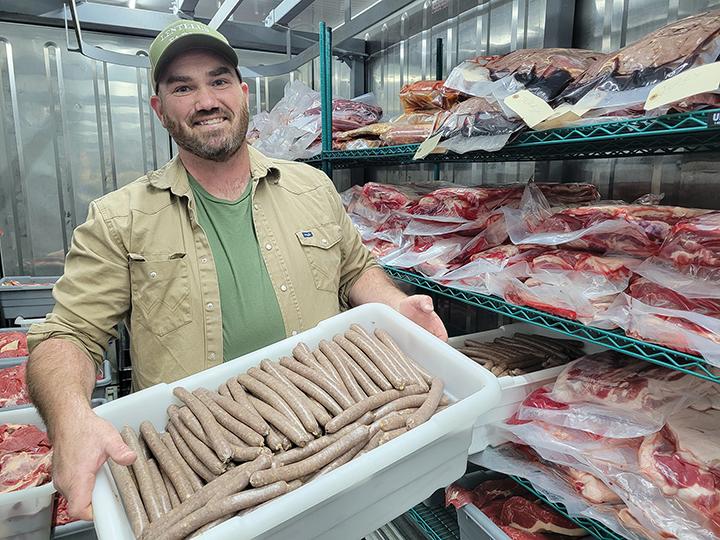
Dave Semmelink has added meat processing to his agriculture businesses, bringing a Kelowna abattoir back on stream and expanding since 2021. MYRNA STARK LEADER

May 1, 2025 byMyrna Stark Leader

KELOWNA – A Vancouver Island farmer has reactivated and expanded a Kelowna abattoir, providing processing to about 80 farmers.

“I’ve processed hogs and lambs from 100 Mile (and) Vanderhoof, so people need the services, but about 80% of my customers are within an hour,” says operator Dave Semmelink, who opened Creekside Meats in 2021 to process beef, pork, poultry and sheep.

The venture is Semmelink’s second agricultural initiative. The South African-born farmer started Lentelus Farms in Courtenay in 2014, growing vegetables, beef, some grain and forage. Most of the produce is sold at his popular roadside farmstand in Courtenay.

Semmelink made the leap to Kelowna in 2021, signing a 15-year lease for the Kelowna abattoir shortly after former owner Sue Haley gifted the 36-acre property where it’s located to the Okanagan Tree Fruit Project, a registered charity focused on food rescue and food security.

The lease term is long enough for him to justify the significant capital investment needed to operate the facility, formerly operated by Kevin Morin of Kelowna Free Graze Lamb.

Semmelink recognized the continuing demand among meat producers for slaughter capacity and the rising interest in local meat. Family ties in Kelowna – his father is a former vineyard manager at Summerhill Pyramid Winery – also made the location attractive.

Semmelink has expanded the abattoir and added new equipment, retrofitting three shipping containers for processing and cold storage. The improvements were supported by a private investor in Vancouver.

“We added to the facility little by little as demand grew – beef processing, pork processing and substantially increasing capacity for chicken and lamb,” he explains. “We‘re capable of processing several hundred lamb a year, 200 beef and a couple hundred pigs. Plus, we regularly process larger quantities of chicken; 600 is a typical day.”

Six full-time staff work four days a week, with six more on-call as needed.

Staff have included graduates of an eight-week hands-on, humane meat processing program he taught at the abattoir in summer 2024 for eight students. Semmelink completed a similar course a decade ago through BC Meats at Gunter Brothers Meats on Vancouver Island. It sparked him to move from livestock farmer to processor.

Semmelink’s course taught low-stress livestock handling, ethical slaughter procedures, whole carcass breakdown and custom meat cutting, packaging and safety. Students also learned value-added techniques like sausage and bacon-making, and how to manage a small-scale operation.

He’s taught similar courses funded by WorkBC’s Community Work Force Response Grant in Port Alberni and Campbell River, the latter offered in conjunction with North Island College.

Semmelink says creativity is essential to farming in BC without inherited land. He began with a $50,000 student loan and has relied on side hustles, grants and government support to develop his businesses.

“We’ve been recipient of several grants – the meat processing facilities specifically,” he says. “A $150,000 IAF grant from the Small Food Processor Scale-Up Program was instrumental for scaling up last year, helping add three full-time staff.”

Growing capacity

For smaller cattle producers like Kevin Day, Creekside Meats fills a gap left following the retirement of Dave Marshall, who operated an abattoir at Longhorn Farms near the Kelowna International Airport.

“Having a provincially inspected facility located right here in Kelowna is a godsend,” says Day. “It allows me to finish beef for my family and friends and also lets me consider expanding my business to finishing all of my calves from my 50-cow herd for direct sales here.”

In October, Creekside began working with Toronto-based distributor Niku Farms, aggregating meat from local farmers and ranchers. By aggregating local production, Semmelink sees opportunities to support smaller operators’ growth and profitability.

A member of BC Meats and the Small-Scale Meat Producers Association, Semmelink believes a fresh surge of interest in local purchasing in response to US trade tensions could translate into a greater boost for locally grown food.

Semmelink plans to hand day-to-day management of the Kelowna abattoir to shop manager Sam Munns. Originally from England, Munns helped build the business from the ground up, collaborating with Semmelink for three years.

The transition will allow Semmelink to spend more time at his home farm in Courtenay, where he hopes to establish a provincially inspected abattoir on the Island for a select group of local poultry growers to supply his meat box subscription program.

Ideally, Creekside would process red meat, beef, lamb and pork, with Okanagan chickens processed perhaps by another student thinking of starting a poultry abattoir in Kelowna.

Semmelink notes that shorter courses give students a quicker way to learn the trade and gain employment. He’d gladly hire someone with 20 years of experience if he could find them. Without the overhead of a mortgage payment, he pays employees above industry average, but the cost of housing makes worker retention a challenge.

“If I could offer accommodation, I would probably be able to hire more staff. But since I lease, I can’t justify building housing on the farm for employees,” says Semmelink.

While he sees further potential in value-added processing down the line – things like dry-curing meat for charcuterie – perhaps supplying local businesses like wineries to create higher meat demand and jobs, Creekside Meats is a humane slaughter plant first.

“My Vancouver business partner and I both see meat processing as essential to farming,” he says. “If we could operate five days a week and supply more meat cutting shops, we’d be super happy.”

Related Posts

You may be interested in these posts from the same category.

Previous Post: « Arts leads BCFGA forward
Next Post: Driediger Farms for sale »

Copyright © 2026 Country Life in BC · All Rights Reserved