• Menu
  • Skip to primary navigation
  • Skip to main content
  • Skip to primary sidebar

Country Life In BC Logo

The agricultural news source in British Columbia since 1915

  • Headlines
  • Calendar
  • Subscribe
  • Advertise
  • About
  • Archives
  • Contact
  • Search
  • Cart
  • Checkout
  • Headlines
  • Calendar
  • Subscribe
  • Advertise
  • About
  • Archives
  • Contact
  • Search
  • Cart
  • Checkout

Primary Sidebar

Current Issue:

AUGUST 2026
Vol. 112 Issue 8

Subscribe Now!

Sign up for free weekly FARM NEWS UPDATES

Loading form…

Your information will not be
shared or sold ever

Follow us on Facebook

Comments Box SVG iconsUsed for the like, share, comment, and reaction icons

16 hours ago

The province has just issued a new temporary protection order for the Salmon River, effective immediately, restricting irrigation water for forage crops such as hay, alfalfa, and corn. A previous order was issued on July 28 and rescinded on August 8 due to wildfire risk, but low stream flows persist, threatening over 200 spawning Chinook salmon in the watershed. Affected licence holders will be contacted directly. Drought support is available to farmers through the Ministry of Agriculture and Food. The province has invested $120 million in the Agriculture Water Infrastructure Program to support farmers facing water scarcity.

#BCAg
... See MoreSee Less

The province has just issued a new temporary protection order for the Salmon River, effective immediately, restricting irrigation water for forage crops such as hay, alfalfa, and corn. A previous order was issued on July 28 and rescinded on August 8 due to wildfire risk, but low stream flows persist, threatening over 200 spawning Chinook salmon in the watershed. Affected licence holders will be contacted directly. Drought support is available to farmers through the Ministry of Agriculture and Food. The province has invested $120 million in the Agriculture Water Infrastructure Program to support farmers facing water scarcity.

#BCAg
View Comments
  • Likes: 9
  • Shares: 7
  • Comments: 2

Comment on Facebook

200 fish over all the feed that grows in this valley wow that some expensive fish

Get your water off fly hills two big lakes off there Spa and author

3 days ago

Kwantlen Polytechnic University has established a one-acre research hopyard at Molson Coors' Chilliwack plant, housing 10 experimental selections and 40 heritage varieties. The multi-year partnership supports new hop variety development and breeding decisions for BC growers, building on Chilliwack's history as Canada's former largest hop-producing region. www.countrylifeinbc.com/kpu-sets-up-rese#BCAgh#kwantlenpolytechnicuniversityc#MolsonCoorsty #MolsonCoors ... See MoreSee Less

Kwantlen Polytechnic University has established a one-acre research hopyard at Molson Coors Chilliwack plant, housing 10 experimental selections and 40 heritage varieties. The multi-year partnership supports new hop variety development and breeding decisions for BC growers, building on Chilliwacks history as Canadas former largest hop-producing region. https://www.countrylifeinbc.com/kpu-sets-up-research-hopyard/

#BCAg #kwantlenpolytechnicuniversity #MolsonCoors
View Comments
  • Likes: 23
  • Shares: 2
  • Comments: 1

Comment on Facebook

What is old is new again in Chilliwack.

6 days ago

Complex, curious and compassionate, and above all a contributor to his family, his community and the dairy industry is how family, friends and colleagues remembered Dave Janssens this morning at a memorial service in Surrey following his untimely passing July 21 while cycling through the Peace region. A standing-room-only congregation attended as Janssens' life and decades of service were honoured. An elected member of both the BC Milk Marketing Board and the BC Dairy Association, Janssens represented the industry at the provincial and national level and was recognized for his clear thinking and willingness to entertain diverse perspectives. He retired last year following six years as a director of the BC Milk Marketing Board. His absence from industry discussions will be miss#BCAg##BCDairyDairy ... See MoreSee Less

Complex, curious and compassionate, and above all a contributor to his family, his community and the dairy industry is how family, friends and colleagues remembered Dave Janssens this morning at a memorial service in Surrey following his untimely passing July 21 while cycling through the Peace region. A standing-room-only congregation attended as Janssens  life and decades of service were honoured. An elected member of both the BC Milk Marketing Board and the BC Dairy Association, Janssens represented the industry at the provincial and national level and was recognized for his clear thinking and willingness to entertain diverse perspectives. He retired last year following six years as a director of the BC Milk Marketing Board. His absence from industry discussions will be missed.

#BCAg #BCDairy
View Comments
  • Likes: 27
  • Shares: 0
  • Comments: 2

Comment on Facebook

Our Sincere Condolences to the family and all who had the pleasure of knowing David, he left his mark, Rest in Peace David 🙏🏼

A significant contributor in so many ways, sorry for your loss!

1 week ago

The committee of MLAs charged with setting priorities for the next provincial budget is recommending regular, annual funding for water storage infrastructure associated with food production, including for engineering inspections, maintenance and upgrades. The recommendation builds on the BC Cattlemen's Association's recommendation of an annual allocation of $5 million for water storage infrastructure related to food production, noting that it could also support resilience in the face of climate-related events. While the province has allocated $120 million for agricultural water infrastructure, agriculture minister Lana Popham told Country Life in BC this week that other ministries and the federal government will need to be involved in funding future p#BCAgts#BCAgCAg

#BCAg
... See MoreSee Less

The committee of MLAs charged with setting priorities for the next provincial budget is recommending regular, annual funding for water storage infrastructure associated with food production, including for engineering inspections, maintenance and upgrades. The recommendation builds on the BC Cattlemens Associations recommendation of an annual allocation of $5 million for water storage infrastructure related to food production, noting that it could also support resilience in the face of climate-related events. While the province has allocated $120 million for agricultural water infrastructure, agriculture minister Lana Popham told Country Life in BC this week that other ministries and the federal government will need to be involved in funding future projects.

#BCAg

#BCAg
View Comments
  • Likes: 32
  • Shares: 17
  • Comments: 4

Comment on Facebook

A typical small-to-medium farming operation featuring a house, main barn, and machine shed generally has around 8,000 to 12,000 square feet of total roof surface. The Okanagan Valley is one of the driest regions in Canada, averaging roughly 300 millimetres (11.8 inches) of annual precipitation. Storing a full year's collected rainwater from those roofs yields roughly 262,500 litres. In the three regional districts that make up the Okanagan valley proper (North Okanagan, Central Okanagan, and Okanagan-Similkameen), the 2021 Statistics Canada Census of Agriculture records roughly 3,100 total farms. Multiply that number by 262,500 litres of harvested rainwater equals 813.75 million litres of water saved per year. Capturing that volume of water across every farm roof in the region would significantly ease peak summer pumping pressure on local groundwater aquifers and Okanagan Lake.

Fantastic!! We will work hard to be involved and do what we can as well as a collective group on the Salmon River!

Absolutely! Long over due and very welcomed. Let's make this happen.

It isn't enough that cattle open graze on crown land now govt to create water storage, come on cattle ranchers enough subsidizing for a resource half of us can't afford to consume

1 week ago

... See MoreSee Less

View Comments
  • Likes: 2
  • Shares: 0
  • Comments: 0

Comment on Facebook

Subscribe | Advertise

The agricultural news source in British Columbia since 1915
  • Email
  • Facebook

Langley logs Asian hornet

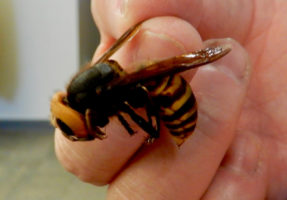
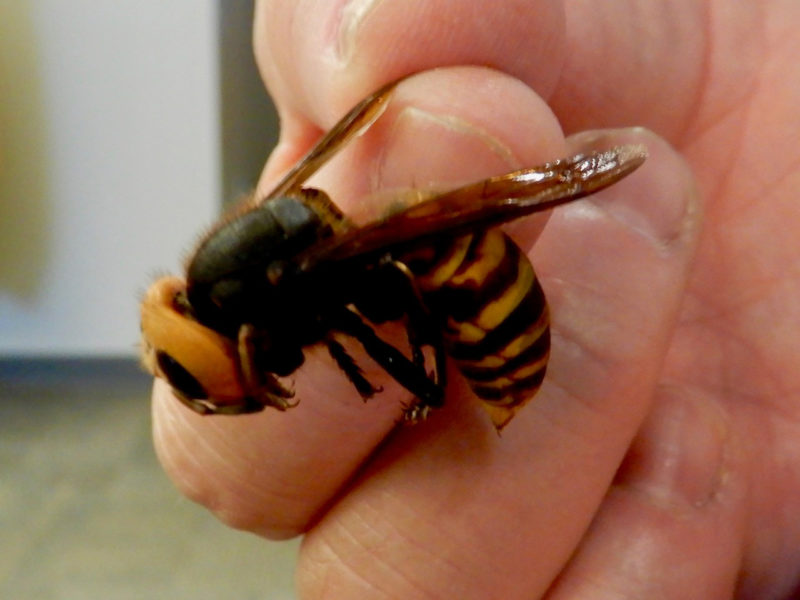
Asian Giant Hornet
PHOTO / Paul van Westendorp

November 3, 2021 byPeter Mitham

Canadian Food Inspection Agency staff made an unexpected discovery October 22 while performing a routine monthly check of a trap set to monitor for Japanese beetle in south Langley.

The decaying body of an Asian giant hornet lay within, the first confirmed report of one of the insects this year in Canada. Since no hornets were found in adjacent traps, all signs point to the individual being an interloper that flew north from Whatcom County.

Provincial apiculturist Paul van Westendorp told the BC Honey Producers Association annual meeting on October 29 that genetic tests are taking place to confirm the hornet’s connection to the four colonies Washington State Department of Agriculture staff have eradicated over the past year.

“It is probably highly likely that it all comes from the same stock as all these four nests had similarity, or relatedness,” he said. “It meant all of those came from one single introduction. This is hopeful.”

Van Westendorp said the close relationships between the hornets makes for a shallower gene pool that reduces the viability of future matings.

The latest discovery, near 216 Street and 3 Avenue, was just 1,200 metres north of where a WSDA team destroyed a nest at the end of August. WSDA destroyed two more nests in September, one of which was just 400 metres from the international boundary.

Researchers do not know how long the hornets have been present in the area. Langley beekeepers voiced concerns about the insect as early as 2018, but the first confirmed report of giant hornets in the province came in 2019. Sightings were confirmed that summer around Burrard Inlet and a nest was destroyed in September 2019 in Nanaimo.

The past two years have seen monitoring continue on Vancouver Island and in the Fraser Valley.

Asian giant hornets can measure up to 5 cm in length and appear to prefer hollow deciduous trees as nesting sites. They’re most active in the fall as they seek out animal protein in the run-up to winter. Honey bees are among the hornet’s targets; an attack can wipe out a colony in hours.

BC and Washington will continue surveillance programs pending eradication of the pest. Washington has engaged the public in its monitoring efforts, with all 31 reports last year coming from citizen scientists. Surveillance in BC is conducted by the province in partnership with local beekeepers, but similar to Washington, all six confirmed reports in BC last year were filed by the general public rather than government or beekeepers.


All content on this website is copyrighted, and cannot be republished or reproduced without permission.
Related Posts

You may be interested in these posts from the same category.

Bee

Province appoints new apiculturist

Contracts cancelled for beekeepers

Bee losses significant but not extreme

Apiarists fear heavy winter losses

Asian Giant Hornet

BC watches Stateside hornets

Canada holds off Asian giant hornet restrictions

Beekeepers suffer colony losses

Asian Giant Hornet

Hornet surveillance plans outlined

Beekeepers Zoom for 100th AGM

BC beekeepers go online

Asian Giant Hornet

Hornet catch has beekeepers vigilant

Bee replacements grounded

Previous Post: « Quick action on allegations
Next Post: Grading standards shorten cucumbers »

© 2026 COUNTRY LIFE IN BC - ALL RIGHTS RESERVED