
• Menu
  • Skip to primary navigation
  • Skip to main content
  • Skip to primary sidebar

Country Life In BC Logo

The agricultural news source in British Columbia since 1915

  • Headlines
  • Calendar
  • Subscribe
  • Advertise
  • About
  • Archives
  • Contact
  • Search
  • Headlines
  • Calendar
  • Subscribe
  • Advertise
  • About
  • Archives
  • Contact
  • Search

Primary Sidebar

Originally published:

February 2019
Vol. 105 Issue 2

Subscribe Now!

Sign up for free weekly FARM NEWS UPDATES

Loading form…

Your information will not be
shared or sold ever

Stories In This Edition

Joy Ride!

Critics urge licence delay

ALR committee files report

Cannabis drives drop in Delta farm assessments

Editorial: Party and province

Back Forty: You can’t get apps on that

Viewpoint: Annual assessments a chance to take stock

Staff reorganization targets leaner fruit co-op

Preliminary hearing in high-profile poultry abuse

Growers pin hopes on Columbia River update

Survey keeps national park reserve in spotlight

Political engagement headlines dairy meeting

World milk prices take blame for shifting returns

Patience is a virtue

Ag Briefs: Sasaki appointed new head of chicken board

Ag Briefs: Ottawa invests in dairy sector

AB: Piece rates, taxes increase

AB: AITC focuses on growth

Capital Region considers compensation cuts

Letters: Protect farmland from cannabis production

Letters: Dog owners need to accept responsibility

Letters: The beef about climate change

Cadillac’ of aviaries will reduce labour costs

Berry growers face new import requirements

Open house reveals secrets of diagnostics lab

Cannabis propagation industry sprouting in BC

Sidebar: Deep roots

FCC targets women with new business program

Agreement sets stage for fish farm phase-out

Grazing, forage and water top list at town hall

Ranchers reassured regarding bovine TB cases

Digging into soil nutrition at education day

Microgreen grower attracts far-flung following

Science of cannabis takes centre stage

Blueberry growers hone use of box liners

Ostrich industry takes flight with big plans

Tunnels boost fruit quality, add to berry season

Big bucks being spent to protect bee health

Sidebar: Province boosts funding

Mystery bee disease studied

Direct-marketing opportunities have potential

Research: Preventing soft scald in apples

Regional food system is the new focus of group’s efforts

Wannabe: Growers deserve our love

Woodshed: A performance Kenneth can’t afford to miss

Jude’s Kitchen: Happy new year, my sweet Valentine

All content on this website is copyrighted, and cannot be republished or reproduced without permission.

More Headlines

Follow us on Facebook

Comments Box SVG iconsUsed for the like, share, comment, and reaction icons

2 days ago

A draft update to the Code of Practice for the Care and Handling of Beef Cattle is now open for public comment until June 12. The code, one of 14 animal care codes developed and maintained by the National Farm Animal Care Council, is undergoing a routine 10-year review. "Your feedback will help shape the industry's guide to cattle welfare for the next decade," says Canadian Cattle Association policy manager Jessica Radau, urging producers to weigh in. For more information, visit tinyurl.com/58a3u9fz.

#BCAg
... See MoreSee Less

A draft update to the Code of Practice for the Care and Handling of Beef Cattle is now open for public comment until June 12. The code, one of 14 animal care codes developed and maintained by the National Farm Animal Care Council, is undergoing a routine 10-year review.  Your feedback will help shape the industrys guide to cattle welfare for the next decade, says Canadian Cattle Association policy manager Jessica Radau, urging producers to weigh in. For more information, visit https://tinyurl.com/58a3u9fz.

#BCAg
View Comments
  • Likes: 4
  • Shares: 2
  • Comments: 1

Comment on Facebook

I sat in the webinar yesterday by the Canadian Cattle Association. My initial concern was that this would be another "play" into the government's hands. It has been worked on by people that are actually in the Beef industry from Cow calf to feedlot. The thrust is an update of the 2013 Code of Practice which was reviewed in 2018. The changes are more a move from "left to the producers discretion" to clearer directions regarding pain management, proper transport of animals which are impaired and keeping cattle in in good condition. Much of what is recommended is what producers who care about animal husbandry already do. The important part is to GIVE THEM FEEDBACK good, bad or otherwise. The document is about 60 pages long, and I ran it through CHAT to see what had been changed. It is important to understand that the PUBLIC is invited to comment on the draft not just producers. Think about it... do you really want the public influencing how you manage your cattle. If you think that this is just one of those things, I have been following Bill 22 in Alberta which will grant the SPCA a proactive roll in entering farms and checking on animals. When I asked CHAT how the new bill relates to the Cattle Code, it came back that the Code although not a regulation will be able to be used as a guide by producers for backup in dealing with the SPCA regarding cattle conditions, sick animal handling etc. Take the time.... Go onto the Canadian Cattle Association website and speak to those parts that you wish to input.

3 days ago

According to the BC River Forecast Centre, the Okanagan snowpack stood at just 58% of normal on April 1 — the lowest reading since measurements began in 1980 — raising concerns about drought conditions in the region this summer. The rest of the province sits at 92% of normal.

#BCAg
... See MoreSee Less

According to the BC River Forecast Centre, the Okanagan snowpack stood at just 58% of normal on April 1 — the lowest reading since measurements began in 1980 — raising concerns about drought conditions in the region this summer. The rest of the province sits at 92% of normal.

#BCAg
View Comments
  • Likes: 3
  • Shares: 0
  • Comments: 0

Comment on Facebook

4 days ago

At her first AGM as executive director of BC Meats, held Saturday in Abbotsford, Jennifer Busmann spoke about her strong ties to agriculture and her optimism for the organization's future. Busmann has cattle of her own and came to the role with existing relationships with members and the board of directors that helped her feel integrated from the start. She stepped into the position in Februa#BCAg#BCAg ... See MoreSee Less

At her first AGM as executive director of BC Meats, held Saturday in Abbotsford, Jennifer Busmann spoke about her strong ties to agriculture and her optimism for the organizations future. Busmann has cattle of her own and came to the role with existing relationships with members and the board of directors that helped her feel integrated from the start. She stepped into the position in February.

#BCAg
View Comments
  • Likes: 6
  • Shares: 0
  • Comments: 0

Comment on Facebook

6 days ago

Shannon Wiggins of Headwind Farm in North Saanich is this year's Mary Forstbauer Grant recipient from the BC Association of Farmers Markets. The $500 grant will help Wiggins expand her plot at Sandown Centre for Regenerative Agriculture, growing more storage crops to extend her harvest season. Wiggins credits farmers markets with inspiring her own farming journey and commitment to building community through food. Congratulations!

tinyurl.com/45bdd#BCAg#BCAg
... See MoreSee Less

Shannon Wiggins of Headwind Farm in North Saanich is this years Mary Forstbauer Grant recipient from the BC Association of Farmers Markets. The $500 grant will help Wiggins expand her plot at Sandown Centre for Regenerative Agriculture, growing more storage crops to extend her harvest season. Wiggins credits farmers markets with inspiring her own farming journey and commitment to building community through food. Congratulations!

https://tinyurl.com/45bddtw8

#BCAg
View Comments
  • Likes: 50
  • Shares: 2
  • Comments: 3

Comment on Facebook

Wahoo! Congrats Shannon! I love your produce. Can’t wait for the radishes 🫜

Congratulations!

Well done!! 🩷🩷🩷

1 week ago

New farmers can avoid costly mistakes by learning from those who've been there. At a Young Agrarians mixer in Penticton, five BC farmers shared hard-won lessons on pricing, pivoting, relationships and burnout. From coyote losses to business burnout, their message was clear: set prices that reflect true costs, make decisions quickly and don't let farming define your worth. Myrna Stark Leader's story appears in our April e-edition, now available to view online at: tinyurl#BCAg2uw53vvm

#BCAg
... See MoreSee Less

New farmers can avoid costly mistakes by learning from those whove been there. At a Young Agrarians mixer in Penticton, five BC farmers shared hard-won lessons on pricing, pivoting, relationships and burnout. From coyote losses to business burnout, their message was clear: set prices that reflect true costs, make decisions quickly and dont let farming define your worth. Myrna Stark Leaders story appears in our April e-edition, now available to view online at: https://tinyurl.com/2uw53vvm

#BCAg
View Comments
  • Likes: 15
  • Shares: 0
  • Comments: 0

Comment on Facebook

Subscribe | Advertise

The agricultural news source in British Columbia since 1915
  • Email
  • Facebook

Microgreen grower attracts far-flung following

Salmon Arm hydroponic grower harvests sales in Calgary

January 29, 2019 byJackie Pearase

SALMON ARM – A different kind of hydroponic grow-op has set up shop in the Shuswap, looking to meet the demand for leafy greens.

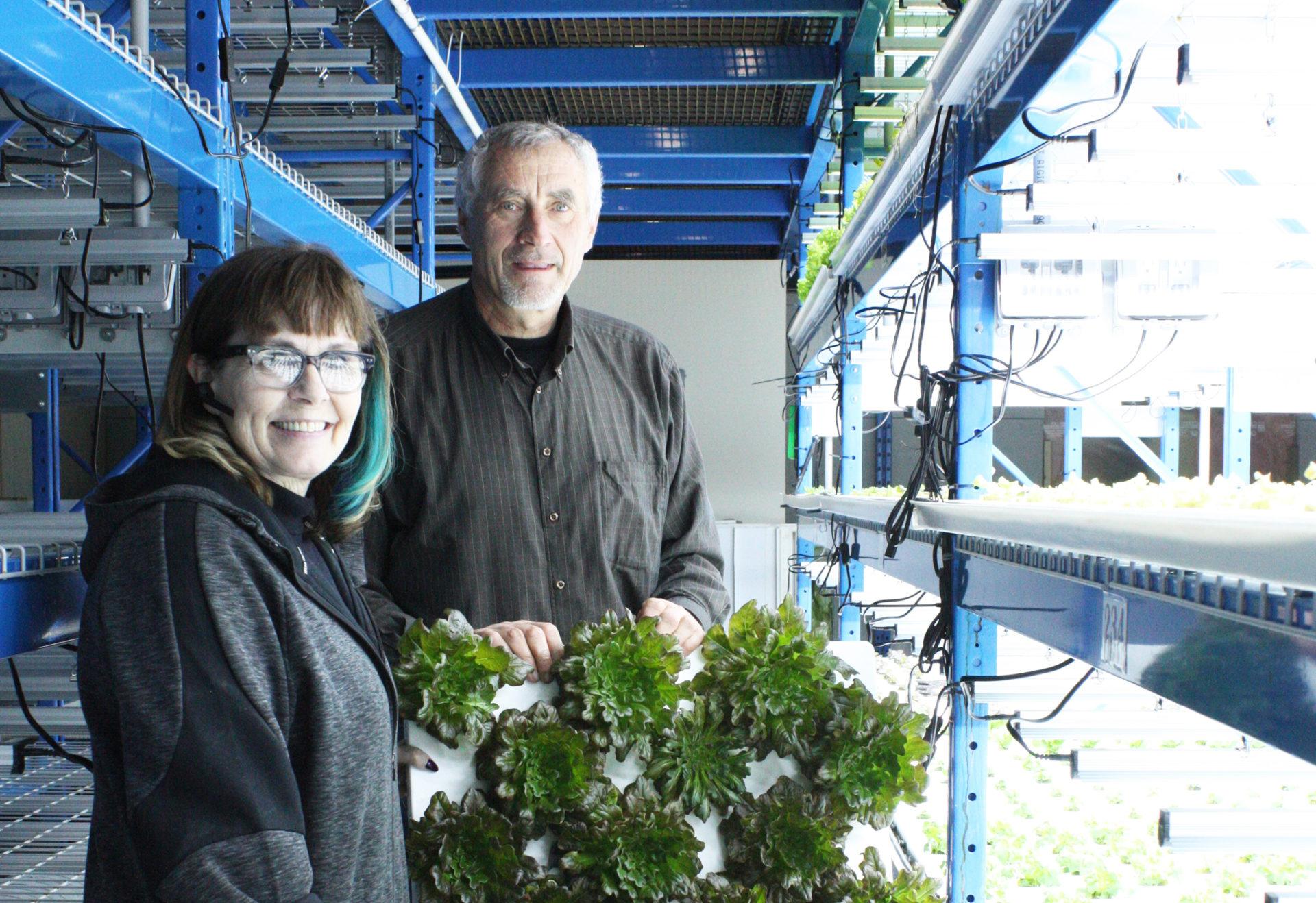
Living Leaf Growers started producing microgreens in a corner of Salmon Arm’s Westgate Public Market late last year, planting its first crop in October and harvesting its third in early January.

The 2,500-square-foot space has four sections, each with seven rows of hydroponic growing rafts reaching to the ceiling. Owner Karen Dow expects to have 28,000 plugs of produce – arugula, cabbage, kale, pea shoots, basil, lettuces and more – growing when the facility is fully operational.

“We’re hoping within two to three months we’ll be at full capacity for harvesting upstairs and down,” says Dow. “When the full system is going, we’ll be harvesting 7,000 heads of produce a week.”

In addition, PVC piping along one wall is ready to receive 700 ever-bearing strawberry plants set to arrive in March.

Growth has been steady. The first planting resulted in nearly 50 bags of microgreens, and the second crop yielded 80. Dow and a crew of three picked another 130 bags in January.

Dow is an accomplished businesswoman, but has no gardening experience. She hired Wolf Wesle from Green Croft Gardens in Grindrod to help with the initial set-up and deal with the inevitable snags along the way, like a leaky raft system.

“We have to go to a different raft system, which is really what we should have done from the beginning. That was a mistake but that’s all part of it,” she says. “So, yeah, we’ve had a lot of challenges in there, but they’re fun.”

Wesle combines formal training in hydroponics with more than three decades of hands-on organic experience in his consulting work for Dow.

He is now installing a more eco-friendly channel system to replace the styrofoam rafts for growing, and hemp plugs are replacing Rockwool for starting seedlings. The microgreens themselves are grown on fully biodegradable hemp matts.

Organic seeds, fertilizers and disease and pest management practices are used as much as possible. In fact, small plastic-covered jars containing apple cider vinegar is a simple and common pest control method.

Wesle says adding an organic fertilizer to the mix caused issues that required some trial and error to resolve but has resulted in better colour and texture.

Wesle’s experience tells him there will be a few more issues to deal with before things are running smoothly.

“We currently operate at about 15% capacity but hope to have all kinks ironed out over the next six to 12 months,” he says.

Wesle has agreed to stay on until his farm’s growing season starts in April, and he’ll likely continue as a part-time consultant as required.

Dow sold her initial crops at $1 per bag to people registered through Westgate’s website. Customers provided valuable feedback.

Trials are also helping determine the best crops to grow for the bags of microgreens and mixed lettuce she’s selling.

Dow says she will have no problem selling the produce, with interest already coming from food delivery services in Kelowna, Vernon, Kamloops and even Calgary.

“They like the produce because it’s year-round, it’s organic, it’s fresh; we cut it, you get it,” she notes.

Dow is mulling other options for commercial sales locally but is leaning toward keeping it unique to the Salmon Arm market.

“Right now I’m on the fence about whether I sell to Askew’s and DeMille’s and everybody,” she says mentioning a popular local grocer and farm market.

The hydroponic produce is grown with few inputs but doesn’t qualify for organic certification, which is limited to soil-based production systems. Dow would like to see organic certification criteria amended to accommodate hydroponics.

“I think you’ll see in the next year or two a big change with how hydroponics is accepted,” she says. “It’s a battle coming down and we’d definitely jump on the train on that one.”


All content on this website is copyrighted, and cannot be republished or reproduced without permission.

Related Posts

You may be interested in these posts from the same category.

Previous Post: « It’s show time!
Next Post: Capital Region considers compensation cuts »
© 2026 COUNTRY LIFE IN BC - ALL RIGHTS RESERVED