• Menu
  • Skip to primary navigation
  • Skip to main content
  • Skip to primary sidebar

Country Life In BC Logo

The agricultural news source in British Columbia since 1915

  • Headlines
  • Calendar
  • Subscribe
  • Advertise
  • About
  • Archives
  • Contact
  • Search
  • Headlines
  • Calendar
  • Subscribe
  • Advertise
  • About
  • Archives
  • Contact
  • Search

Primary Sidebar

Originally published:

APRIL 2025
Vol. 111 Issue 3

Subscribe Now!

Sign up for free weekly FARM NEWS UPDATES

Loading form…

Your information will not be
shared or sold ever

Stories In This Edition

Standing her ground

Minister endorses farmland loss

BC ag funding hits record level

Okanagan drives increase in land values

Editorial: Choosing engagement

Back 40: Trade war claims lack economic reality

Viewpoint: Tried of the to and fro of the tariff foe?

Popham fields questions at town hall

Fruit growers find strength in united front

Sidebar: Tesche quits

BC research leading way on avian influenza

Ag Briefs: Premier’s task force members announced

Ag Briefs: Carbon tax under fire

Cuthberts win Outstanding Young Farmers award

BC delegation urges  review of foreign ownership

Alliance strengthens Westgen’s bottom line

Major BC Tree fruit Co-op asset changes hands

Elbows up

Island farmers insitutes garner local support

Potato processors hold key to tariffs

Tech solutions highlight packed hort show

BC-bed apple set to fill market niche in 2026

Cherry growers optimistic after tough years

Local bylaw will increase access to farmland

Sidebar: First of its kind

Drone technology takes flight on BC farms

Sidebar: Okanagan pilot project heads off problems

Tech investments transform BC farm operations

Ranchers cry foul over green energy projects

Top bull

Ranchers oppose plans for solar energy project

Johne’s disease management critical for sheep

Food Shed gets $1 million for distribution

Market farm works smarter, not harder

Digging deep into soil amendments

Farm Story: Spring thaw unveils winter’s secrets

Berry farm goes soil-free for strawberries

Woodshed: Rocket’s revenge makes a cowboy out of Kenneth

Comox Valley sweeps farmers market awards

Jude’s Kitchen: Cooking Canadian is not a problem

More Headlines

Follow us on Facebook

Comments Box SVG iconsUsed for the like, share, comment, and reaction icons

5 days ago

A BC Forest Practices Board investigation has found overgrazing has damaged grasslands in the Coutlee Range Unit near Merritt — and the range-use plan meant to prevent it was unenforceable. With complaints about overgrazing on the rise and grasslands covering just 1% of BC's land mass, the findings raise fresh questions about how the province manages one of its most vulnerable — and valuable — food-producing ecosyste#BCAg#BCAg ... See MoreSee Less

Link thumbnail

Board finds overgrazing rules unenforceable unmeasurable

www.countrylifeinbc.com

MERRITT – A BC Forest Practices Board investigation has found instances of non-compliance related to overgrazing have damaged open grasslands in the Mine pasture, part of the Coutlee Range Unit near...
View Comments
  • Likes: 6
  • Shares: 6
  • Comments: 6

Comment on Facebook

Several ranchers in recent years have gone into temporary non use on that range , so that means the grass should grow. But drought conditions/lack of rain and snow don’t allow that to happen . Dried up springs , creeks waterholes in various pastures add to over grazing where there is water , as livestock and everything else stay close to the water source . So even though less cattle are on it , over grazing appears. There is a large volume of horses on it 365 days/year which is wrong ! They pull grass right out of the ground when it’s just trying to grow ,, opens the door for weeds to grow in. That don’t help it. Aging infrastructure ( fences) laying on the ground, pipe line building , ( lack of commitment to fence maintenance) amongst all users contributes also to over grazing. Recreational atv users leaving gates open between pastures allows livestock to go back or ahead in pastures also expidites over grazing. Logging ( bcts) has no problem laying out cut locks on both sides of a fence , then it gets smashed down during logging and they don’t take responsibility to stand it back up or clean the cattle gaurds out when they are done , that happened 4 years ago on pasture 5 up there . I bet it is still not fixed . There are lots of contributing factors to the problem.

Tragedy of the commons.

I looked through the report. I saw nothing about the effects of noxious weeds on productive grasslands. This particular area is vulnerable because of the Ministry’a efforts to diversify the use of the Grasslands.

This pasture is under tremendous pressure not only from cattle but from irresponsible local residents who treat it as a landfill dumping all manner of household debris here. And don't even get me started on the mud bogging and camping in sensitive riparian areas. The feral horses are in this pasture 365 days a year just hammering it. Would sure be nice to see some enforcement action on people who are intentionally ripping up the grasslands and riparian areas. Cattle could be a valuable resource for rebuilding soils and native grasses in this area with the help of electric fencing and/or e-collars. The humans will be harder to manage.

The Forest and Range Practices Act was written by lawyers for global forest licencee shareholders. Results-based = unenforceable.

Also, can we talk about the impact of a pipeline being built through the middle of this field for multiple years?

View more comments

1 week ago

East Kootenay rancher Randy Reay is digging a new well after two natural water sources dried up on his Crown tenures. A new Living Lakes Canada assessment found 15% of mapped aquifers in the region are high-priority for monitoring, yet 80% of those go unmonitored. With over 48% of BC's provincial observation wells reporting below-normal groundwater levels, ranchers and researchers are sounding the alarm on water security. The story is in our March edition, and we've posted it to our website thi#BCAgk.

#BCAg
... See MoreSee Less

Link thumbnail

Water woes: groundwater under pressure across BC

www.countrylifeinbc.com

JAFFRAY – As a young boy growing up in the Kootenay-Boundary region, Randy Reay never expected to run out of water. But this year, in mid-February, his fields are bare. There is no snow halfway up t...
View Comments
  • Likes: 8
  • Shares: 7
  • Comments: 1

Comment on Facebook

Jaffrey is in the east Kootenays not kooteney boundary

2 weeks ago

BC farmers are bracing for prolonged higher input costs as war in the Middle East drives up fuel and fertilizer prices. Nitrogen fertilizer costs were already climbing before the Iran conflict began, with prices still roughly 60% above pre-pandemic levels. Farm Credit Canada warns that unlike 2022, strong commodity prices may not offset rising costs this time. Local suppliers expect supply challenges and further price increases ahead.

#BCAg
... See MoreSee Less

Link thumbnail

Fertilizer prices on the rise

www.countrylifeinbc.com

War in the Middle East has delivered a generational shock to energy prices, meaning BC farmers can expect a prolonged period of higher costs not just for fuel but also for fertilizer.
View Comments
  • Likes: 2
  • Shares: 1
  • Comments: 0

Comment on Facebook

2 weeks ago

... See MoreSee Less

View Comments
  • Likes: 1
  • Shares: 0
  • Comments: 0

Comment on Facebook

2 weeks ago

Cameron Stockdale is the new executive director of provincial farm safety organization AgSafeBC. Find out more in this week's Farm News Update from Country Life in B#BCAg#BCAg ... See MoreSee Less

Link thumbnail

New leadership at AgSafe BC

www.countrylifeinbc.com

Cameron Stockdale is the new executive director of provincial farm safety organization AgSafeBC, succeeding Wendy Bennett. Bennett left AgSafeBC in September 2025, following 12 years with the…
View Comments
  • Likes: 5
  • Shares: 1
  • Comments: 0

Comment on Facebook

Subscribe | Advertise

The agricultural news source in British Columbia since 1915
  • Email
  • Facebook

Okanagan drives increase in land values

Values rebound, driven primarily by smaller acreages

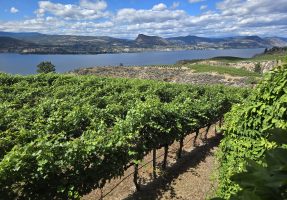
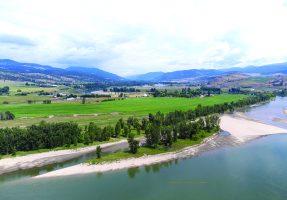
Gains in farmland values in 2024 were mostly realized in the Okanagan, according to Farm Credit Canada's annual survey of farmland prices. Photo | Myrna Stark Leader

March 26, 2025 byPeter Mitham

KELOWNA – BC farmland values rose 11% last year, firmly reversing the decline posted in 2023.

The gains were driven in large part by the Okanagan, according to Farm Credit Canada’s annual survey of farmland values. Prices there soared nearly 25% to an average of $40,500 an acre, with sales tracked by FCC maxing out at $120,000 an acre.

“It’s always the case that location matters, but I would say location matters a great, great deal in BC more so than anywhere else,” says JP Gervais, chief economist at  Farm Credit Canada.

While the region saw many orchard operations under pressure from extreme weather and low crop prices, Gervais said the data speaks for itself in terms of what was driving values last year.

“The numbers are driven, obviously, by the Okanagan,” he says.

Properties in the Peace ranked second in growth, with values rising 16% off a low base to $2,400 an acre, the lowest of any region in the province.

Values in the South Coast held steady, rising less than 1% to an average of $113,000 an acre, having borne the brunt of declines in last year’s survey with a 19% decline that made local farmland among the region’s worst-performing real estate.

Kootenay farmland fared the worst last year, with values dropping 11% to $21,500 an acre.

The decline reflected a broader malaise affecting the market last year, with overall market activity falling and many properties sitting on the market for longer.

This was the case in both the Okanagan, despite its strong performance, as well as the South Coast, where high values continue to put land out of reach of many buyers.

“Sales activity increased in early 2024 but slowed again in the latter half of the year. Listings sat longer with some sellers holding firm, still expecting to receive peak market values,” FCC said of the Okanagan, with a similar trend seen in certain areas of the Lower Mainland.

Nevertheless, falling interest rates last year also prompted some owners to bring properties forward.

“Demand for farmland near urban areas remained strong, with continued competition for part-time farming, rural residences and investment purposes,” FCC reported. “[Some] sections saw numerous properties entering the market, suggesting that sellers are anticipating a market recovery.”

Yet those on the ground indicate less robust trends.

While smaller acreages have seen strong demand, Bryan Van Hoepen of Century 21 Creekside Realty in Chilliwack said trends for commercial farm properties have held to a slower course.

“The smaller ones have been quite strong, but the smaller ones are really not farming,” he says. “Those numbers have been quite strong, but the actual commercial farming – the guys who actually have to make money off the land – those are the ones that have adjusted more, just with the changes in the market.”

While values in the Okanagan reported a dramatic increase, Van Hoepen is more cautious, based on his experience in the Fraser Valley.

Gains in the Okanagan were likely driven by activity in the central and southern portions of the valley, said Pat Duggan, a Vernon agent with Royal LePage Downtown Realty specializing in farm and ranch properties.

“As soon as you leave Vernon going south, prices get ridiculous,” he says.

He said larger parcels of irrigated land in the north Okanagan are selling in the range of $28,000 to $30,000, well below the regional average, though a 20-acre parcel might be close to $50,000 an acre.

Orchard land typically sells for more, but Duggan sold a 160-acre parcel for orchard development in Lumby last year for $15,000 an acre – again, reflective of the size and the need for capital expenses related to orchard development.

“You’re going to pay less in the Lumby area than you are in Armstrong-Enderby,” he adds.

While buyers have been cautious this year, Duggan doesn’t expect significant changes in values in 2025.

“Those prices will probably carry on at similar values,” he says.
Related Posts

You may be interested in these posts from the same category.

Fertilizer prices on the rise

Avian influenza returns

BC farmland values flat

CUSMA consultations begin

BC growers look beyond tariff turbulence

Beef herd drops

BC farmland values see strong growth

Farmland lease rates

BC farmland values fall

Producers struggle to talk about mental health

BC farmland values flat

Land values “on solid ground”: FCC

Previous Post: « Tesche leaving BCFGA
Next Post: BC delegation urges review of foreign ownership »

Copyright © 2026 Country Life in BC · All Rights Reserved