
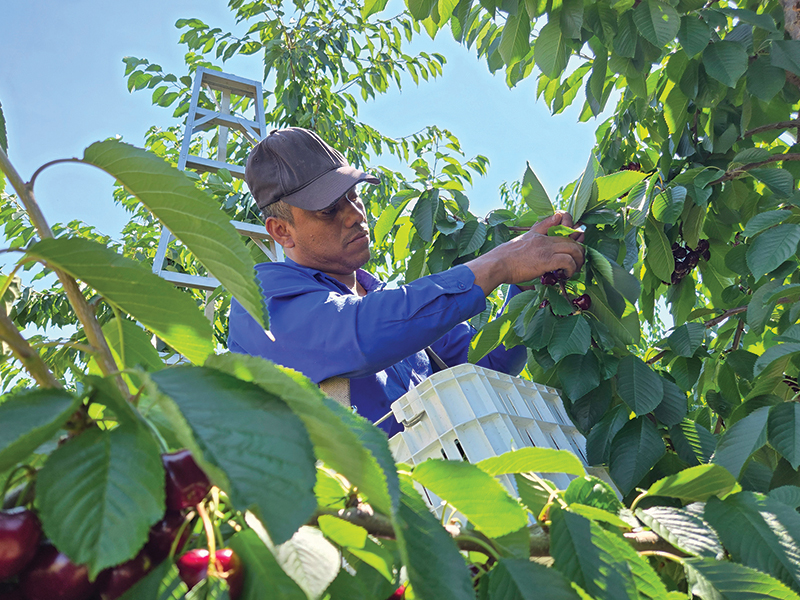
KELOWNA – Fruit growers in the Okanagan have suffered at the hands of Mother Nature over the past four years, but she just might be smiling on them this season.
“This is very good weather that is conducive to growing good quality fruit,” says Sam DiMaria of Bella Rosa Orchards in Kelowna. “From my perspective here, looking at my orchard, I’m quite content with the way things are going.”
The year hasn’t delivered the high temperatures that baked fruit in July 2021 nor the extreme cold events of December 2022 and January 2024.
“We haven’t had any freakish weather so far,” he says. “As long as we don’t have any curve balls thrown at us by Mother Nature (we still have half the summer left), it’s sizing up to be a good quality year.”
Bella Rosa Orchards produces cherries, apples and pears. DiMaria says he had “a few” cherries last year, but the winter damage to the trees affected quality and he did not ship them.
This year is a different story, as his five-year-old cherry block produces its first full crop.
DiMaria describes a “snowball bloom” in the spring that overset fruit.
“We actually went in with our hands and combed out 20% to 30% of the fruit,” he explains. “It’s tedious and expensive work, but it beats having cherries the size of marbles.”
DiMaria expects an average crop of apples, but he is particularly pleased with his pears.
The freeze events in December 2022 and January 2024 affected the 2023 and 2024 harvests.
“This year we’ve got a beautiful pear crop,” he says. “Probably the best pear crop I have seen in my life.”
Soft fruits took a particular beating from the 2024 freeze.
“My plum trees took it pretty hard as did some of the peaches,” says Oliver grower Pinder Dhaliwal. “They didn’t die and have come back, but they have lost branches. They look awkward.”
Dhaliwal says it’s a sign of long-term damage.
“There is definitely internal damage to the xylem and the trees will go onto decline and likely die in three or four years,” he says.
If he removes the trees and replants, it will be four years before he will see a crop. Instead, Dhaliwal has chosen to cut back the trees to stumps and hopes the new growth will be stronger.
“That way I might get three or four years out of them and plan a gradual replant,” he explains.
Trees that survived the winter damage are doing well, Dhaliwal says.
“All the crops rebounded pretty nicely,” he says. “The peaches, cherries, nectarines, and pears, they’ve all got fruit.”
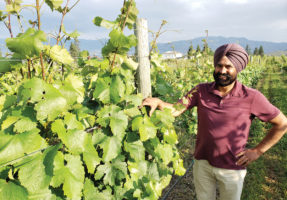
Grape grower Karnail Singh Sidhu is hoping for 50% to 60% of a normal crop this year, following 20% vine loss and no grapes last year.
“We’ve actually thinned clusters from the vines as I don’t want to push them too hard this year,” he says from West Kelowna where he farms and owns the Kalala and Little Straw vineyards and wineries.
Sidhu wasn’t taking any chances last year, cutting back all his surviving vines and retraining new trunks from the base.
“It’s hard to tell what trunk damage you might have; it could take a couple of years where they are really struggling, so we brought up new shoots on every vine just to be sure,” he says.
Vines were hilled in the fall for winter protection and a cane from each vine was buried as well.
“It’s expensive, around $1,000 an acre, but it’s good insurance and better than no crop at all,” he says.
He’s happy with the weather so far.
“We haven’t had any really hot weather, which is important,” Sidhu says. “If it gets too hot, like it did in July 2021, the vines shut down. They stop growing and we lose a couple of weeks of the growing season.”
 Regulatory hurdles threaten farm income solutions