
• Menu
  • Skip to primary navigation
  • Skip to main content
  • Skip to primary sidebar

Country Life In BC Logo

The agricultural news source in British Columbia since 1915

  • Headlines
  • Calendar
  • Subscribe
  • Advertise
  • About
  • Archives
  • Contact
  • Search
  • Headlines
  • Calendar
  • Subscribe
  • Advertise
  • About
  • Archives
  • Contact
  • Search

Primary Sidebar

Originally published:

AUGUST 2025
Vol. 111 Issue 7

Subscribe Now!

Sign up for free weekly FARM NEWS UPDATES

Loading form…

Your information will not be
shared or sold ever

Stories In This Edition

Peek-a-boo

Hatching egg supplies tight

Farm losses driven by depreciation

On the rebound

Editorial: Growing concern

Back 40: Good neighbour, good night

Viewpoint: Retailer consolidation weakens the food system

Water shut-off orders loom as planning stalls

Greenhouse growers face new levy burden

Ag Briefs: Cabinet shuffle expands agriculture minister’s role

Ag Briefs: Apiarist John Boone dies

Ag Briefs: New nursery specialist appointed

Panel discussion identifies farming challenges

Consultation critical when markets move

Cherry field day showcases recent research

Fencing, hunting key to elk management

Here’s the beef

Land clearing with an eye to soil health

Irrigation gets efficient

Farmers urged to prepare for emergencies

More is better

Sweetpea Farms focuses on sustainable meat

Langley farms blend tradition with technnology

Foundation buys Pemberton farm

Farm Story: Weeding philosophical

Woodshed: Junkyard Frank falls for Newt’s movie star distraction

Langley couple defends farmers’ flying allies

Jude’s Kitchen: Choose local food to eat outdoors

All content on this website is copyrighted, and cannot be republished or reproduced without permission.
More Headlines

Follow us on Facebook

Comments Box SVG iconsUsed for the like, share, comment, and reaction icons

2 days ago

A draft update to the Code of Practice for the Care and Handling of Beef Cattle is now open for public comment until June 12. The code, one of 14 animal care codes developed and maintained by the National Farm Animal Care Council, is undergoing a routine 10-year review. "Your feedback will help shape the industry's guide to cattle welfare for the next decade," says Canadian Cattle Association policy manager Jessica Radau, urging producers to weigh in. For more information, visit tinyurl.com/58a3u9fz.

#BCAg
... See MoreSee Less

A draft update to the Code of Practice for the Care and Handling of Beef Cattle is now open for public comment until June 12. The code, one of 14 animal care codes developed and maintained by the National Farm Animal Care Council, is undergoing a routine 10-year review.  Your feedback will help shape the industrys guide to cattle welfare for the next decade, says Canadian Cattle Association policy manager Jessica Radau, urging producers to weigh in. For more information, visit https://tinyurl.com/58a3u9fz.

#BCAg
View Comments
  • Likes: 4
  • Shares: 2
  • Comments: 1

Comment on Facebook

I sat in the webinar yesterday by the Canadian Cattle Association. My initial concern was that this would be another "play" into the government's hands. It has been worked on by people that are actually in the Beef industry from Cow calf to feedlot. The thrust is an update of the 2013 Code of Practice which was reviewed in 2018. The changes are more a move from "left to the producers discretion" to clearer directions regarding pain management, proper transport of animals which are impaired and keeping cattle in in good condition. Much of what is recommended is what producers who care about animal husbandry already do. The important part is to GIVE THEM FEEDBACK good, bad or otherwise. The document is about 60 pages long, and I ran it through CHAT to see what had been changed. It is important to understand that the PUBLIC is invited to comment on the draft not just producers. Think about it... do you really want the public influencing how you manage your cattle. If you think that this is just one of those things, I have been following Bill 22 in Alberta which will grant the SPCA a proactive roll in entering farms and checking on animals. When I asked CHAT how the new bill relates to the Cattle Code, it came back that the Code although not a regulation will be able to be used as a guide by producers for backup in dealing with the SPCA regarding cattle conditions, sick animal handling etc. Take the time.... Go onto the Canadian Cattle Association website and speak to those parts that you wish to input.

3 days ago

According to the BC River Forecast Centre, the Okanagan snowpack stood at just 58% of normal on April 1 — the lowest reading since measurements began in 1980 — raising concerns about drought conditions in the region this summer. The rest of the province sits at 92% of normal.

#BCAg
... See MoreSee Less

According to the BC River Forecast Centre, the Okanagan snowpack stood at just 58% of normal on April 1 — the lowest reading since measurements began in 1980 — raising concerns about drought conditions in the region this summer. The rest of the province sits at 92% of normal.

#BCAg
View Comments
  • Likes: 3
  • Shares: 0
  • Comments: 0

Comment on Facebook

4 days ago

At her first AGM as executive director of BC Meats, held Saturday in Abbotsford, Jennifer Busmann spoke about her strong ties to agriculture and her optimism for the organization's future. Busmann has cattle of her own and came to the role with existing relationships with members and the board of directors that helped her feel integrated from the start. She stepped into the position in Februa#BCAg#BCAg ... See MoreSee Less

At her first AGM as executive director of BC Meats, held Saturday in Abbotsford, Jennifer Busmann spoke about her strong ties to agriculture and her optimism for the organizations future. Busmann has cattle of her own and came to the role with existing relationships with members and the board of directors that helped her feel integrated from the start. She stepped into the position in February.

#BCAg
View Comments
  • Likes: 6
  • Shares: 0
  • Comments: 0

Comment on Facebook

6 days ago

Shannon Wiggins of Headwind Farm in North Saanich is this year's Mary Forstbauer Grant recipient from the BC Association of Farmers Markets. The $500 grant will help Wiggins expand her plot at Sandown Centre for Regenerative Agriculture, growing more storage crops to extend her harvest season. Wiggins credits farmers markets with inspiring her own farming journey and commitment to building community through food. Congratulations!

tinyurl.com/45bdd#BCAg#BCAg
... See MoreSee Less

Shannon Wiggins of Headwind Farm in North Saanich is this years Mary Forstbauer Grant recipient from the BC Association of Farmers Markets. The $500 grant will help Wiggins expand her plot at Sandown Centre for Regenerative Agriculture, growing more storage crops to extend her harvest season. Wiggins credits farmers markets with inspiring her own farming journey and commitment to building community through food. Congratulations!

https://tinyurl.com/45bddtw8

#BCAg
View Comments
  • Likes: 50
  • Shares: 2
  • Comments: 3

Comment on Facebook

Wahoo! Congrats Shannon! I love your produce. Can’t wait for the radishes 🫜

Congratulations!

Well done!! 🩷🩷🩷

1 week ago

New farmers can avoid costly mistakes by learning from those who've been there. At a Young Agrarians mixer in Penticton, five BC farmers shared hard-won lessons on pricing, pivoting, relationships and burnout. From coyote losses to business burnout, their message was clear: set prices that reflect true costs, make decisions quickly and don't let farming define your worth. Myrna Stark Leader's story appears in our April e-edition, now available to view online at: tinyurl#BCAg2uw53vvm

#BCAg
... See MoreSee Less

New farmers can avoid costly mistakes by learning from those whove been there. At a Young Agrarians mixer in Penticton, five BC farmers shared hard-won lessons on pricing, pivoting, relationships and burnout. From coyote losses to business burnout, their message was clear: set prices that reflect true costs, make decisions quickly and dont let farming define your worth. Myrna Stark Leaders story appears in our April e-edition, now available to view online at: https://tinyurl.com/2uw53vvm

#BCAg
View Comments
  • Likes: 15
  • Shares: 0
  • Comments: 0

Comment on Facebook

Subscribe | Advertise

The agricultural news source in British Columbia since 1915
  • Email
  • Facebook

On the rebound

Fruit growers optimistic after weather challenges

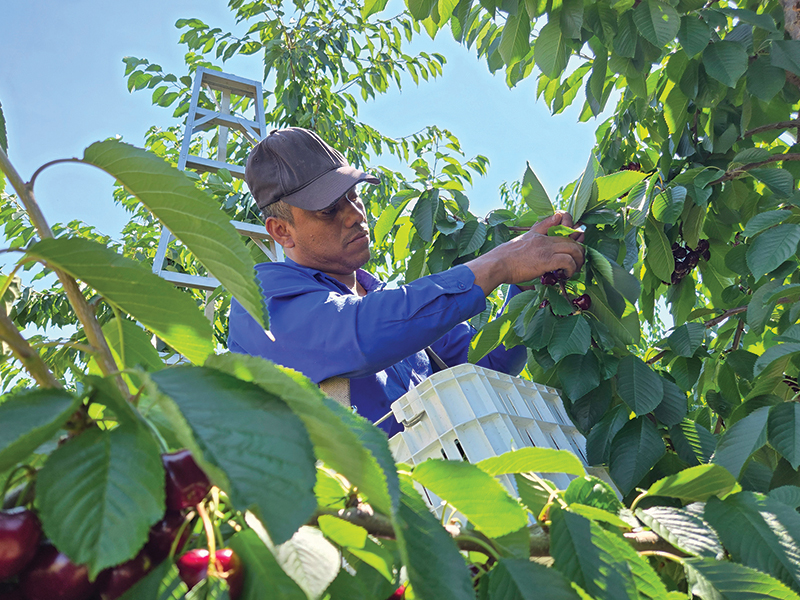
A shortage of pickers for last year's massive cherry harvest meant lower returns for growers as a lot of fruit went unharvested . Photo | Myrna Stark Leader

August 5, 2025 byTom Walker

KELOWNA – Fruit growers in the Okanagan have suffered at the hands of Mother Nature over the past four years, but she just might be smiling on them this season.

“This is very good weather that is conducive to growing good quality fruit,” says Sam DiMaria of Bella Rosa Orchards in Kelowna. “From my perspective here, looking at my orchard, I’m quite content with the way things are going.”

The year hasn’t delivered the high temperatures that baked fruit in July 2021 nor the extreme cold events of December 2022 and January 2024.

“We haven’t had any freakish weather so far,” he says. “As long as we don’t have any curve balls thrown at us by Mother Nature (we still have half the summer left), it’s sizing up to be a good quality year.”

Bella Rosa Orchards produces cherries, apples and pears. DiMaria says he had “a few” cherries last year, but the winter damage to the trees affected quality and he did not ship them.

This year is a different story, as his five-year-old cherry block produces its first full crop.

DiMaria describes a “snowball bloom” in the spring that overset fruit.

“We actually went in with our hands and combed out 20% to 30% of the fruit,” he explains. “It’s tedious and expensive work, but it beats having cherries the size of marbles.”

DiMaria expects an average crop of apples, but he is particularly pleased with his pears.

The freeze events in December 2022 and January 2024 affected the 2023 and 2024 harvests.

“This year we’ve got a beautiful pear crop,” he says. “Probably the best pear crop I have seen in my life.”

Soft fruits took a particular beating from the 2024 freeze.

“My plum trees took it pretty hard as did some of the peaches,” says Oliver grower Pinder Dhaliwal. “They didn’t die and have come back, but they have lost branches. They look awkward.”

Dhaliwal says it’s a sign of long-term damage.

“There is definitely internal damage to the xylem and the trees will go onto decline and likely die in three or four years,” he says.

If he removes the trees and replants, it will be four years before he will see a crop. Instead, Dhaliwal has chosen to cut back the trees to stumps and hopes the new growth will be stronger.

“That way I might get three or four years out of them and plan a gradual replant,” he explains.

Trees that survived the winter damage are doing well, Dhaliwal says.

“All the crops rebounded pretty nicely,” he says. “The peaches, cherries, nectarines, and pears, they’ve all got fruit.”

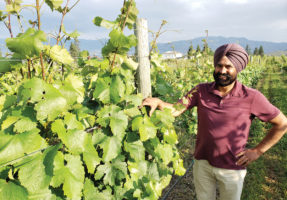
Grape grower Karnail Singh Sidhu is hoping for 50% to 60% of a normal crop this year, following 20% vine loss and no grapes last year.

“We’ve actually thinned clusters from the vines as I don’t want to push them too hard this year,” he says from West Kelowna where he farms and owns the Kalala and Little Straw vineyards and wineries.

Sidhu wasn’t taking any chances last year, cutting back all his surviving vines and retraining new trunks from the base.

“It’s hard to tell what trunk damage you might have; it could take a couple of years where they are really struggling, so we brought up new shoots on every vine just to be sure,” he says.

Vines were hilled in the fall for winter protection and a cane from each vine was buried as well.

“It’s expensive, around $1,000 an acre, but it’s good insurance and better than no crop at all,” he says.

He’s happy with the weather so far.

“We haven’t had any really hot weather, which is important,” Sidhu says. “If it gets too hot, like it did in July 2021, the vines shut down. They stop growing and we lose a couple of weeks of the growing season.”


All content on this website is copyrighted, and cannot be republished or reproduced without permission.
Related Posts

You may be interested in these posts from the same category.

Apple marketing commission rejected

Tree fruit growers struggle to source plants

Inaugural viticulturist of the year chosen

Previous Post: « Regulatory hurdles threaten farm income solutions
Next Post: BC Milk chooses new entrants »

© 2026 COUNTRY LIFE IN BC - ALL RIGHTS RESERVED