
• Menu
  • Skip to primary navigation
  • Skip to main content
  • Skip to primary sidebar

Country Life In BC Logo

The agricultural news source in British Columbia since 1915

  • Headlines
  • Calendar
  • Subscribe
  • Advertise
  • About
  • Archives
  • Contact
  • Search
  • Headlines
  • Calendar
  • Subscribe
  • Advertise
  • About
  • Archives
  • Contact
  • Search

Primary Sidebar

Originally published:

DECEMBER 2024
Vol. 110 Issue 12

Subscribe Now!

Sign up for free weekly FARM NEWS UPDATES

Loading form…

Your information will not be
shared or sold ever

Stories In This Edition

Heading home

Avian flu response keeping pace

Popham back as ag minister

Farm equipment sales down, but not out

Winter harvest

Editorial: Goodwill wanted

Back 40: The election’s over. Now what?

Viewpoint: BC orchard sector needs more than sales

Court decision a bowl of cherries for Canada

Ag Briefs: Sturko leads apple marketing commission consultations

Ag Briefs: New BC field vegetable specialist

Ag Briefs: Slash smoke challenge planned

Ag Briefs: Mushroom farm fined

Island farmers fish for water solutions

Economic summit makes case to buy local

Cow-op urges community to buy local

Demand for milk, lower input costs good for dairy

Replant program begins accepting applications

Researchers explore ways to detect Cherry X

Trade imblance baffles honey producers

Pilot addresses gap in distribution infrastructure

Rotational grzing field day tracks progress

Cool spring challenges high-heat corn

Sidebar: It’s not all about the yield

Panel celebrates waste reduction strategies

Global sales blossom from native berry

Farm Story: Why hibernate in such a friendly valley?

Timely rains support Christmas tree supply

Sidebar: BCCTA AGM opportunity for knowledge transfer

On-farm research doesn’t have to be complicated

Woodshed: Some manners would go a long way with Delta

Young rancher honoured for leadership

Jude’s Kitchen: Much to celebrate in December

More Headlines

Follow us on Facebook

Comments Box SVG iconsUsed for the like, share, comment, and reaction icons

6 days ago

A BC Forest Practices Board investigation has found overgrazing has damaged grasslands in the Coutlee Range Unit near Merritt — and the range-use plan meant to prevent it was unenforceable. With complaints about overgrazing on the rise and grasslands covering just 1% of BC's land mass, the findings raise fresh questions about how the province manages one of its most vulnerable — and valuable — food-producing ecosyste#BCAg#BCAg ... See MoreSee Less

Link thumbnail

Board finds overgrazing rules unenforceable unmeasurable

www.countrylifeinbc.com

MERRITT – A BC Forest Practices Board investigation has found instances of non-compliance related to overgrazing have damaged open grasslands in the Mine pasture, part of the Coutlee Range Unit near...
View Comments
  • Likes: 6
  • Shares: 6
  • Comments: 6

Comment on Facebook

Several ranchers in recent years have gone into temporary non use on that range , so that means the grass should grow. But drought conditions/lack of rain and snow don’t allow that to happen . Dried up springs , creeks waterholes in various pastures add to over grazing where there is water , as livestock and everything else stay close to the water source . So even though less cattle are on it , over grazing appears. There is a large volume of horses on it 365 days/year which is wrong ! They pull grass right out of the ground when it’s just trying to grow ,, opens the door for weeds to grow in. That don’t help it. Aging infrastructure ( fences) laying on the ground, pipe line building , ( lack of commitment to fence maintenance) amongst all users contributes also to over grazing. Recreational atv users leaving gates open between pastures allows livestock to go back or ahead in pastures also expidites over grazing. Logging ( bcts) has no problem laying out cut locks on both sides of a fence , then it gets smashed down during logging and they don’t take responsibility to stand it back up or clean the cattle gaurds out when they are done , that happened 4 years ago on pasture 5 up there . I bet it is still not fixed . There are lots of contributing factors to the problem.

Tragedy of the commons.

I looked through the report. I saw nothing about the effects of noxious weeds on productive grasslands. This particular area is vulnerable because of the Ministry’a efforts to diversify the use of the Grasslands.

This pasture is under tremendous pressure not only from cattle but from irresponsible local residents who treat it as a landfill dumping all manner of household debris here. And don't even get me started on the mud bogging and camping in sensitive riparian areas. The feral horses are in this pasture 365 days a year just hammering it. Would sure be nice to see some enforcement action on people who are intentionally ripping up the grasslands and riparian areas. Cattle could be a valuable resource for rebuilding soils and native grasses in this area with the help of electric fencing and/or e-collars. The humans will be harder to manage.

The Forest and Range Practices Act was written by lawyers for global forest licencee shareholders. Results-based = unenforceable.

Also, can we talk about the impact of a pipeline being built through the middle of this field for multiple years?

View more comments

1 week ago

East Kootenay rancher Randy Reay is digging a new well after two natural water sources dried up on his Crown tenures. A new Living Lakes Canada assessment found 15% of mapped aquifers in the region are high-priority for monitoring, yet 80% of those go unmonitored. With over 48% of BC's provincial observation wells reporting below-normal groundwater levels, ranchers and researchers are sounding the alarm on water security. The story is in our March edition, and we've posted it to our website thi#BCAgk.

#BCAg
... See MoreSee Less

Link thumbnail

Water woes: groundwater under pressure across BC

www.countrylifeinbc.com

JAFFRAY – As a young boy growing up in the Kootenay-Boundary region, Randy Reay never expected to run out of water. But this year, in mid-February, his fields are bare. There is no snow halfway up t...
View Comments
  • Likes: 8
  • Shares: 7
  • Comments: 1

Comment on Facebook

Jaffrey is in the east Kootenays not kooteney boundary

2 weeks ago

BC farmers are bracing for prolonged higher input costs as war in the Middle East drives up fuel and fertilizer prices. Nitrogen fertilizer costs were already climbing before the Iran conflict began, with prices still roughly 60% above pre-pandemic levels. Farm Credit Canada warns that unlike 2022, strong commodity prices may not offset rising costs this time. Local suppliers expect supply challenges and further price increases ahead.

#BCAg
... See MoreSee Less

Link thumbnail

Fertilizer prices on the rise

www.countrylifeinbc.com

War in the Middle East has delivered a generational shock to energy prices, meaning BC farmers can expect a prolonged period of higher costs not just for fuel but also for fertilizer.
View Comments
  • Likes: 2
  • Shares: 1
  • Comments: 0

Comment on Facebook

2 weeks ago

... See MoreSee Less

View Comments
  • Likes: 1
  • Shares: 0
  • Comments: 0

Comment on Facebook

2 weeks ago

Cameron Stockdale is the new executive director of provincial farm safety organization AgSafeBC. Find out more in this week's Farm News Update from Country Life in B#BCAg#BCAg ... See MoreSee Less

Link thumbnail

New leadership at AgSafe BC

www.countrylifeinbc.com

Cameron Stockdale is the new executive director of provincial farm safety organization AgSafeBC, succeeding Wendy Bennett. Bennett left AgSafeBC in September 2025, following 12 years with the…
View Comments
  • Likes: 5
  • Shares: 1
  • Comments: 0

Comment on Facebook

Subscribe | Advertise

The agricultural news source in British Columbia since 1915
  • Email
  • Facebook

Pilot addresses gap in distribution infrastructure

Kootenay project works to solve regional supply chain Issues

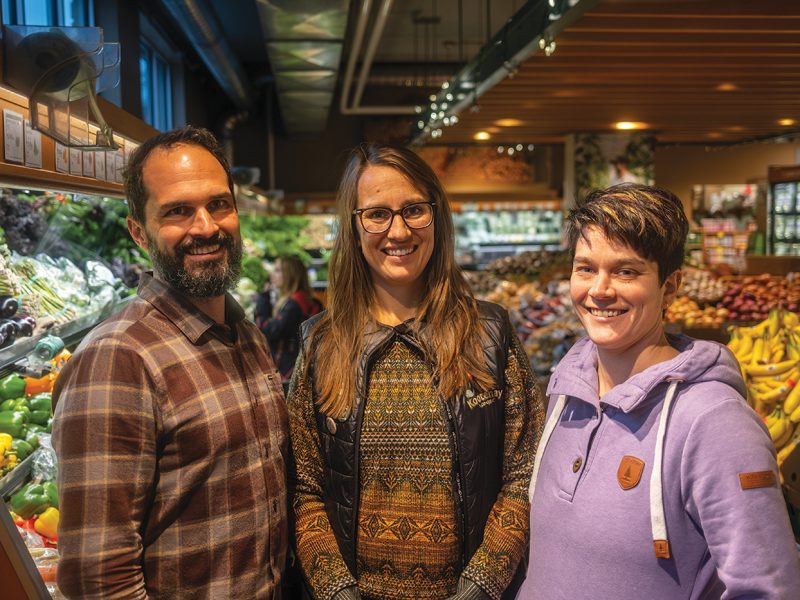
From left to right, Damon Chouinard, executive director, Central Kootenay Food Policy Council; Amanda Verigan, marketing manager for the Kootenay Co-op, and Rebecca Richard of Hedgehog & Heron Consulting. | KOOTENAY CO-OP

December 2, 2024 byTracey Fredrickson

NELSON – A pilot project to transform food distribution in the Kootenays is underway through the Central Kootenay Food Policy Council (CKFPC) with the goal of building a more efficient, cost-effective and sustainable food distribution system across the region.

“The Kootenays is a large geographic area and home to a broad network of interconnected people and food-related businesses from meat, vegetable and dairy products to value-added beverages, canned foods and other products,” says CKFPC executive director Damon Chouinard, who says a regional scope is especially important in food-system research and decision-making. “Yet there is only one primary cold storage truck moving through the area and some smaller independent carriers.”

The gap prompted development of the Grow and Connect Kootenay Distribution Project, one of three BC pilots taking place under the “Grow and Connect Interior” umbrella which also includes projects in the Kamloops and Boundary regions. All three pilots use the Grow and Connect software developed by TruGIS Consulting, specialists in GIS data tracking applications.

In the Kootenays, the software is being used to automate the food distribution process, improve communication between producers, carriers and retailers, and create cost-effective options for producers to move their products throughout the region.

“It’s challenging for our small-scale seasonal  producers to find a carrier they can afford. Those that are successful are usually transporting their own goods within the region, a time-consuming, inefficient process that takes them away from producing. As a result, there are numerous examples of missed opportunities for new business, late deliveries and lack of capacity among producers to fill retail orders.”

Rebecca Richards of Hedgehog & Heron Consulting initiated the Kootenay distribution pilot while working in rural and economic development out of Trail. Richards was contracted by CKFCP in 2023 to continue championing the project.

“Initially, we looked at supply chain issues in multiple sectors and there was particularly strong interest from the food and agriculture sector,” Richards says.

More than 30 producers, carriers and retailers have expressed interest in using the system, shared information about their transportation needs and participated in testing of distribution routes.

Once the automation of existing food transportation routes is completed, a critical focus will be establishing aggregation points where multiple producers can drop off, store and consolidate goods to be picked up by participating carriers.

Eventually the software will include an order status tracking application so that suppliers, retail customers and carriers have timely access to information about orders. Professional carriers can use the system to realize more business opportunities and ensure full loads when their trucks are on the road.  Users can also confirm or adjust delivery times, and check on how products are stored and handled during transportation, and at aggregation points.

A working model is expected to be available by mid-2025. At that point, system users will be able to use the information in the system to collaborate on the development of new routes and business partnerships. It is hoped the supply chain model will be adopted by other communities in BC.

Kootenay Co-op marketing manager Amanda Verigan is enthusiastic about the potential.

The co-op is the largest independent consumer-owned natural foods retail co-operative in Canada, and a major retail supplier of Kootenay-made food products.

“This project has really grown from the initial concept to creation of real-life applications,” she says. “It demonstrates the importance of food supply research and how issues can be solved when multiple organizations work together to address them.”

CKFPC was established in 2016 to promote a coordinated approach to resolving issues related to hunger, agriculture, land and water. It supports networking, public education, and research around local food systems in both municipal and rural areas in the central Kootenays.


Related Posts

You may be interested in these posts from the same category.

Previous Post: « Demand for milk, lower input costs good for dairy
Next Post: Shuswap watershed grants once again open »

Copyright © 2026 Country Life in BC · All Rights Reserved