
ROCK CREEK – Farmers and non-farmers wanting to buy farmland are increasingly migrating to BC’s rural communities to find land that’s more affordable than in urban areas.
The impacts of this trend are wide-reaching: land is in high demand and supply is limited, land values have increased and properties suited to growing food are being purchased for non-farm use.
According to Farm Credit Canada (FCC), average farmland values in the province increased more than 18% in 2021, with the greatest increases in the South Coast/Lower Mainland (33.7%), Cariboo-Chilcotin (28.2%) and Okanagan (21.6%). Even in the Kootenays, where the increase is relatively low at 9.8%, demand for land has been steady.
“After years of relatively low numbers of sales of farmland, we have seen a substantial increase in sales,” says Vicki Gee, director for Electoral Area ‘E’ (West Boundary) for the Regional District of Kootenay Boundary, an 8,200-square-kilometre region neighbouring the Okanagan. “Based on what I personally see and what my residents tell me, many of the purchasers are not farming the land after they buy. When the number of active farms decrease, it has a negative impact on the agricultural economy in general.”
Two years ago, Gee had a call from a local real estate agent saying that five farms in the area had sold to foreign buyers.
“Not only were they not being farmed, lease arrangements for haying and grazing with neighbouring farms were discontinued. When farms are not managed, invasive species take over and spread into neighbouring properties,” she points out.
“About the same time, two farms were purchased by dairy farms from the coast to provide hay to those operations. This took that supply of hay out of the sales pool for local use. A local farm with egg quota and infrastructure was purchased as a running concern and the new owners have since shut down. This is a huge loss to our area.”
Hailey Troock, Kootenay/ Columbia Basin land matcher for the BC Land Matching Program delivered by Young Agrarians, says there were noticeably more inquiries about land availability in the region during the pandemic, especially from people outside the region wanting to relocate to the Kootenays to homestead.
“People who sell their property in Vancouver or the Okanagan can afford to purchase farmland for hobby farming or recreational use, while most young farmers can’t qualify for a mortgage to afford a property to farm,” says Troock. “If they do find something they can afford, it will be a piece of land that has never been farmed and requires significant infrastructure and soil development before it can be productive and profitable.”
Uncertainty during the pandemic also made landowners reticent to enter long-term leases with farmers, further limiting access to land.
“People were hesitant to make long-term commitments to leasing farmers due to … the potential for a quick and unplanned land sale,” says Troock. “I also heard from landholders whose properties were not even on the market that they had received verbal offers through local real estate agents to buy land sight-unseen and above market value. This complexity around sales and financial uncertainty still exists.”
Willing to adapt
Despite this challenging environment, agripreneurs in different parts of the province have found innovative ways to access the farmland they need and the lifestyle they want.
Andrew Hope and his wife Janie have operated Hope Organics near Prince George since 2011.
“There is an increase of folks moving to rural areas currently,” Hope says. “Unlike us when we moved out here, most seem to be in their late 30s all the way up to the 60s.”
With one or two exceptions, most are starting off as hobby farmers but there are significant challenges. While a changing climate has brought warmer temperatures and a longer growing season, extreme weather events and temperatures are also more frequent.
But opportunities exist.
“We are proof that you can work around that, as we are in the coldest, wettest, bio-geoclimatic zone in the Prince George Forest District. If folks come to the table preparing for climate change and weather events, Northern BC is a fine and affordable place to start your agriculture endeavour,” says Hope.
Kendall Ballantine is a first-generation farmer who runs Central Park Farms in Langley with her partner, Jay. When Ballantine started farming in 2015, she was fortunate to have access to land Jay owned to raise produce and free-range chickens. By 2018, the farm was also producing pasture-raised pork and grass-fed and finished Black Angus beef and needed more space.
Ballantine quit her corporate job with an international trucking company and she and Jay moved to Rock Creek in south-central BC where they purchased 160 acres for ranching.
“While the land was affordable, we had moved to a community of large, established ranches that could offer better prices than we could as a start-up,” says Ballantine. “Six years down the road our infrastructure is still in development. To be sustainable, we divide our time between Rock Creek and Langley where the buyers of the property we owned lease the land back to us so we can continue to farm it.”
The availability of cheap land within a few hours of the Lower Mainland is a combination that works for many producers.
“The Vancouver market will spend money on grass-fed, specialty food,” explains Ballantyne. “That’s why you’ll see so many vendors at the Vancouver Farmers Market bringing their products in every week from as far as Williams Lake and Cawston.”
Open to ideas
Cowichan Valley Regional District economic development analyst Brittney Taylor notes that farmland on Vancouver Island is the second most expensive in BC next to the Lower Mainland but it supports a wide range of farms and is a hub for agri-tourism. This combination also helps keep farms in production and profitable.
One such venture is Yellow Point Farms in Ladysmith. Rebecca and Justin Dault sold their hobby farm in Langley when they became overwhelmed by daily commutes to their full-time jobs. Rising land prices and the desire to spend more time at home with their children also contributed to their decision to relocate.
They sold the Langley farm in 2018, quit their day jobs and bought a blueberry farm in Yellow Point. The sellers moved just minutes down the road and offered to mentor the couple for a year to help them expand the farm.
“They were so happy that a young family would want to take it over,” Rebecca says.
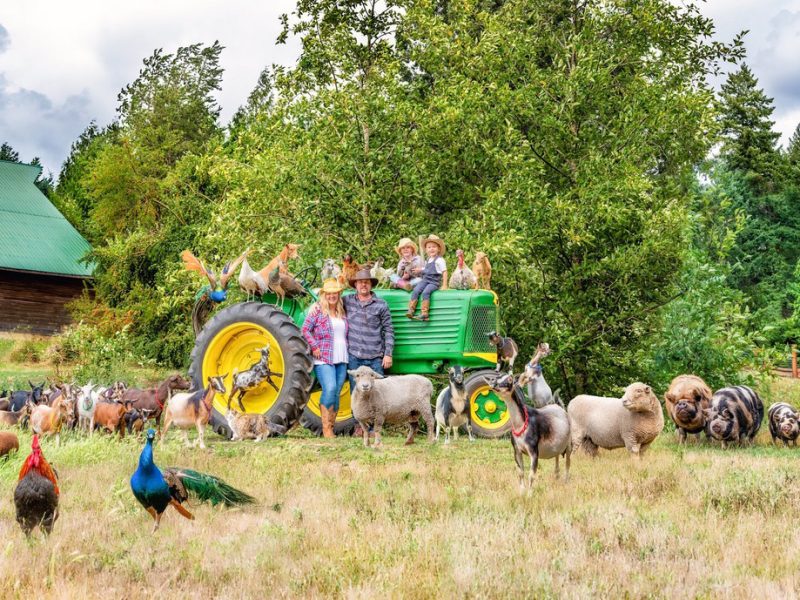
In addition to growing a variety of produce, Yellow Point Farms has an on-farm store, offers educational tours and baby goat yoga with the help of three full time staff.
“We have all sorts of miniature animals that provide compost, milk and wool and everyone wants to see them,” says Rebecca. “Creating a petting farm/interactive barnyard addressed this need, created a new revenue stream, and encourages produce sales while people are at the farm.”
It’s been a win-win for the Daults and their customers, who they hope will leave inspired, too.
“We love the property and lifestyle we have and are keen to share what we’ve learned,” she adds. “Our hope is that when visitors leave, they will be equally inspired to pursue their farming dreams.”
 ALR policy review shows room for improvement