
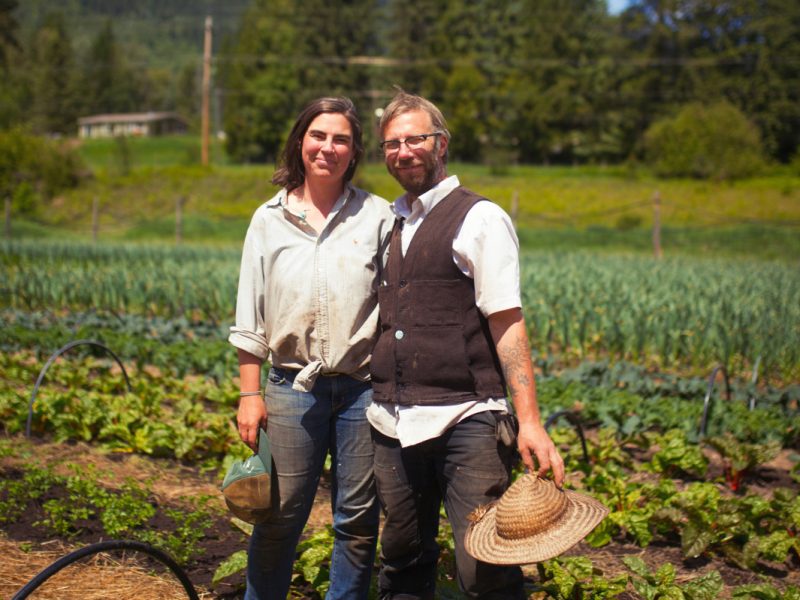
WINLAW – Good management and a commitment to making nutritious, ecologically grown food accessible to their community have made Ravine Creek Farm a model for market gardeners in the region.
The 10-acre vegetable farm in the Slocan Valley is the sole source of income for Alys Ford, Eric Struxness and their two children, and has been profitable since its inception in 2010.
A visit to the farm this spring showed how Alys and Eric have adapted to unprecedented weather and natural events during the last few years.
“Even with the best planning, farmers are like sailors,” Alys points out. “You can chart your course but in the end it’s about what Nature deals you.”
There wasn’t a great deal of charting or planning for these farmers in the early days. Alys had worked in the library system and was an avid gardener. Eric was a carpenter by trade who went on to study sustainable agriculture at Evergreen State College in Washington.
“We were hippie-era homesteaders with a vision to pursue farming full-time,” Alys reflects.
In 2010, the couple happened on some vacant land available for lease near Winlaw. The property was originally farmed at the turn of the century and supported grazing animals, hay pastures and assorted vegetables. Its rich, dark clay soil is the result of natural soil building processes that took place thousands of years ago. A creek runs through the land, providing an essential water source and the gardens are visible and accessible from Hwy 6.
Leasing instead of buying land allowed the couple to start farming without a huge cash outlay. It also provided more “room for error” as they experimented with different crops and production methods on land that had been fallow for two years.
“At first we weren’t sure if we’d become certified organic, but we definitely wanted to practice ecological agriculture using less harmful growing methods than conventional farming,” Alys says.
The farm certified with the Kootenay Organic Growers Society in 2012. Revenue is generated from sales at the Nelson farmers market, a 20-member CSA program and at the farm gate.
A turning point came in 2019. With two young children on the scene, Alys wasn’t working in the field as much as in the past.
“It was very hard to find staff and the weeds were out of hand,” she recalls. “We needed to do something big to continue to cultivate in season – either a whole lot of tarping or this new thing we’d heard about called no-till farming.”
No-till farming is the practice of planting crops without tilling the soil. Conventional tilling prepares the soil by digging, stirring and turning, which usually requires two or more passes over the field with heavy equipment. Tilling kills unwanted plants and buries mulch, leaving behind barren soil. It can even lower the quality of the soil, causing compaction and erosion.
With the no-till method, there are fewer steps involved in preparing the soil. Seeds are planted in the remains of previous crops in seed furrows. The furrow is closed and the crop is covered with a high-carbon, low-nutrient mulch made of decomposed leaves, twigs and commercial waste products. No-till provides several benefits over conventional tilling, from increased productivity to more fertile and resilient soils.
“We were pretty skeptical at first, so we started with a low-till approach in three beds,” says Alys. “We purchased just enough commercial mulch and thought if it doesn’t work, we’ll only be out a couple of hundred dollars.”
By the end of the season, the couple had joined the growing ranks of dedicated no-till farmers.
“The proof was right there,” Alys says. “Our produce was even better than in the past and the weeds far less than we expected. In fact they have decreased with each subsequent season. We’ve become stackers instead of stirrers.”
“Moving to no-till is one of the best management decisions we’ve made,” adds Eric. “There are tons of earthworms and microorganisms regenerating the soil and the ecosystem. We spend less time weeding, our plants are healthier, and we don’t have to run around after a tiller. We can also get into places where we used to wait for the soil to dry out before planting.”
Another change was made in 2020 when the Nelson farmers market temporarily moved out of the downtown area during the pandemic to nearby Cottonwood Park, eliminating what had been an important source of walk-by business. In response, Ravine Creek increased its farmgate sales to seven days a week, operating on the honour system.
“It’s been amazing,” Alys says. “Our close neighbours have become frequent customers because they don’t have to go into town to buy our produce. We’re driving less to get our products to the community and selling produce as fresh as possible.”
The couple re-evaluates their goals every year to ensure both the farm and the family’s lifestyle are resilient and harmonious.
“We do a ruthless review of the last season,” Alys says. “We’re not afraid to eliminate a crop or make other changes. As new farmers continue to come into the area, we respect what everyone does and maintain our own sweet spot.”
Even during the pandemic, the farm has thrived.
“We provide an essential service – everyone needs to eat,” says Alys.
Of all the challenges the couple has experienced, smoke from wildfires has been the most difficult.
The land has few trees and a creek runs through it, keeping the farm fairly safe from the actual fires. But lingering smoke from fires around the farm affected everything, from employees as they worked to the quality of the produce.
Last year, fires were right behind the farmhouse. Helicopters were above from dawn to dusk and at times the crew members were working in respirators. Emotions were running high.
“Our road was a staging point for the ground crews fighting the fires and we would see them and the helicopter pilots come and go,” says Alys. “One day we took some freshly cut hay and made a giant strawbale heart in one of our hayfields that could be seen from the air. The commander declared us ‘the heart people’ and the heart became an easily visible landmark for the pilots. It was an upbeat experience in a difficult time that really pulled people together.”
As fulfilled as they are by their farming careers, Alys and Eric are thinking about the future. While “Eric will probably farm forever,” according to Alys, she is looking at building her credentials to work as a farm consultant, helping people design and plan farms according to the Ravine Creek model.
“All the supply chain issues, floods and other events have shown us we need more food sources closer to home,” she says. “Small farms like ours are a big solution to that problem.”
 Hog farm invaders convicted