• Menu
  • Skip to primary navigation
  • Skip to main content
  • Skip to primary sidebar

Country Life In BC Logo

The agricultural news source in British Columbia since 1915

  • Headlines
  • Calendar
  • Subscribe
  • Advertise
  • About
  • Archives
  • Contact
  • Search
  • Headlines
  • Calendar
  • Subscribe
  • Advertise
  • About
  • Archives
  • Contact
  • Search

Primary Sidebar

Originally published:

AUGUST 2020
Vol. 105 Issue 8

Subscribe Now!

Sign up for free weekly FARM NEWS UPDATES

Select list(s) to subscribe to


By submitting this form, you are consenting to receive marketing emails from: Country Life in BC. You can revoke your consent to receive emails at any time by using the SafeUnsubscribe® link, found at the bottom of every email. Emails are serviced by Constant Contact
Your information will not be
shared or sold ever

Stories In This Edition

Master of Vine

Second farm locked down

COVID-19 darkens sales outlook

Initiative takes aim at invasive Asian hornets

Editorial: Relax, rethnk, reset

Back 40: A fire prevention and response plan is crucial

OpEd: Food priorities need to focus on the basics

BC berries face mixed outlook this season

Pandemic puts the squeeze on blueberry growers

U-picks popular as consumers seek outdoor activities

Cosures underscore need for licensing reform

Small-lot farmers  call for greater infrastructure

Ag Briefs: Milk production adjusted to meet demand

Ag Briefs: Former minister of agriculture Ed Conroy dies

Ag Briefs: Paton introduces artisan food bill in legislature

Ag Briefs: Milk board takes out recall insurance

Vancouver Island hazelnut plans focus on growth

Hazelnut replant program enters home stretch

Agrologists unveil new designation

Woodjam Ranch honoured for sustainability

Outlook cautiously optimistic for fall run

Sidebar: Set-aside program easing backlog

Research: Managing crop residue to increase soil health

Inaugural viticulturist of the year chosen

Shuswap couple sees future in elderberries

Research farm grows in the Garden City

New crops could join greenhouse association

Garlic time

Farm Story: Summertime road trips

4-H auctions steer toward online formula

Woodshed: Kenneth takes social distancing up a level

Consumers are responding to transparency

Rain-be-gone

Jude’s Kitchen: Outdoor appies while keeping your distance

More Headlines

Follow us on Facebook

Comments Box SVG iconsUsed for the like, share, comment, and reaction icons

7 days ago

... See MoreSee Less

View Comments
  • Likes: 4
  • Shares: 0
  • Comments: 0

Comment on Facebook

7 days ago

On the last day of the BC Organic Conference, Thursday, Molly Thurston of Pearl Agricultural Consulting helped growers learn how to manage bugs such as codling moth, wireworm, and rootworm in organic growing systems. Her talk alongside Renee Prasad included hands-on activities in which participants checked out various traps and examined pests under microscopes. Be sure to look for more upcoming ag events on our online calendar at www.countrylifeinbc.com/calendar/

#BCAg
... See MoreSee Less

On the last day of the BC Organic Conference, Thursday, Molly Thurston of Pearl Agricultural Consulting helped growers learn how to manage bugs such as codling moth, wireworm, and rootworm in organic growing systems. Her talk alongside Renee Prasad included hands-on activities in which participants checked out various traps and examined pests under microscopes. Be sure to look for more upcoming ag events on our online calendar at www.countrylifeinbc.com/calendar/

#BCAg
View Comments
  • Likes: 15
  • Shares: 0
  • Comments: 0

Comment on Facebook

1 week ago

Well-known organic farmer and podcaster Jordan Marr gets interviewed by Country Life in BC’s own columnist and potato mavin Anna Helmer during the opening session of the BC Organic Conference at Harrison Hot Springs yesterday. Sessions run today (Wednesday) and Thursday and include organic and regenerative growing practices and expanding and advocating for the organic sector, all under the background of the newly launched Organic BC banner.

#BCAg
... See MoreSee Less

Well-known organic farmer and podcaster Jordan Marr gets interviewed by Country Life in BC’s own columnist and potato mavin Anna Helmer during the opening session of the BC Organic Conference at Harrison Hot Springs yesterday. Sessions run today (Wednesday) and Thursday and include organic and regenerative growing practices and expanding and advocating for the organic sector, all under the background of the newly launched Organic BC banner.

#BCAg
View Comments
  • Likes: 37
  • Shares: 2
  • Comments: 1

Comment on Facebook

Interested in finding out more about this

3 weeks ago

Today, we remember those who sacrificed their lives or their well-being for our freedom. Lest we forget. ... See MoreSee Less

Today, we remember those who sacrificed their lives or their well-being for our freedom. Lest we forget.
View Comments
  • Likes: 8
  • Shares: 0
  • Comments: 0

Comment on Facebook

1 month ago

FarmFolk CItyFolk is hosting its biennial BC Seed Gathering in Harrison Hot Springs November 27 and 28. Farmers, gardeners and seed advocates are invited to learn more about seed through topics like growing perennial vegetables for seed, advances in seed breeding for crop resilience, seed production as a whole and much more. David Catzel, BC Seed Security program manager with FF/CF will talk about how the Citizen Seed Trail program is helping advance seed development in BC. Expect newcomers, experts and seed-curious individuals to talk about how seed saving is a necessity for food security. ... See MoreSee Less

Link thumbnail

BC Seed Gathering - FarmFolk CityFolk

farmfolkcityfolk.ca

Save the date for our upcoming 2023 BC Seed Gathering happening this November 3rd and 4th at the Richmond Kwantlen Polytechnic University campus.
View Comments
  • Likes: 1
  • Shares: 0
  • Comments: 0

Comment on Facebook

Subscribe | Advertise

The agricultural news source in British Columbia since 1915
  • Email
  • Facebook

Small-lot farmers call for greater Infrastructure

Small producers will stay small without basic supports

Andrea Gunner of Rosebank Farms says rebuilding local infrastructure such as cold storage and distribution options, not just processing, is critical for BC’s small-lot farmers to realize their potential. PHOTO / CATHY GLOVER

August 1, 2020 byTom Walker

ARMSTRONG – Small-scale producers say the province needs to rebuild rural food processing capacity if it wants them to thrive.

While small, local producers have come into their own in recent years and drawn several aspiring farmers to rural acreages, the rules often restrict growth and leave them scrambling for the kind of support that was withdrawn as the economy became centralized.

The provincial small-lot poultry quota of 2,000 birds a year is a case in point.

Andrea Gunner of Rosebank Farms in Armstrong  is a business consultant who regularly speaks to farm groups about the importance of knowing production costs and planning for profits. She knows how tough it can be.

A small-lot grower with just 2,000 birds cannot make a living.

“Absolutely not,” says Gunner without hesitation.

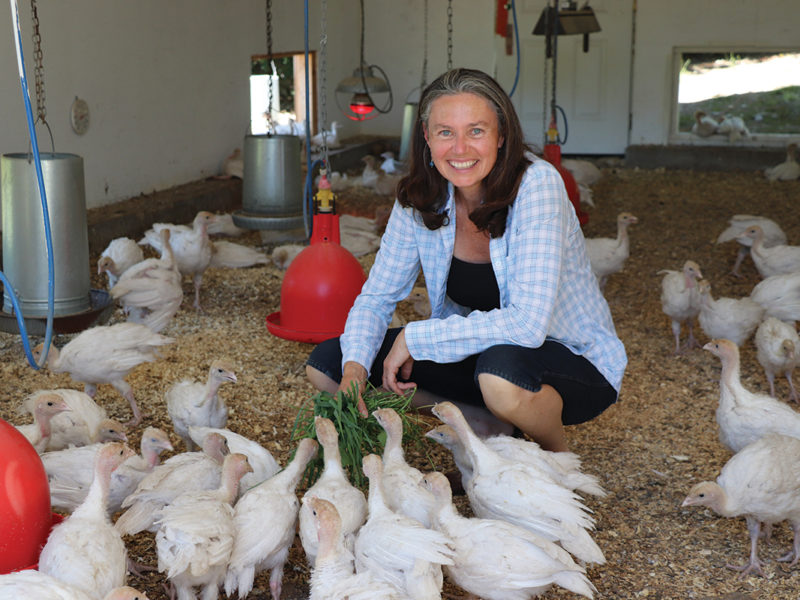
Gunner and her husband Steve have made Rosebank work by combining several small-lot quotas to direct market about 3,500 chicken and 300 turkeys a year to some 600 buyers.

But it still isn’t enough. In order to make ends meet, Gunner and her husband have part-time jobs off the farm.

“If we had other species and value-added and managed it full time, I think it could be viable,” she says.

This is the direction they are heading with the business, but many small producers have trouble making the leap.

Linda Geggie, executive director of the Capital Region Food and Agriculture Initiatives Roundtable (CRFAIR), told the Expanding the Influence of Regional Agriculture Support workshop organized by the Alberni-Clayoquot Regional District in Duncan this past February that the biggest challenge facing small-lot farmers in the Capital Regional District is moving from modest income direct marketing at the local farmers market to a full-time income.

The Gunners have invested in a provincially inspected processing plant, Rancho Cooling in Armstrong provides them with freezer space and they can transport their product to an established customer base willing to meet them at designated pick-up spots, but they wonder if there isn’t a better way.

Julia Smith, president of the Small-Scale Meat Producers Association, quips that her business model is based on meeting her meat customers in gas station parking lots. But Lisa Dueck of Sterling Springs Chicken in Falkland says there’s no way she is doing that.

“I’m not going to sit at a truck stop with a cash box,” she says.

Instead, Dueck gets up at 4 am twice a week to be at the farmers markets in Kelowna and Vernon when they start at 8 am.

The model is not one that appeals to Gunner, who sold flowers at the local farmers market for several years.

“I admire people who can do it,” she says. “I know what it’s like.”

She recalls the early starts, hoping the weather and her display and smiling personality would help her sell everything she had brought. It didn’t.

What’s needed, she says, is a renewed appreciation for and investment in the basic elements of the food system that connect food with consumers.

“We need to rebuild local infrastructure,” she explains.

The processing, cold storage and distribution and marketing infrastructure that were part of the less-centralized economy of the past have disappeared, she points out.

A centralized processing plant is efficient and cost-effective but disruptions related to COVID-19 at Alberta beef plants this spring jeopardized 70% of the country’s processing capacity.

Abra Brynne, executive director of the Central Kootenay Food Policy Council and a long-time advocate for local food systems, says BC needs to recover its processing capacity.

“People will always ask me what are the top three things that we need to move sustainable food systems forward in the province and I simply can’t answer them,” she says. “There are so many parts to the issue and we have lost so much capacity in the province.”

Gunner and Brynne both put agriculture extension programs at the top of their wish lists.

“They have been gone since 1993,” Gunner notes.

Nevertheless, they remain part of the province’s mandate under the Ministry of Agriculture and Food Act, Brynne points out.

Brynne says that when she first approached the Columbia Basin Trust and the three regional districts about funding the popular Kootenay Boundary Farm Advisors program it was an easy sell.

“But not all regional districts have the funding or the desire to take on a responsibility mandated to the province,” she says.

Brynne is one of the 13 signatories to an open letter to Premier John Horgan in July providing 21 recommendations to foster safe, sustainable and resilient food systems.

She says the group has already heard back from the province. She expects a meeting in the coming weeks, but a quick solution is unlikely.

“It has taken 50 to 60 years to deconstruct our localized food economies into a globalized food supply chain,” she notes. “It is going to take a long time and a complex set of interventions to turn it around.”

That’s where government leadership and dollars are needed.

“In terms of recreating the infrastructure of our food system, there are some things in which the business case will never be there,” says Brynne. “There will need to be a significant input of capital to rebuild infrastructure and level the proverbial playing field.”
Related Posts

You may be interested in these posts from the same category.

Food priorities need to focus on the basics

BC cranberries get green verification

Food security demands out-of-box thinking

Previous Post: « Ottawa announces new rules for foreign workers
Next Post: Inaugural viticulturist of the year chosen »

Copyright © 2025 Country Life in BC · All Rights Reserved