• Menu
  • Skip to primary navigation
  • Skip to main content
  • Skip to primary sidebar

Country Life In BC Logo

The agricultural news source in British Columbia since 1915

  • Headlines
  • Calendar
  • Subscribe
  • Advertise
  • About
  • Archives
  • Contact
  • Search
  • Headlines
  • Calendar
  • Subscribe
  • Advertise
  • About
  • Archives
  • Contact
  • Search

Primary Sidebar

Originally published:

MARCH 2022
Vol. 108 Issue 3

Subscribe Now!

Sign up for free weekly FARM NEWS UPDATES

Select list(s) to subscribe to


By submitting this form, you are consenting to receive marketing emails from: Country Life in BC. You can revoke your consent to receive emails at any time by using the SafeUnsubscribe® link, found at the bottom of every email. Emails are serviced by Constant Contact
Your information will not be
shared or sold ever

Stories In This Edition

Lucky chickens

$227m rebuild fund

Glyphosate shortage looms

Province opens ALR to agritech development

Editorial: Divorced from the earth

Back 40: Broken supply chain weakens food system

Viewpoint: BC’s emergency response needs improvement

Building back better means avoiding past mistakes

Sidebar: Grand Forks initiative protects farms

Rural, urban areas prepare for extreme weather

Ag Briefs: Property owner appeals BC SPCA seizure

Ag Briefs: Province sued over mind ban

Farm income projected to reach new heights

Potato growers brace for higher input costs

Keeping cranberries cool a hot topic

Rewarding farmers for enhancing riparian areas

Sidebar: Farmers need not apply

Diversification drives growth of organic farm

Leadership skills can help farmers cope with disaster

Winter rainbow

Compost facilities facing pushback

Cheese leads the way as BC dairies seek capacity

Island yogurt producer boosting production

Grape growers prepare for climate change

The perfect solution for farmers on the go

Small-lot egg producer awarded quota

Sidebar: Future quota draws likely limited

Broiler health in spotlight for small-lot farmers

Pest data helps with management decisions

Research: Researchers discover a world of apple microbiomes

Farms meet the demand for local food

Better berry harvester meets growers’ needs

Farm Story: Spring demands the old heave-ho

Safety in the spotlight as farms recover

Woodshed: Henderson style has chins wagging

Chilliwack teams plow past the century mark

Jude’s Kitchen: Spring has sprung! Time to make bread!


More Headlines

Follow us on Facebook

Comments Box SVG iconsUsed for the like, share, comment, and reaction icons

6 days ago

... See MoreSee Less

View Comments
  • Likes: 4
  • Shares: 0
  • Comments: 0

Comment on Facebook

6 days ago

On the last day of the BC Organic Conference, Thursday, Molly Thurston of Pearl Agricultural Consulting helped growers learn how to manage bugs such as codling moth, wireworm, and rootworm in organic growing systems. Her talk alongside Renee Prasad included hands-on activities in which participants checked out various traps and examined pests under microscopes. Be sure to look for more upcoming ag events on our online calendar at www.countrylifeinbc.com/calendar/

#BCAg
... See MoreSee Less

On the last day of the BC Organic Conference, Thursday, Molly Thurston of Pearl Agricultural Consulting helped growers learn how to manage bugs such as codling moth, wireworm, and rootworm in organic growing systems. Her talk alongside Renee Prasad included hands-on activities in which participants checked out various traps and examined pests under microscopes. Be sure to look for more upcoming ag events on our online calendar at www.countrylifeinbc.com/calendar/

#BCAg
View Comments
  • Likes: 15
  • Shares: 0
  • Comments: 0

Comment on Facebook

1 week ago

Well-known organic farmer and podcaster Jordan Marr gets interviewed by Country Life in BC’s own columnist and potato mavin Anna Helmer during the opening session of the BC Organic Conference at Harrison Hot Springs yesterday. Sessions run today (Wednesday) and Thursday and include organic and regenerative growing practices and expanding and advocating for the organic sector, all under the background of the newly launched Organic BC banner.

#BCAg
... See MoreSee Less

Well-known organic farmer and podcaster Jordan Marr gets interviewed by Country Life in BC’s own columnist and potato mavin Anna Helmer during the opening session of the BC Organic Conference at Harrison Hot Springs yesterday. Sessions run today (Wednesday) and Thursday and include organic and regenerative growing practices and expanding and advocating for the organic sector, all under the background of the newly launched Organic BC banner.

#BCAg
View Comments
  • Likes: 37
  • Shares: 2
  • Comments: 1

Comment on Facebook

Interested in finding out more about this

3 weeks ago

Today, we remember those who sacrificed their lives or their well-being for our freedom. Lest we forget. ... See MoreSee Less

Today, we remember those who sacrificed their lives or their well-being for our freedom. Lest we forget.
View Comments
  • Likes: 8
  • Shares: 0
  • Comments: 0

Comment on Facebook

1 month ago

FarmFolk CItyFolk is hosting its biennial BC Seed Gathering in Harrison Hot Springs November 27 and 28. Farmers, gardeners and seed advocates are invited to learn more about seed through topics like growing perennial vegetables for seed, advances in seed breeding for crop resilience, seed production as a whole and much more. David Catzel, BC Seed Security program manager with FF/CF will talk about how the Citizen Seed Trail program is helping advance seed development in BC. Expect newcomers, experts and seed-curious individuals to talk about how seed saving is a necessity for food security. ... See MoreSee Less

Link thumbnail

BC Seed Gathering - FarmFolk CityFolk

farmfolkcityfolk.ca

Save the date for our upcoming 2023 BC Seed Gathering happening this November 3rd and 4th at the Richmond Kwantlen Polytechnic University campus.
View Comments
  • Likes: 1
  • Shares: 0
  • Comments: 0

Comment on Facebook

Subscribe | Advertise

The agricultural news source in British Columbia since 1915
  • Email
  • Facebook

The perfect solution for farmers on the go

Shipping container offers packing facilities and cold storage

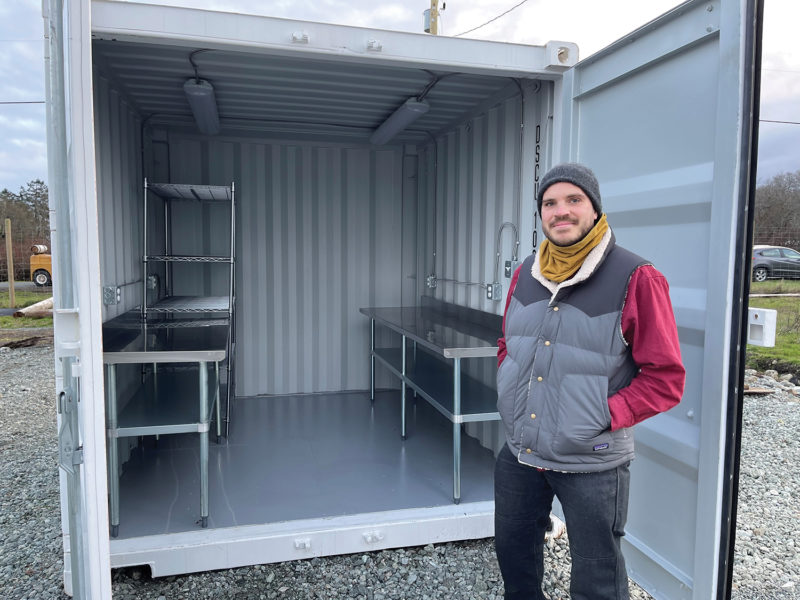
Matthew Kyriakides, director of land management at the Sandown Centre for Regenerative Agriculture in North Saanich, standing in front of the centre’s new GAP Can vegetable packing cube. SUBMITTED

March 1, 2022 bySandra Tretick

NORTH SAANICH – Out in the fields of the Sandown Centre for Regenerative Agriculture in North Saanich, something innovative is happening.

If you drive by the 83-acre site on Glamorgan Road, once home to the Sandown Racetrack, you’d be hard-pressed to see anything out of the ordinary. Sure, there are two new 10-foot shipping containers sitting out there, but those are just used to store tools, aren’t they?

But according to Ty James, the man behind the containers, they’re a game-changer for small farmers that produce field crops, especially those who want to avoid sinking cash into costly infrastructure on leased properties.

James, a 35-year-old market gardener who grows produce on leased farmland in North Saanich and sells to grocery stores like Country Grocer and Red Barn Market, knows what it’s like to move his operations from one farm to another. He used to lease two acres in Central Saanich before outgrowing that space three years ago. He now farms five acres in field production and 20,000 square feet of greenhouses.

“I quickly realized that farming is a business of economies of scale and that I needed more land in order to make a living, and I also needed better infrastructure,” says James. “I was packing in a greenhouse in the summertime that was getting up to 40 degrees. I had a couple little household fridges strapped together, packing into clamshells, just trying to make the most of it.”

It was insufficient for what he needed to do to meet his buyers’ exacting specifications.

James says the CanadaGAP program is one of the must-haves for farmers today, because that’s what larger grocery chains demand. Even though there are about 1,000 farms in BC with GAP certification – the highest rate of participation in the country – James notes that most farmers don’t have it yet, especially smaller growers.

GAP stands for good agricultural practices and James wanted to design infrastructure that would give farmers access to affordable GAP and HACCP-compliant infrastructure. He says CanadaGAP certification is important because it provides assurance to retailers that fresh produce growers are following appropriate food safety procedures.

James believes having access to post-harvest infrastructure is just as important as having fields and fencing. By infrastructure, he means packinghouses and walk-in coolers; a dry place to store labels and packing materials and a cool place to store product during hot weather.

Several companies, like Freight Farms out of the US, sell vertical farming and hydroponic farming systems in shipping containers but through his own company, GAP Can, James is planning something entirely different.

“We’re providing infrastructure for field-growing operations,” says James. “With the heat dome we had last year, it would be virtually impossible to grow successfully without this type of infrastructure. You need access to a shady cold spot to keep your produce fresh as you pack it and get it ready to go to market.”

Two summers ago, he built an early prototype on the farm he is currently leasing with a grant from the BC On-Farm Food Safety Program.

To further develop the concept, James obtained $32,000 through the Canada-BC Agri-Innovation Program and entered into contracts last summer with Sandown Centre and Lytton First Nation to build what he calls “version two prototypes.” James worked with Keith Hayton of K. Hayton Construction Ltd. on the build.

Each unit – built from a shipping container sold off after a one-way trip from China – is custom-built to meet the customer’s needs. That means a lot of discussions on layout and design. They are built to allow producers to achieve CanadaGAP certification, are Canada Safety Association-approved and inspected for road transportation.

“We wanted to design something around CanadaGAP because I get audited on my farm every year,” says James. “We’re trying to service the area of the market that’s like myself, leasehold farmers, people that want to farm but need infrastructure and don’t want to spend hundreds of thousands of dollars to build it.”

The prototype at Sandown was built using two 10-foot shipping containers, avoiding the need for a building permit. One unit is set up for packing and the other is cold storage. Another unit – in a standard 20-foot container – was in the process of being delivered to the Lytton First Nation last month for a large-scale market garden project. Delivery was delayed by wildfires, flooding and mudslides last year.

The little cubes, which arrived at Sandown in January, still need an electrical hookup. Sandown Centre has a 10-year lease on the land from North Saanich and it in turn subleases small plots to farmers. What the centre offers its growers is a cross between land-leasing and farm school that includes learning about horticulture and business.

Sandown director of community and partner engagement Jen Rashleigh says the GAP cubes, as she likes to call them, are a complete and utter game-changer.

Growers will be able to use Sandown’s units this spring to weigh, bunch, pack and store produce, giving them the option to achieve CanadaGAP certification if they want to enter bigger markets.

“If we don’t have a processing unit it’s a major setback,” says Rashleigh. “[With it] they can get the audit and they can get into the bigger retailers.”

Having the units on site means they can also serve as a demonstration for other growers.

The cubes, sold through James’ company GAP Can, come in different sizes and configurations – what James terms modular infrastructure. The company’s flagship unit is a 20-foot container with a vegetable processing area and a walk-in cooler starting around $35,000. Forty-foot containers are also possible for larger applications.

With these prototypes complete, James is now in discussions on two bigger projects, including a multi-unit food hub for Lytton First Nation and a three-unit prototype for a poultry processing plant at Glassen Farms near Nanaimo. He’s also looking for a new yard in Langford for the upcoming builds.
 

Related Posts

You may be interested in these posts from the same category.

CanadaGAP participation drops

Poultry processing goes mobile

CanadaGAP expands options

CanadaGAP participation drops

Small farmers raise concerns about CanadaGAP

Previous Post: « ALR opened for agritech
Next Post: Rewarding farmers for enhancing riparian areas »

Copyright © 2025 Country Life in BC · All Rights Reserved