• Menu
  • Skip to primary navigation
  • Skip to main content
  • Skip to primary sidebar

Country Life In BC Logo

The agricultural news source in British Columbia since 1915

  • Headlines
  • Calendar
  • Subscribe
  • Advertise
  • About
  • Archives
  • Contact
  • Search
  • Headlines
  • Calendar
  • Subscribe
  • Advertise
  • About
  • Archives
  • Contact
  • Search

Primary Sidebar

Originally published:

JANUARY / FEBRUARY 2025
Vol. 111 Issue 1

Subscribe Now!

Sign up for free weekly FARM NEWS UPDATES

Select list(s) to subscribe to


By submitting this form, you are consenting to receive marketing emails from: Country Life in BC. You can revoke your consent to receive emails at any time by using the SafeUnsubscribe® link, found at the bottom of every email. Emails are serviced by Constant Contact
Your information will not be
shared or sold ever

Stories In This Edition

Silver Lining

DCCs hit farms hard

Dairy producers on alert: AI

Popham picks up where she left off

Editorial: Staying connected

Back 40: Roots to growth in an agrarian community

Viewpoint: Polarized legislature offers industry an opportunity

Mega-barns on Delta farmland raise concerns

Sidebar: Noise concerns from air show

Dairy meetings look forward to more stable times

Ag Briefs: Property sales continue as fruit sector retrenches

Ag Briefs: Farm-class properties rise

Ag Briefs: Creston bee keeper wins award

Letter: Rural customers want telephone service from Telus, not innovation

Margins key as costs rise faster than revenues

Software aims to improve Interior food distribution

BC producer groups nourish the needy

AI puts the focus on waterfowl management

Prevention, control efforts go full boar

PAS Preview: Trade show features drone, AI supplies

Sidebar: Kick-off in style

Going with the flow

Sidebar: Berried treasure

Sidebar: Beyond the Lower Mainland

Common pressures face Canada’s farmland

Good job

Vineyards enter new year with recovery in sight

Sidebar: Relaxed rules give wineries production option

Culture change as winterkill chills industry

Farm Story: Plan B keeps the cash flowing through winter

BC Cattlemen’s holds townhalls with producers

Making memories

Fundamentals strong as ranchers enter a new year

Collaborative spirit buoys new winery

Little Cherry Disease going to the dogs

Woodshed: Kenneth heads to the barn to meet Rocket

Scale-model builder creates true-to-life farms

Jude’s Kitchen: Begin a new year with new flavours

More Headlines

Follow us on Facebook

Comments Box SVG iconsUsed for the like, share, comment, and reaction icons

6 days ago

... See MoreSee Less

View Comments
  • Likes: 4
  • Shares: 0
  • Comments: 0

Comment on Facebook

6 days ago

On the last day of the BC Organic Conference, Thursday, Molly Thurston of Pearl Agricultural Consulting helped growers learn how to manage bugs such as codling moth, wireworm, and rootworm in organic growing systems. Her talk alongside Renee Prasad included hands-on activities in which participants checked out various traps and examined pests under microscopes. Be sure to look for more upcoming ag events on our online calendar at www.countrylifeinbc.com/calendar/

#BCAg
... See MoreSee Less

On the last day of the BC Organic Conference, Thursday, Molly Thurston of Pearl Agricultural Consulting helped growers learn how to manage bugs such as codling moth, wireworm, and rootworm in organic growing systems. Her talk alongside Renee Prasad included hands-on activities in which participants checked out various traps and examined pests under microscopes. Be sure to look for more upcoming ag events on our online calendar at www.countrylifeinbc.com/calendar/

#BCAg
View Comments
  • Likes: 15
  • Shares: 0
  • Comments: 0

Comment on Facebook

1 week ago

Well-known organic farmer and podcaster Jordan Marr gets interviewed by Country Life in BC’s own columnist and potato mavin Anna Helmer during the opening session of the BC Organic Conference at Harrison Hot Springs yesterday. Sessions run today (Wednesday) and Thursday and include organic and regenerative growing practices and expanding and advocating for the organic sector, all under the background of the newly launched Organic BC banner.

#BCAg
... See MoreSee Less

Well-known organic farmer and podcaster Jordan Marr gets interviewed by Country Life in BC’s own columnist and potato mavin Anna Helmer during the opening session of the BC Organic Conference at Harrison Hot Springs yesterday. Sessions run today (Wednesday) and Thursday and include organic and regenerative growing practices and expanding and advocating for the organic sector, all under the background of the newly launched Organic BC banner.

#BCAg
View Comments
  • Likes: 37
  • Shares: 2
  • Comments: 1

Comment on Facebook

Interested in finding out more about this

3 weeks ago

Today, we remember those who sacrificed their lives or their well-being for our freedom. Lest we forget. ... See MoreSee Less

Today, we remember those who sacrificed their lives or their well-being for our freedom. Lest we forget.
View Comments
  • Likes: 8
  • Shares: 0
  • Comments: 0

Comment on Facebook

1 month ago

FarmFolk CItyFolk is hosting its biennial BC Seed Gathering in Harrison Hot Springs November 27 and 28. Farmers, gardeners and seed advocates are invited to learn more about seed through topics like growing perennial vegetables for seed, advances in seed breeding for crop resilience, seed production as a whole and much more. David Catzel, BC Seed Security program manager with FF/CF will talk about how the Citizen Seed Trail program is helping advance seed development in BC. Expect newcomers, experts and seed-curious individuals to talk about how seed saving is a necessity for food security. ... See MoreSee Less

Link thumbnail

BC Seed Gathering - FarmFolk CityFolk

farmfolkcityfolk.ca

Save the date for our upcoming 2023 BC Seed Gathering happening this November 3rd and 4th at the Richmond Kwantlen Polytechnic University campus.
View Comments
  • Likes: 1
  • Shares: 0
  • Comments: 0

Comment on Facebook

Subscribe | Advertise

The agricultural news source in British Columbia since 1915
  • Email
  • Facebook

Vineyards enter new year with recovery in sight

Growers pull up vineyards to prepare for replant

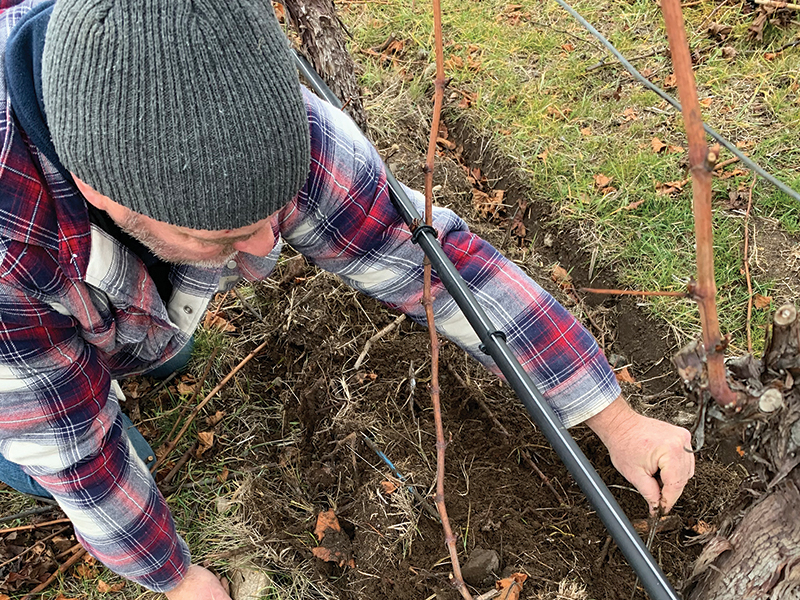
Andrew Moon buries a cane, then hills the entire grapevine for winter protection. Photo | Tom Walker

January 1, 2025 byTom Walker

OSOYOOS – While the 2024 grape crop across the southern Interior was 10% of normal thanks to the cumulative effects of extreme cold events in two consecutive winters, the losses weren’t spread evenly.

BC growers typically harvest in the range of 30,000 tons of wine grapes, but in 2023 that fell to 19,570 tons. In 2024, some vineyards delivered 80% of their usual crop while many others were littered with acres of dead vines.

Ironically, the results may be the true measure of the province’s grape sector.

“This is a true reflection of our BC growing conditions and industry,” says Michael Kullmann, winemaker at Osoyoos Larose in Osoyoos. “We have such a variety of slopes, aspects and soil types. Some vineyards are close to the lake and some are at higher elevations and further north. We grow some 90 different grape varieties with multiple clones of each variety and about half are own-rooted and the rest are on a variety of rootstocks.”

Kullmann adds that there are as many management styles as there are  viticulturists, meaning pruning, fertilizing, crop load, disease management and irrigation can vary significantly between vineyards.

Riesling has fared the best, according to reports.

“We had an 80% Riesling crop in our home vineyard which is right next to the lake,” says Stefanie Schales, general manager at 8th Generation Vineyard in Summerland. “We were also able to purchase additional Riesling grapes from Monte Creek Farm east of Kamloops.”

At Waldhof Family Estate Winery in Kelowna’s Mission area, owner Reto Gebert saw a 60% Riesling crop. His Gamay produced fruit as well, but much of it was lost to birds and bears, something other growers also experienced.

“We are stubborn and we picked 210 kg of Gamay from our 7.1 acres,” Gebert says.

Hybrids fared better in many areas.

Gebert says his Marechal Foch yielded a “normal” crop.

Over in the Similkameen, Orofino Vineyards winemaker John Weber says he agreed to buy some Foch he was offered, but in the end there was not enough crop worth picking.

The vineyards between Oliver and Osoyoos and those in the Similkameen appear to be the hardest hit.

“We had -32°C for 40 hours (last) January so absolutely no crop,” says Andrew Moon, viticulture manager for Bartier Bros. Vineyard and Winery just a few kilometres south of Oliver. “We will have to replant about 50% of our vines.”

That will include a block of Syrah, known to be a cold-tender variety.

“Michael Bartier has replanted Syrah a couple times now and it hasn’t worked for us. It just doesn’t make economic sense to keep replanting,” Moon says. “We will replace it with Chenin Blanc, put in some more Cabernet Franc which does well on our site and seems to have done better than most in the cold, along with more Semillon.”

But a wholesale change in varieties planted across BC is unlikely.

Tweaking

“I would call it tweaking,” say Rhys Pender, who conducted a series of industry townhalls in November. “I am hearing that there will be adjustments if a variety didn’t do well in a particular site.”

Some growers are talking about planting a small amount of hybrids just as insurance.

“They could use them in blends and if there is another freeze event, they would have some grapes to process,” Pender says. “But overall, if a variety is known for making good wine from a particular grape, even if they have to replant, they are going to continue with that variety.”

When temperatures get really low, hybrids don’t have all that much advantage over popular European viniferas, UBC associate professor Elizabeth Wolkovich told the BC Grapegrowers Association and BC Winegrape Council joint grower day last August.

“Marquette, a hybrid developed in Minnesota, can be damaged at -26°C or -27°C; that’s close to Pinot Gris,” she says.

Vine management for next year depends on the strength that vines have shown over the summer. Vines that survived grew shoots and leaves, either from the tops of the vine or from the trunk closer to ground level.

“I believe I am seeing some of the healthiest vines ever going into the winter,” says Moon. “We farmed all summer, but the vines weren’t working to produce fruit; it was a mild fall with lots of moisture, so they are really set.”

Pruning crews will be able to tie those canes to trellis wires next spring.

“In our Chardonnay, for example, we have six or seven shoots that we can use as canes next year and could produce 2.5 to 3 tons to the acre,” Moon says.
Related Posts

You may be interested in these posts from the same category.

Warm winter stalls icewine

Phylloxera found on Vancouver Island

Growers, wineries welcome sustainability launch

Cold snap hits Okanagan fruit growers

Wineries reopen amid COVID-19

Top grape grower recognized

Icewine harvest begins

Autumn showers dampen harvest

Grape diversification in play

Clean plants build confidence

Grape growers honoured

BC wine pioneer Harry McWatters dies

Previous Post: « Ag leaders honoured at gala
Next Post: Roots to growth in an agrarian community »

Copyright © 2025 Country Life in BC · All Rights Reserved