BURNABY – Beekeepers across Canada were in for a shock when they opened their hives this spring to check on colony health. The Canadian Honey Council (CHC) confirms severe losses from Alberta to Quebec.
“Nationally, it seems to be very high. We may come close to 40%,” says CHC executive director Rod Scarlett. “But on the two coasts I have not heard of any disasters.”
The 15-year national average is below 26%.
BC beekeepers open their hives earlier than those east of the Rockies, but it is unclear as yet what the numbers will be here. The province’s annual survey on wintering losses won’t be complete until June, and the BC Honey Producers Association is reluctant to comment on overwintering numbers at this point because of concern that its observations might be skewed to a particular area or operation.
Last year, BC reported losses of around 32%.
Further east, these high losses have some beekeepers calling on the federal government to relax the ban on bee package imports from the US. Currently, packages and queens can only be imported from select countries and the US is not on that list. When a large commercial beekeeper has to build up colony numbers quickly after a heavy loss, they’d like more options.
Scarlett says package imports from Italy are expected to be approved by the Canadian Food Inspection Agency (CFIA) within the next month. CFIA, however, has no plans to perform a new risk assessment for import of honeybee packages from the US, as they say there has been no indication that the level of risk has changed significantly since the last assessment in 2014.
Mites to blame
Ineffective control of the Varroa destructor mite within colonies is the main reason for overwintering losses. As mite numbers go up during the active season, the bees weaken and eventually the colony dies.
“We all agree that varroa is the No. 1 challenge of beekeepers, not only in BC but in Canada and worldwide,” says Nuria Morfin, technology transfer program lead for the BC Honey Producers Association (BCHPA). “It’s the No. 1 cause of overwinter colony mortality.”
Many would like to see more emphasis placed on monitoring for pests like varroa and better integrated pest management (IPM). Done properly, IPM can keep mite numbers in check. The target is two or fewer mites per 100 bees.
Effective IPM includes monitoring mite numbers, cultural techniques to prevent reproduction, and mechanical or chemical treatments to reduce mite levels. Apivar, one of the most reliable acaricides (miticides) for treating varroa in Canada, is now showing some evidence of resistance. Other chemicals can be more difficult to apply or require exacting timing or temperatures for effective treatment.
Beekeepers say new IPM tools could aid in the fight against varroa.
“The reason why we have such high overwintering loss numbers this year nationally seems to be varroa and the lack of tools for beekeepers to control varroa,” says Scarlett. “So the testing and approval of new products is paramount to the success and livelihood of the honey industry in Canada.”
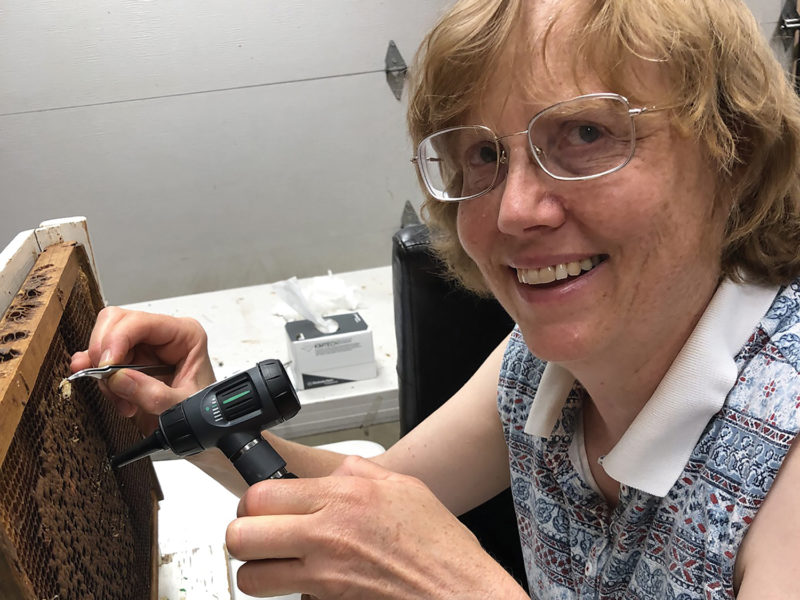
A new acaricide developed at Simon Fraser University is showing promise.
SFU chemistry professor Erika Plettner discovered the compound in her lab a number of years ago when she was looking for feeding deterrents for cabbage looper. It’s a synthetic compound that closely resembles products typically produced by plants. When she turned her focus on bees, she found that this particular compound, nicknamed 3C, also slows down varroa mites and eventually kills them. Plettner says it doesn’t visibly harm the bees and has no adverse effects in vertebrates.
After a series of laboratory experiments, she did the first field trial in 2019. Another one planned for 2020 was cancelled due to the pandemic, but she was back in the field last year. More trials are planned for this year and next.
While it’s too soon to get really excited, initial results are promising.
“In the lab, it’s pretty good,” says Plettner. “The thing is, it has to work in a real colony. And that’s what we’re trying to establish in the field.”
Honey producers are hopeful, but acknowledge that commercializing a product created in the lab is complicated.
“I can clearly see from the field trials that there is good potential. It showed good mite drop in the trial,” says BCHPA president Heather Higo, who ran a field trial for Plettner in 2019. “The need is absolutely huge with the hiving losses that we’re having every year in BC and in other areas. We need another tool in the tool basket to fight varroa.”
The new trials will determine the best timing, the best method of application and the efficacy. The first step is mite collection and BCHPA members are supplying these. Mites are needed to seed the colonies so the numbers are high enough for testing. The compound will be applied this summer and they will measure what happens. Follow-up treatments will happen in the fall. Each of the BC trials are being mirrored at the Beaverlodge research station in Alberta, so they will end up with twice the data.
The actual field trials are only one aspect of the project going forward. Plettner is collaborating with Leonard Foster, a professor in the Michael Smith Laboratories at UBC.
“When we made progress with this acaricide, I really felt that we needed to figure out exactly what the acaricide is doing inside the mite and why it doesn’t really affect the bees too much at all,” she says. “That’s when I approached Dr. Foster.”
Foster will apply proteomics tools to identify the molecular target and determine when and where the compound can be applied. Information about the new compound’s target site in mites is vital for registration with health authorities, the biggest hurdle to commercialization. Understanding the target site and mechanism of interaction will help the team, and end users, make future improvements to the product, its formulation, and the schedule of application.
Genome BC is contributing $250,000 through the Pilot Innovation Fund.
Paul van Westendorp, provincial apiculturist with the BC Ministry of Agriculture and Food, believes the best approach is a cautious one until more is known about the compound’s effectiveness. Plettner agrees.
“It’s a slow process,” she says. “It takes a couple of years to get it approved, even just for emergency use.”
Until such time as this compound gains approval, beekeepers will need to keep monitoring their hives and rotating the existing treatment options. Beekeepers are also encouraged to report their mite numbers for the period April 30 to May 15 and August 13-28, as part of the biannual North American Mite-A-Thon [www.mitecheck.com].


 Province backs off compensation