• Menu
  • Skip to primary navigation
  • Skip to main content
  • Skip to primary sidebar

Country Life In BC Logo

The agricultural news source in British Columbia since 1915

  • Headlines
  • Calendar
  • Subscribe
  • Advertise
  • About
  • Archives
  • Contact
  • Search
  • Headlines
  • Calendar
  • Subscribe
  • Advertise
  • About
  • Archives
  • Contact
  • Search

Primary Sidebar

Originally published:

MARCH 2024
Vol. 110 Issue 3

Subscribe Now!

Sign up for free weekly FARM NEWS UPDATES

Select list(s) to subscribe to


By submitting this form, you are consenting to receive marketing emails from: Country Life in BC. You can revoke your consent to receive emails at any time by using the SafeUnsubscribe® link, found at the bottom of every email. Emails are serviced by Constant Contact
Your information will not be
shared or sold ever

Stories In This Edition

Crown land shakeup

Start me up!

BC Veg mandate expands

Trade show, gala celebrate the best in agriculture

Editorial: Reconciliation is never a one-way street

Back 40: We need to do better, and we can

Viewpoint: The Land Act: important context, faulty process

BC vineyards wiped out by freeze event

Sidebar: Cherries, tender fruits affected

Apple industry eyes orderly marketing plan

Ag Briefs: BC Tree Fruits members vote down hostile motions

Ag Briefs: Farmers lead protest in Duncan

BC FIRB strategic plan aims to clarify role

Two Interior farms face abuse claims

Good times!

Study shows BC farmers markets add value

Story  tellers

Berry farmer recognized for achievements

Nursery specialist appointed

Blueberries top pick amid strong demand

Awards generate buzz for BC beekeepers

Promising developments in berry breeding

Help takes stress out of Farmgate meat licences

New abattoir offers lifeline to local growers

Pest science

Cattle spark fencing debate

Thistle require innovative management

Job well done!

Pruners should focus on needs of the bush

Islands show brings community together

Farm Story: Spring is claling, but my phone is in pieces

Forecasting will improve with AI technology

Woodshed: Breakfast gives Delta time to do her research

New honeybee program in works for Cariboo

Jude’s Kitchen: Food trend points to healthier eating

More Headlines

Follow us on Facebook

Comments Box SVG iconsUsed for the like, share, comment, and reaction icons

6 days ago

... See MoreSee Less

View Comments
  • Likes: 4
  • Shares: 0
  • Comments: 0

Comment on Facebook

7 days ago

On the last day of the BC Organic Conference, Thursday, Molly Thurston of Pearl Agricultural Consulting helped growers learn how to manage bugs such as codling moth, wireworm, and rootworm in organic growing systems. Her talk alongside Renee Prasad included hands-on activities in which participants checked out various traps and examined pests under microscopes. Be sure to look for more upcoming ag events on our online calendar at www.countrylifeinbc.com/calendar/

#BCAg
... See MoreSee Less

On the last day of the BC Organic Conference, Thursday, Molly Thurston of Pearl Agricultural Consulting helped growers learn how to manage bugs such as codling moth, wireworm, and rootworm in organic growing systems. Her talk alongside Renee Prasad included hands-on activities in which participants checked out various traps and examined pests under microscopes. Be sure to look for more upcoming ag events on our online calendar at www.countrylifeinbc.com/calendar/

#BCAg
View Comments
  • Likes: 15
  • Shares: 0
  • Comments: 0

Comment on Facebook

1 week ago

Well-known organic farmer and podcaster Jordan Marr gets interviewed by Country Life in BC’s own columnist and potato mavin Anna Helmer during the opening session of the BC Organic Conference at Harrison Hot Springs yesterday. Sessions run today (Wednesday) and Thursday and include organic and regenerative growing practices and expanding and advocating for the organic sector, all under the background of the newly launched Organic BC banner.

#BCAg
... See MoreSee Less

Well-known organic farmer and podcaster Jordan Marr gets interviewed by Country Life in BC’s own columnist and potato mavin Anna Helmer during the opening session of the BC Organic Conference at Harrison Hot Springs yesterday. Sessions run today (Wednesday) and Thursday and include organic and regenerative growing practices and expanding and advocating for the organic sector, all under the background of the newly launched Organic BC banner.

#BCAg
View Comments
  • Likes: 37
  • Shares: 2
  • Comments: 1

Comment on Facebook

Interested in finding out more about this

3 weeks ago

Today, we remember those who sacrificed their lives or their well-being for our freedom. Lest we forget. ... See MoreSee Less

Today, we remember those who sacrificed their lives or their well-being for our freedom. Lest we forget.
View Comments
  • Likes: 8
  • Shares: 0
  • Comments: 0

Comment on Facebook

1 month ago

FarmFolk CItyFolk is hosting its biennial BC Seed Gathering in Harrison Hot Springs November 27 and 28. Farmers, gardeners and seed advocates are invited to learn more about seed through topics like growing perennial vegetables for seed, advances in seed breeding for crop resilience, seed production as a whole and much more. David Catzel, BC Seed Security program manager with FF/CF will talk about how the Citizen Seed Trail program is helping advance seed development in BC. Expect newcomers, experts and seed-curious individuals to talk about how seed saving is a necessity for food security. ... See MoreSee Less

Link thumbnail

BC Seed Gathering - FarmFolk CityFolk

farmfolkcityfolk.ca

Save the date for our upcoming 2023 BC Seed Gathering happening this November 3rd and 4th at the Richmond Kwantlen Polytechnic University campus.
View Comments
  • Likes: 1
  • Shares: 0
  • Comments: 0

Comment on Facebook

Subscribe | Advertise

The agricultural news source in British Columbia since 1915
  • Email
  • Facebook

Awards generate buzz for BC beekeepers

A jar of Best of Show honey sold for $800 at charity auction

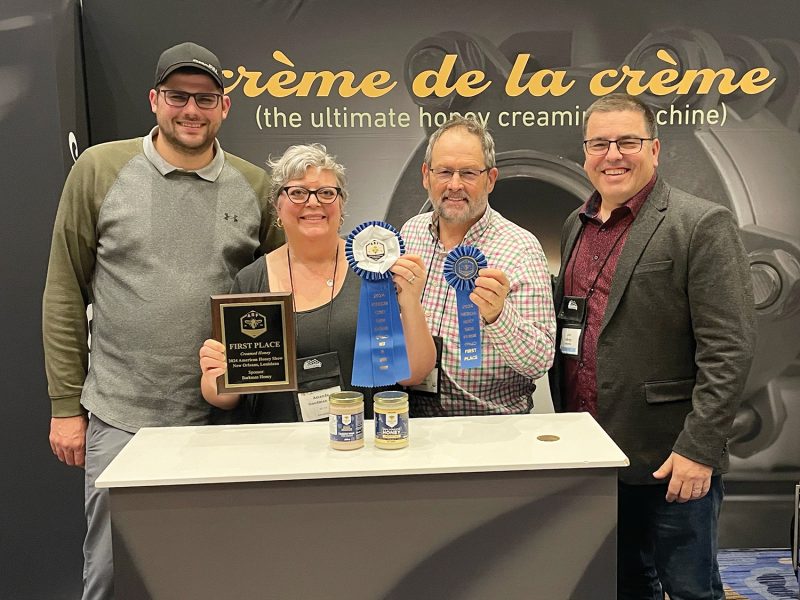
Creston beekeepers Amanda Goodman Lee and Jeff Lee, centre, took home top honours at the North American Honey Bee Expo in January with the help of a specialized honey creamer from Quebec's family-run Creampal Equipment, represented by brothers Sébastien, left, and Joel Laberge, right. Photo | Jeff Lee

March 1, 2024 byVanessa Farnsworth

CRESTON – The year is off to a roaring start for Kootenay beekeepers Amanda Goodman Lee and Jeff Lee.

Facing stiff competition at the prestigious American Beekeeping Federation’s (APF’s) 2024 American Honey Show in New Orleans in January, their honey took home top prize in several categories including Best of Show.

A week earlier, one of their creamed honeys placed first in its category at the highly competitive North American Honey Bee Expo’s Honey Show in Louisville, Kentucky.

“We had a really good January. It was a great way to start the year, that’s for sure,” says Goodman Lee, whose Best of Show honey went on to fetch more than $800 per jar at an auction to benefit APF programming. A jar of that honey normally sells for closer to $15.

The couple has come a long way since first taking up beekeeping as a hobby while living in New Westminster. It wasn’t long before they realized they wanted more from beekeeping than a casual way to spend their leisure time and they started Honey Bee Zen Apiaries in 2012.

“Making the choice to get into beekeeping started as a lifestyle choice and ended up as a business opportunity,” says Lee.

By 2017, the business had outgrown its New Westminster location and when the opportunity arrived to purchase Swan Valley Honey in Creston, they leapt at it.

“We came over and looked at it for a few hours and literally fell in love with the place,” Lee says.

Swan Valley Honey had several things going for it: an established roster of commercial clients, an extensive network of established bee yards and a relatively efficient honey house for processing.

“It had the three legs that were necessary to make the business work and we bought it outright,” Lee says. “And then immediately we went through some downturns.”

Early setbacks

There were issues surrounding production facilities and breakdowns, but by far the biggest challenge came in 2018 when an infestation of varroa mites resulted in the couple losing close to 90% of the 400 colonies they had at the time.

“That just about finished us. We had to rebuild with about 40 colonies and we had to buy a bunch of packages,” Lee says, referring to the small, specially built boxes of bees used to start new hives. “It took a lot of money to do that.”

Six years down the road, he can be philosophical about those early challenges.

“The reality is, when we talk about the problems beekeepers have, about winter mortality, it has everything to do with a complex relationship of beekeeper behaviour, weather patterns, these mites and diseases,“ Lee says.

Some other challenges the growing business faced are enviable, including the times when they haven’t been able to produce enough honey to meet high demand. When that happens, they bring in honey from other producers they know and trust, changing the labels on their jars to clearly reflect this.

“We say to our commercial customers, if you don’t want to buy this honey because you’d rather wait for our [own] to come back into season, we understand,” Lee says. “The reason why our company is doing really well is because we have a level of integrity and transparency that’s key. We believe that you don’t lie to your customers. You don’t try to fool them.”

Because Swan Valley Honey has been in the kitchens of Kootenay residents for more than 50 years, the Lees decided to keep that branding for their liquid honey line. Every other honey they produce, including their creamed and varietal honeys, are marketed under the Honey Bee Zen brand.

“Swan Valley Honey had such a deep penetration and support amongst Kootenay residents that it made no sense for us to change the name to Honey Bee Zen,” Lee says.

With time has come success.

During the first year of production at their Creston location, Honey Bee Zen Apiaries generated four barrels of honey totaling 2,500 pounds. Now they produce between 40 and 80 barrels (25,000 to 50,000 pounds) annually of their Kootenay wildflower honey alone, while maintaining 300 to 500 large production colonies and about 400 smaller nucleus colonies that they use to replace overwintering losses in their production hives and sell to customers.

“Our goal over the next two years is to move to 1,000 production hives,” Lee says.

The severe freeze in January didn’t significantly impact their larger production hives but it did hit their smaller nucleus colonies hard.

“I think they were probably just too small,” Goodman Lee says. “When you have such a long period of cold, the bees can’t generate enough heat to  fill that box and keep it warm.”

In addition to honey, the company produces salves, lip balms, beeswax candles and tinctures that use a resin-like compound called propolis that’s collected from its hives.

“We try to use as many products from the hive as we can,” Goodman Lee says. “It’s a great add-on to our business.”

While January and February are typically quiet months for the company, the recent award wins and ensuing media coverage have had a major impact on business.

“I’m doing deliveries and I’m going in and the shelves are empty [of our products]. That’s a wonderful problem to have and we’re like hamsters on a wheel running to catch up with ourselves,” says Goodman Lee. “We even had to upgrade our website because it couldn’t handle the volume of traffic going to it.”

Honey Bee Zen Apiaries sells honey on site, at farmers markets and through its website but its business model focuses on supplying commercial clients, and the recent attention has drawn inquiries from across Canada.

Because their honey house has been certified by the Canadian Food Inspection Agency, the Lees can ship their honey across Canada and internationally.

Whether or not the recent surge in interest translates into ongoing demand is an open question.

“Is it going to taper off and we’ll go back to a normal level of sales or is this escalating our business?” Goodman Lee wonders. “It’s a hard position to be in as a small business.”

Lee agrees.

“We aren’t afraid to hire people and we’re not afraid to take calculated risks because I don’t think you can grow a farm business without understanding what the risks are and being willing to take it on,” he says.
Related Posts

You may be interested in these posts from the same category.

Creston beekeeper wins award

Contracts cancelled for beekeepers

Beekeepers Zoom for 100th AGM

Previous Post: « New replant funding announced
Next Post: Forecasting will improve with AI technology »

Copyright © 2025 Country Life in BC · All Rights Reserved