
• Menu
  • Skip to primary navigation
  • Skip to main content
  • Skip to primary sidebar

Country Life In BC Logo

The agricultural news source in British Columbia since 1915

  • Headlines
  • Calendar
  • Subscribe
  • Advertise
  • About
  • Archives
  • Contact
  • Search
  • Headlines
  • Calendar
  • Subscribe
  • Advertise
  • About
  • Archives
  • Contact
  • Search

Primary Sidebar

Originally published:

September 2017
Vol. 103 Issue 9

Subscribe Now!

Sign up for free weekly FARM NEWS UPDATES

Select list(s) to subscribe to


By submitting this form, you are consenting to receive marketing emails from: Country Life in BC. You can revoke your consent to receive emails at any time by using the SafeUnsubscribe® link, found at the bottom of every email. Emails are serviced by Constant Contact
Your information will not be
shared or sold ever

Stories In This Edition

Bleak

Rising from the ashes

Foreign ownership on radar

Local knowledge & premise ID earn creditibility

Political overhaul targets major issues

Back to the future

Back Forty: Support can’t come soon enough

Viewpoint: Smartphones dial up new green revolution

Govt orders review of contaminated acquifer

Ag waste regs coming

Perfect attendance

BC-Washington collaborate on water mgmt

BC leads in organic consumption

Bracing for second flight of armyworm

Budget funding starts flowoing for genomics work

The “S” Team

Ag ministers sign new funding framework

Supply management takes hit

Delta land swap yields benefits

Consolidation strengthens ALR exclusion bid

Salt Spring facility gets big boost from local donor

Corn rootworm infesting FV crops

Kelowna farmers’ market gives new location a try

Compensetion sought for Clinton backburn

Fall promises volatility in cattle markets

Cattle feeders face certain uncertainties

Shave Shower Shampoo

Strong showing for Hereford Bonanza

Grain research helps address shifting conditions

FV, N OK dairies win at Chilliwack

Research: Breeding cows to beat the heat

Kootenay program aims to revive extension expertise

Beet trials target “seed sovereignty”

New hop debuts

Washington lab holds opportunities for grain growers

Sheep dog trials make comeback

Bear kills cause grief for Island sheep producers

Get it in writing

Celebrating 100 years: Eaglet FI

Managing risks, seizing opportunities

Naturally rich soil, low inputs support Kelowna garden

In celebration of thse who buy local

Woodshed: Ashley exercises power of persuasion

Jude’s Kitchen: Back-to-it Bites

More Headlines

Follow us on Facebook

Comments Box SVG iconsUsed for the like, share, comment, and reaction icons

14 hours ago

... See MoreSee Less

View Comments
  • Likes: 6
  • Shares: 0
  • Comments: 0

Comment on Facebook

2 days ago

Four 4-H members were walking the Islands Ag Show Friday sharing leftover flower lollipops to exhibitors. The colourful pops were prizes for those who guessed answers based on the 4-H project boards on display at the show. Left to right, Talia Prenger, Kate Barter, Ella Prenger and Emma Barter of Parksville and Qualicum thought making lollipops into flowers "was really cute," says Kate. The Islands Ag Show wraps up today at 2 pm at the Cowichan Exhibition Centre. Stop by our booth and say hi to Ronda, Bob and Ann!

#BCAg
... See MoreSee Less

Four 4-H members were walking the Islands Ag Show Friday sharing leftover flower lollipops to exhibitors. The colourful pops were prizes for those who guessed answers based on the 4-H project boards on display at the show. Left to right, Talia Prenger, Kate Barter, Ella Prenger and Emma Barter of Parksville and Qualicum thought making lollipops into flowers was really cute, says Kate. The Islands Ag Show wraps up today at 2 pm at the Cowichan Exhibition Centre. Stop by our booth and say hi to Ronda, Bob and Ann! 

#BCAg
View Comments
  • Likes: 23
  • Shares: 4
  • Comments: 0

Comment on Facebook

3 weeks ago

The Canadian Food Inspection Agency is preparing to implement changes to its livestock traceability rules that will include mandatory computer reporting within seven days on movement of animals for veterinary appointments, community pastures, exhibitions, carcass and on-farm disposal and the births and deaths of every animal on your farm. Writer Tom Walker first brought these changes to the attention of our readers back in June 2023. We've posted his story to our website:

www.countrylifeinbc.com/cfia-proposes-traceability-updat#BCAg#BCag
... See MoreSee Less

The Canadian Food Inspection Agency is preparing to implement changes to its livestock traceability rules that will include mandatory computer reporting within seven days on movement of animals for veterinary appointments, community pastures, exhibitions, carcass and on-farm disposal and the births and deaths of every animal on your farm. Writer Tom Walker first brought these changes to the attention of our readers back in June 2023. Weve posted his story to our website: 

https://www.countrylifeinbc.com/cfia-proposes-traceability-updates/

#BCag
View Comments
  • Likes: 11
  • Shares: 21
  • Comments: 15

Comment on Facebook

I love hpw the cow in the picture hasn't even got a RFID tag in it but I digress. We can not read the link, it says "we are not permitted to read drafts". Please post again with the correct link.

Dairy farmers having been doing this several years. The app we use has become quite simple to use

Including equine?

Premise ID was slowly rolled through the country, voluntary then mandatory. Transparency and 'Consultation' has been light. Those who tried to bring this for discussion a couple years ago, because of forseen overreach, were quite often labeled conspiracy theorists and that it wasnt meant to be so heavily regulated and controlled. Gardens and seeds will be next. "Invasive species" reporting, check out the plants medicinal properties. Read the BC intentions papers. The premise ID that already heavy regulated commodities have claims to be treated different in the intentions papers on page 8. www2.gov.bc.ca/assets/gov/farming-natural-resources-and-industry/agriculture-and-seafood/food-saf...

Says i am "not allowed to preview draft".

Also concerning is the part on compliance...they can 'stumble onto' any farm and if you're not complying there are consequences.

When the CFIA stumbles into the wrong place compliance will be met with civil engagement

Says I can't preview draft

This is government overreach - Do Not Comply!

Do not comply

Fu

As if the price of beef isn't bad enough for consumers,,,,,be prepared to be gouged some more now

Ridiculous!!

Let's hold up on the beef exports tell we can get our own house in order... we need to deregulated, cheapen up the supply chain back into a 5 buck a pound rage so the good people canada can eat healthy food.. fuck your bean diets, that's retarded

This, along with the majority of new legislation pertaining to any type of farm, is a blatant squeeze on any sort of small, alternative agricultural venture. I am a massive believer in working together and sharing resources and costs and solutions - do not get me wrong - but this and the water registration among others, is an overreach (at most generous) and an absolute killer to smaller, local initiatives that LITERALLY save lives during extreme events. There is ONE ROAD into and out of my community. We don’t need or want some sort of backlogged government response when shit goes sideways. We want the ability AND SUPPORT to provide for our communities without penalty when things go badly. We want to produce sustainability for our communities. We live here, we work here, we want to STAY HERE. Stop making it harder.

View more comments

1 month ago

BC's minimum piece rates for 15 hand-harvested crops increased 2.6% on December 31. Crops include peaches, apricots, brussels sprouts, daffodils, mushrooms, apples, beans, blueberries, cherries, grapes, pears, peas, prune plums, raspberries and strawberries. Farm-worker piece rates in BC were increased by 11.5% in January 2019 and 6.9% in December 2024. BC’s current minimum wage sits at $17.85 per hour.

#BCAg
... See MoreSee Less

BCs minimum piece rates for 15 hand-harvested crops increased 2.6% on December 31. Crops include peaches, apricots, brussels sprouts, daffodils, mushrooms, apples, beans, blueberries, cherries, grapes, pears, peas, prune plums, raspberries and strawberries. Farm-worker piece rates in BC were increased by 11.5% in January 2019 and 6.9% in December 2024. BC’s current minimum wage sits at $17.85 per hour. 

#BCAg
View Comments
  • Likes: 9
  • Shares: 0
  • Comments: 2

Comment on Facebook

I'm not sure what they're telling us. Did peace rates have to increase so that Farm workers could make minimum wage?

They deserve it, but the general public will be whining about increased prices in the stores. Will need to make more information average to the g.p.

1 month ago

... See MoreSee Less

View Comments
  • Likes: 14
  • Shares: 0
  • Comments: 1

Comment on Facebook

105 Mile Ranch

Subscribe | Advertise

The agricultural news source in British Columbia since 1915
  • Email
  • Facebook

Corn rootworm infesting Fraser Valley crops

September 1, 2017 byRonda Payne

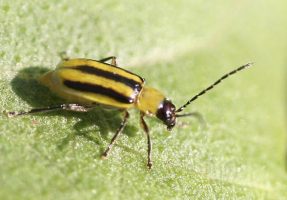
ABBOTSFORD – BC farmers have been spared from the damaging effects of corn rootworm. That is, until last year, when the beetles were first discovered in sweet corn in the Fraser Valley.

BC Ministry of Agriculture entomologist Tracey Hueppelsheuser says damage from the pest can be substantial. Both the larvae and adult beetles cause damage.

“They call it the billion- dollar bug in the Midwest, so it’s significant,” she says.

Damage has been seen primarily in the central Fraser Valley on both sides of the river but Hueppelsheuser and others continue to be watchful throughout the province.

“[The beetles] have mandibles and they actually like pollen so they do seek out flowers and pollinating plant parts. They like silks of corn and they can actually prevent the cob fill in corn as a result of their feeding,” she notes.

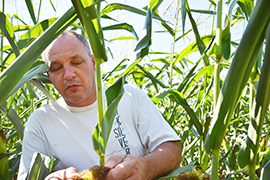
“The other thing the beetles do is feed on the leaf tissues and they eat the top surface of the leaves, so all the green tissue, and then they just leave the outer bottom layer of the corn leaf,” she says. “The leaves start to look bleached and white.”

Dairy farmer Sid Stoker of Fraser Edge Farms in Deroche has the beetle in his forage corn but, fortunately, not in massive quantities.

“The guy who does my custom planting … he said, ‘we’re just checking the field to see who has it and who doesn’t,’” Stoker says. “All we had was the beetles. Didn’t see worms; it’s past that stage.”

He does have some of the bleaching in his field.

Hueppelsheuser notes beetles were first spotted in fields this summer on July 24. The pests’ appearance ramped up quickly after that. Some growers were able to spray but she feels late planting put the corn at greater risk.

“The first sprays went on in early August and would have been just one application in a few select fields,” she says. “Some corn would have been too tall to get the sprayer in.”

Hueppelsheuser says Sevin (carbaryl) is approved for corn rootworm.

“More significant damage is from the larvae, which occurs in June and July,” she says. “So we’re seeing the beetles now and it’s really obvious … but the larvae damage is now going to be something significant.”

Eggs of the beetle overwinter, then as they hatch in early to mid-June, they feed on corn roots, destroying the brace roots. This causes corn to tip, possibly grow upright after tipping, or look like it has been hit by drought. Fields have looked patchy, Hueppelsheuser says, depending upon where the greatest quantities of the pest are.

“Some growers are just trying to keep their corn watered and as vigorous as possible even though they know their roots have been compromised,” she says. “I think people are probably going to have to consider cutting their fields a bit earlier.”

The task will be to prevent potentially increased damage next season. The primary method of control is crop rotation.

“Corn is the primary host, though there can be some survival on some grass species … this beetle just really needs corn to survive,” Hueppelsheuser says.

“An excellent way to manage the corn rootworm is to not give them corn back in that field next year … The really weak link in this insect is that it’s really reliant on corn. Rotation is the number one and best tool for control of corn rootworm.”

If rotation is planned, a crop needs to be found to ensure tonnage for cows without corn. If rotation is impossible, traited corn is another option.

“The corn hybrids that they choose to grow [in the midwest] are ones that have the Bt genetics, so they make the corn toxic to the larvae,” she says. “I’ve talked to the corn seed dealers and they have pulled a little bit of the seed to growers who experienced challenges with corn rootworm last year and I’ve seen some of those fields and they look great. They’re clearly resistant to the beetles.”

She feels growers who experienced corn rootworm need to consider the hybrid varieties of corn seed.

“We probably will [rotate] for that reason,” Stoker says. “We’ll be looking into [traited corn] – at least there’s that option.”
Related Posts

You may be interested in these posts from the same category.

Corn rootworm hits Okanagan

Previous Post: « Food testing within reach
Next Post: Compensation sought for Clinton backburn debacle »

Copyright © 2026 Country Life in BC · All Rights Reserved