• Menu
  • Skip to primary navigation
  • Skip to main content
  • Skip to primary sidebar

Country Life In BC Logo

The agricultural news source in British Columbia since 1915

  • Headlines
  • Calendar
  • Subscribe
  • Advertise
  • About
  • Archives
  • Contact
  • Search
  • Headlines
  • Calendar
  • Subscribe
  • Advertise
  • About
  • Archives
  • Contact
  • Search

Primary Sidebar

Originally published:

MAY 2020
Vol. 106 Issue 5

Subscribe Now!

Sign up for free weekly FARM NEWS UPDATES

Select list(s) to subscribe to


By submitting this form, you are consenting to receive marketing emails from: Country Life in BC. You can revoke your consent to receive emails at any time by using the SafeUnsubscribe® link, found at the bottom of every email. Emails are serviced by Constant Contact
Your information will not be
shared or sold ever

Stories In This Edition

Rapid response

Worker health crisis

Spring melt floods Cariboo

Foreign Labour an essential service for fruit growers

Editorial: Watershed moments

Back Forty: COVID-19 will be a reality check for many

Viewpoint: Register now, question later to keep water rights

COVID-19 has varied impact on poultry sector

Social distancing

Honey producers keep focus on research

Beekeepers stung about import issues

Sidebar: Advocating for technology transfer

Farmland values facing headwinds

IAFBC defers major decisions

BCAC focuses on public trust with lower budget

AgSafe governance set for a shake-up

COVID-19 leads to oversupply of dairy

BC Fairs positive as large events banned

Peace growers facing multiple challenges

Co-op considers four-way fix at crossroads

Surprise audits to double

Co-op focuses on cutting costs, increasing sales

Volatility from plant shutdowns could hit BC

Island farmers renew request for local abattoir

Meat processing capacity stable despite closures

Direct marketing saves producers’ bacon

Small producers ride the online sales wave

Farm equipment dealers keep sale smoving

Strawberry growers pin survival on levies

Sidebar: Blueberry and raspberry AGMs postponed

Raspberry growers target fresh market, quality

Apple soda breaks ground in saturated market

Chilliwack family cracks open direct sales

EFB-resistant trees not out of the woods

Distillery shows resilience as it adapts to market

Home gardeners overwhelm seed companies

Sidebar: Commercial seed supply affected

Research: Viruses pursue unique strategies to evolve

Moisture sensors are not created equal

Woodshed: Kenneth gives new meaning to social isoluation

Farmers’ markets go online as channels shift

Farm Story: Pandemic forces a hard pivot to stay in the game

Cheesemaker adapts to coronavirus restrictions

Jude’s Kitchen: Stay-healty food in uneasy times

More Headlines

Follow us on Facebook

Comments Box SVG iconsUsed for the like, share, comment, and reaction icons

7 days ago

... See MoreSee Less

View Comments
  • Likes: 4
  • Shares: 0
  • Comments: 0

Comment on Facebook

7 days ago

On the last day of the BC Organic Conference, Thursday, Molly Thurston of Pearl Agricultural Consulting helped growers learn how to manage bugs such as codling moth, wireworm, and rootworm in organic growing systems. Her talk alongside Renee Prasad included hands-on activities in which participants checked out various traps and examined pests under microscopes. Be sure to look for more upcoming ag events on our online calendar at www.countrylifeinbc.com/calendar/

#BCAg
... See MoreSee Less

On the last day of the BC Organic Conference, Thursday, Molly Thurston of Pearl Agricultural Consulting helped growers learn how to manage bugs such as codling moth, wireworm, and rootworm in organic growing systems. Her talk alongside Renee Prasad included hands-on activities in which participants checked out various traps and examined pests under microscopes. Be sure to look for more upcoming ag events on our online calendar at www.countrylifeinbc.com/calendar/

#BCAg
View Comments
  • Likes: 15
  • Shares: 0
  • Comments: 0

Comment on Facebook

1 week ago

Well-known organic farmer and podcaster Jordan Marr gets interviewed by Country Life in BC’s own columnist and potato mavin Anna Helmer during the opening session of the BC Organic Conference at Harrison Hot Springs yesterday. Sessions run today (Wednesday) and Thursday and include organic and regenerative growing practices and expanding and advocating for the organic sector, all under the background of the newly launched Organic BC banner.

#BCAg
... See MoreSee Less

Well-known organic farmer and podcaster Jordan Marr gets interviewed by Country Life in BC’s own columnist and potato mavin Anna Helmer during the opening session of the BC Organic Conference at Harrison Hot Springs yesterday. Sessions run today (Wednesday) and Thursday and include organic and regenerative growing practices and expanding and advocating for the organic sector, all under the background of the newly launched Organic BC banner.

#BCAg
View Comments
  • Likes: 37
  • Shares: 2
  • Comments: 1

Comment on Facebook

Interested in finding out more about this

3 weeks ago

Today, we remember those who sacrificed their lives or their well-being for our freedom. Lest we forget. ... See MoreSee Less

Today, we remember those who sacrificed their lives or their well-being for our freedom. Lest we forget.
View Comments
  • Likes: 8
  • Shares: 0
  • Comments: 0

Comment on Facebook

1 month ago

FarmFolk CItyFolk is hosting its biennial BC Seed Gathering in Harrison Hot Springs November 27 and 28. Farmers, gardeners and seed advocates are invited to learn more about seed through topics like growing perennial vegetables for seed, advances in seed breeding for crop resilience, seed production as a whole and much more. David Catzel, BC Seed Security program manager with FF/CF will talk about how the Citizen Seed Trail program is helping advance seed development in BC. Expect newcomers, experts and seed-curious individuals to talk about how seed saving is a necessity for food security. ... See MoreSee Less

Link thumbnail

BC Seed Gathering - FarmFolk CityFolk

farmfolkcityfolk.ca

Save the date for our upcoming 2023 BC Seed Gathering happening this November 3rd and 4th at the Richmond Kwantlen Polytechnic University campus.
View Comments
  • Likes: 1
  • Shares: 0
  • Comments: 0

Comment on Facebook

Subscribe | Advertise

The agricultural news source in British Columbia since 1915
  • Email
  • Facebook

Distillery shows resilience as it adapts to market

COVID-19 creates opportunity for Forbidden Spirits’ alcohol

May 1, 2020 byMyrna Stark Leader

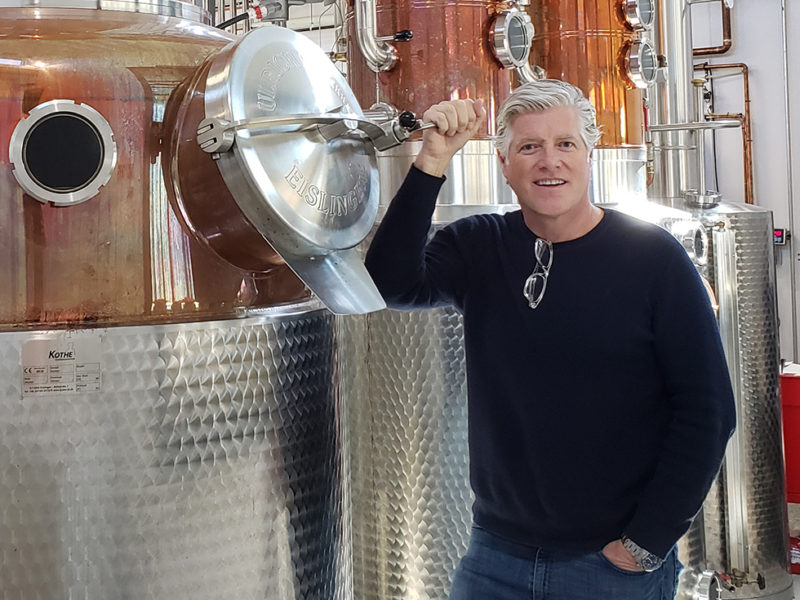
KELOWNA – A retired accountant from Vancouver has given a mature orchard a new lease on life with a vodka that’s finding a niche in local and international markets.

Blair Wilson and his wife moved to southeast Kelowna about 10 years ago after several business ventures in Vancouver and a career in federal politics, including sitting as the Green Party of Canada’s first-ever MP. The couple settled on a 20-acre parcel that came with 6,000 Ambrosia and about 300 Spartan apple trees. Not one to relax, Wilson took up farming. The fruit was sold to BC Tree Fruits Co-op.

“I never realized how hard being a farmer is until then,” says Wilson, a self-proclaimed entrepreneur.

When he saw the returns he was getting for the fruit, he decided there must be another opportunity. He explored making cider but the cost of canning was prohibitive. Instead, he settled on vodka production after chatting with a copper still manufacturer at a whiskey conference in Seattle.

He hired a chemist to figure out the right components for a winning recipe, including a proprietary yeast. Wilson’s apples plus apple concentrate from Kelowna’s Sun-Rype juice plant now underpin two premium apple vodkas: Rebel, which is distilled 25 times, and Forbidden Spirits, distilled 50 times. Added distillations remove impurities and create a smoother-tasting end product.

“Typical vodkas tend to be distilled between three and 10 times,” he explains.

It takes about 25 pounds of apples make one 750-ml bottle of Rebel.

Wilson opened a production facility and tasting room in 2019 and recently received a lounge licence for a 75-seat outdoor patio. Additional tanks were added this spring to accommodate orders he’d been working hard to negotiate from the European Union and China.

“When you have a great-tasting, quality product that’s made in Canada, foreigners are willing to buy. They love the Canadian reputation of being safe and producing things that are safe, clean, and good for you, and that’s helped with marketing,” he says.

But exports demand attention to details quite different from the local market.

“Each country and even each port sometimes has different rules about importing alcohol,” says Wilson. “Navigating the continually shifting sands of economic politics and trade, like Brexit, also takes persistence and agility.”

On the plus side, he says a free trade agreement with Europe means products from Canada don’t face the 25% tariff that US products do. China’s palate for alcohol is also changing from sweeter to dryer, creating opportunities there as well. This spring, Wilson and his wife were booked to be part of a trade mission to South Korea organized by the BC government but it was cancelled due to COVID-19.

That’s not the only change in plans the distillery has faced this spring.

In April, Forbidden Spirits retooled its processing to meet an emerging demand brought about by COVID-19 for industrial-grade alcohol for hand sanitizer, joining the likes of Okanagan Spirits, Wise Acre Distillery and others across the province.

Wilson says the speed of the approval process for the switch amazed him. He put his application in with the federal government to produce alcohol for sanitizer one day and received a phone call from them the next.

“We have all the paperwork done and the licences and continue to work to source bottles, which is the common challenge. I’ve managed to find some in Kentucky,” he says.

Provincial regulations allow production through July 15.

With the new business model, including sanitizer give-away days for the public, Wilson hopes to at least break even without the usual tasting room traffic and overseas sales, both on hold due to COVID-19.

With an estimated daily production of 1,000 litres of sanitizer, he looks forward to rehiring staff laid off in early March when normal business halted. He’s thankful the federal government is providing a 75% subsidy for small business wages to help him make payroll and help cover interim carrying and operating costs during the crisis.

While they are still selling vodka locally, foreign orders are on hold, but there is vodka in tanks ready when the crisis passes.

Wilson is also working to put together a Canadian Craft Spirit Association, a national group that will lobby for changes to the $3.51 federal excise tax per bottle that craft distillers have to pay when producing limited quantities using local Canadian agriculture products.

 

Related Posts

You may be interested in these posts from the same category.

COVID-19 response reviewed

Federal election call

Farmers market returns

Sector events start growing

WorkSafeBC increases inspections

Sunrise Poultry COVID outbreak

Flight ban strands workers

Travel restrictions raise concerns

Foreign worker vaccination prioritized

Strict pandemic plan keeps workers safe

Growers anxious about labour

Governments boost worker supports

Previous Post: « Victoria food hub gets funding
Next Post: Chilliwack family cracks open direct sales »

Copyright © 2025 Country Life in BC · All Rights Reserved