• Menu
  • Skip to primary navigation
  • Skip to main content
  • Skip to primary sidebar

Country Life In BC Logo

The agricultural news source in British Columbia since 1915

  • Headlines
  • Calendar
  • Subscribe
  • Advertise
  • About
  • Archives
  • Contact
  • Search
  • Headlines
  • Calendar
  • Subscribe
  • Advertise
  • About
  • Archives
  • Contact
  • Search

Primary Sidebar

Originally published:

FEBRUARY 2021
Vol. 107 Issue 2

Subscribe Now!

Sign up for free weekly FARM NEWS UPDATES

Select list(s) to subscribe to


By submitting this form, you are consenting to receive marketing emails from: Country Life in BC. You can revoke your consent to receive emails at any time by using the SafeUnsubscribe® link, found at the bottom of every email. Emails are serviced by Constant Contact
Your information will not be
shared or sold ever

Stories In This Edition

CPR on ALR Track

Sea of greens

Farm properties rising

Genomics lab expands service to local growers

Editorial: Put farmers first

Back 40: Knowing when to pull back on extensions

Viewpoint: A watershed moment for BC farms

Egg producer questions support for local eggs

Milk consumption up among young minorities

Nutrient recovery system in third phase

North Saanich approves Sandown proprosal

Tsartlip acquire Woodwyn Farm with provincial help

Woodwynn Farm was first known as Mawuec

Pandemic was profitable for nursery growers

Researcher brings experience to sweet role

Consultant delivered practical advice

Tributes pour in for Island farmer Colin Springford

On-farm abattoir approved for Alberni Valley

Plans for a provincial weather network move forward

Feedlots under pressure with kill instability

If you go out in the woods today …

Round bale bounty

CFIA services get a funding boost

Help available for farm business succession

Sidebar: Considering all the options

Diversification helps farms prepare for challenges

Creston advocacy group continues push for food hub

Frind matches his love of data with grape production

Greenhouse sets example for others to follow

On-farm food networks wire farms for success

OK irrigation systems have a long history

Pemberton family farms beer with deep roots

When life gives you lemons

Personal money strategy as important as farm stragegy

Farm Story: Winter brings the distractions of technology

Well-designed vegetable coolers make for hot sales

Woodshed: Janice Newberry sets the record straight

Research: Plants can recognize attacking herbivores

Jude’s Kitchen: Super simple

More Headlines

Follow us on Facebook

Comments Box SVG iconsUsed for the like, share, comment, and reaction icons

6 days ago

... See MoreSee Less

View Comments
  • Likes: 4
  • Shares: 0
  • Comments: 0

Comment on Facebook

6 days ago

On the last day of the BC Organic Conference, Thursday, Molly Thurston of Pearl Agricultural Consulting helped growers learn how to manage bugs such as codling moth, wireworm, and rootworm in organic growing systems. Her talk alongside Renee Prasad included hands-on activities in which participants checked out various traps and examined pests under microscopes. Be sure to look for more upcoming ag events on our online calendar at www.countrylifeinbc.com/calendar/

#BCAg
... See MoreSee Less

On the last day of the BC Organic Conference, Thursday, Molly Thurston of Pearl Agricultural Consulting helped growers learn how to manage bugs such as codling moth, wireworm, and rootworm in organic growing systems. Her talk alongside Renee Prasad included hands-on activities in which participants checked out various traps and examined pests under microscopes. Be sure to look for more upcoming ag events on our online calendar at www.countrylifeinbc.com/calendar/

#BCAg
View Comments
  • Likes: 15
  • Shares: 0
  • Comments: 0

Comment on Facebook

1 week ago

Well-known organic farmer and podcaster Jordan Marr gets interviewed by Country Life in BC’s own columnist and potato mavin Anna Helmer during the opening session of the BC Organic Conference at Harrison Hot Springs yesterday. Sessions run today (Wednesday) and Thursday and include organic and regenerative growing practices and expanding and advocating for the organic sector, all under the background of the newly launched Organic BC banner.

#BCAg
... See MoreSee Less

Well-known organic farmer and podcaster Jordan Marr gets interviewed by Country Life in BC’s own columnist and potato mavin Anna Helmer during the opening session of the BC Organic Conference at Harrison Hot Springs yesterday. Sessions run today (Wednesday) and Thursday and include organic and regenerative growing practices and expanding and advocating for the organic sector, all under the background of the newly launched Organic BC banner.

#BCAg
View Comments
  • Likes: 37
  • Shares: 2
  • Comments: 1

Comment on Facebook

Interested in finding out more about this

3 weeks ago

Today, we remember those who sacrificed their lives or their well-being for our freedom. Lest we forget. ... See MoreSee Less

Today, we remember those who sacrificed their lives or their well-being for our freedom. Lest we forget.
View Comments
  • Likes: 8
  • Shares: 0
  • Comments: 0

Comment on Facebook

1 month ago

FarmFolk CItyFolk is hosting its biennial BC Seed Gathering in Harrison Hot Springs November 27 and 28. Farmers, gardeners and seed advocates are invited to learn more about seed through topics like growing perennial vegetables for seed, advances in seed breeding for crop resilience, seed production as a whole and much more. David Catzel, BC Seed Security program manager with FF/CF will talk about how the Citizen Seed Trail program is helping advance seed development in BC. Expect newcomers, experts and seed-curious individuals to talk about how seed saving is a necessity for food security. ... See MoreSee Less

Link thumbnail

BC Seed Gathering - FarmFolk CityFolk

farmfolkcityfolk.ca

Save the date for our upcoming 2023 BC Seed Gathering happening this November 3rd and 4th at the Richmond Kwantlen Polytechnic University campus.
View Comments
  • Likes: 1
  • Shares: 0
  • Comments: 0

Comment on Facebook

Subscribe | Advertise

The agricultural news source in British Columbia since 1915
  • Email
  • Facebook

Egg producer questions support for local eggs

Transparency needed from distributors, retailers

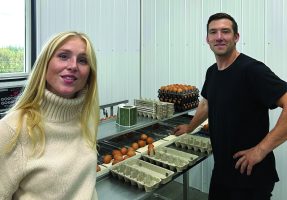
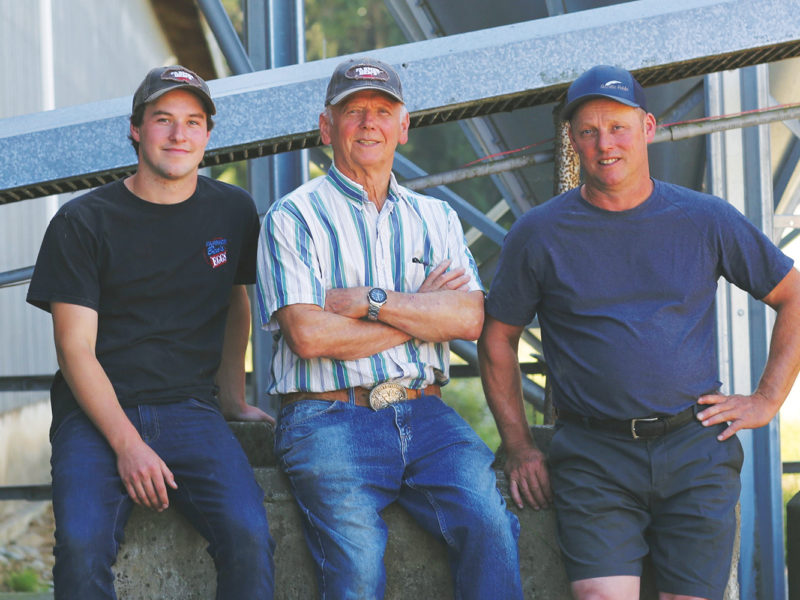
Campbell, Ben and Ian Woike of Farmer Ben’s Eggs. PHOTO / FARMER BEN’S EGGS

February 1, 2021 byJackie Pearase

DUNCAN – A Vancouver Island egg producer/grader wants the corporate egg business to give consumers more transparency and choice.

A blog post on the Farmer Ben’s Eggs website in early December questioned the branding of some eggs sold on the island as being island-produced when, in fact, many of the eggs originate off-island and perhaps even out-of-province.

The post also questioned why local grocery stores can’t carry certain eggs thanks to contracts signed at corporate headquarters elsewhere in Canada.

Jennifer Woike wrote the piece after being thwarted in her efforts to gain a foothold in larger grocery stores.

“Unfortunately, to get into any kind of grocery chain it’s near next to impossible. We’ve been in business for 30 years in the Cowichan Valley and we just get turned away time and time again,” Woike says. “Just last week we had a grocery chain contact us and ask us to offer them some pricing … and then we got an e-mail that said unfortunately we’re under contract with the grader, the other provider, and we can’t take your eggs even though we want to.”

Understanding that Vancouver Island egg farmers do not produce enough eggs to satisfy demand, Woike points out that it was local producers who picked up the slack when COVID-19 resulted in empty shelves at grocery stores.

“We never shorted one of our customers, not one time through the pandemic. Actually, we uptook one of the major grocery store chains because they called us in desperation, not having any eggs on their shelves. We had product to them within two hours and we serviced them for three and a half months. Then, once the other grader caught wind that was happening and they started to get their supplies back up, the store was forced to drop us,” she says. “We learned through COVID that [the industry] is definitely not sustainable but we could be more sustainable than we are currently.”

Woike is also concerned that consumers are being led to believe all their eggs come from the island through packaging and marketing practices.

“The branding the other grader is using is misleading and confusing. I think that the majority of the population doesn’t know that their eggs aren’t from the island. Even though that word is in all of their marketing,” says Woike. “I think it’s unfair for us but I think it’s more unfair for the consumer.”

The misleading information regarding egg origins means consumers can’t buy what they want to buy, and restrictive contracts mean they have less choice at the supermarket.

“I really think that’s unfair,” says Woike.

Millions of eggs

Started in 1994, Farmer Ben’s Eggs is the largest producer/grader serving Vancouver Island. The farm sells 1.7 million dozen eggs a year.

According to the BC Egg Marketing Board, Vancouver Island egg farmers produced just under five million dozen eggs last year through November 2020. BC’s 144 registered egg farmers raise over 3.2 million layer hens that produce more than 87 million dozen eggs annually.

According to Egg Farmers of Canada, almost 55.8 million dozen Grade A eggs (in shell) moved inter-provincially and territorially in Canada in 2020. BC purchased almost 9 million dozen eggs from other provinces in 2020 and sold just over 31,000 dozen in total to the Yukon, Alberta and Ontario.

Ontario-based Burnbrae Farms Ltd., which purchased Island Eggs in 2007 and is a major grader on Vancouver Island, would not comment on the percentage of its shelled eggs that originate off-island or the volume of shelled eggs it deals with on Vancouver Island or Canada.

Burnbrae president Margaret Hudson says the company collects eggs from 32 farms on Vancouver Island and in the Lower Mainland for its Island Eggs grading facility.

She says interprovincial movement of eggs is necessary to meet needs across Canada.

“To ensure Canadians have the eggs they need every day, we move eggs from provinces that have an oversupply to those that have unmet demand. British Columbia does not produce enough eggs annually to meet its ever-rising consumer demand, nor does Vancouver Island have sufficient egg production to meet the needs of those living on the island. This was true even before the pandemic. Today, we supply approximately 20% of the BC egg market and we are pleased to say that our fulfillment rate to our grocery store customers on the island is over 98%.”

Hudson would not comment on restrictive contracts and marketing Woike typifies as unfair and misleading.

“We will continue to do everything we can to supply island-raised eggs to those who prefer them,” she says. “For those consumers interested in only buying eggs processed at Island Eggs, there is an easy way to check. Look for the code on the end of the carton and if it begins with BI, you can be assured the eggs are from our facility on the island. We have added language to our website to clarify our sourcing practices.”

Providing choice

Vancouver Island egg farmer Ross Springford sells 65% to 70% of his free-range eggs to Island Eggs. The rest are sold to specific customers and at Springford Farm in Nanoose Bay.

Springford says providing consumers with choice is critical but going up against the big players is not an avenue he would take.

“It’s not a problem for us because we don’t go into the big grocery stores. Our business model works around smaller, niche-type health food stores and a few different smaller markets as well as some restaurants,” he explains. “We went into that kind of model in about 2013. We stay out of the big (stores) because Burnbrae, who are the big guys, work on the grocery stores.”

Springford is dismayed that restrictive contracts could exist.

“I don’t want to really think that happens. It may and it may not. But it’s business and we don’t always know all the ins and outs of all the deals that go on in that sort of thing.”

He does understand the need to move eggs to supply demand.

“This isn’t the cheapest place in the country to produce eggs. With supply management, we don’t want to be oversupplied in an area where it’s really expensive to produce them when, if you need extra eggs, you can get them from other Western provinces,” he notes.

Springford says the egg industry on the island consists of many players producing a variety of egg types, each with its own market.

While he appreciates the Woikes’ frustration in dealing with large corporations, he predicts a hard-fought battle.

“It’s a little David-and-Goliath and sometimes David has to work really hard to get what David can get,” Springford says.

Related Posts

You may be interested in these posts from the same category.

BCAC holds AGM

BC boosts agriculture spending

Commercial egg production set to begin in Cariboo

Interior egg production set to rise

Budget recognizes climate risks

BC FIRB gets a good egg

Okanagan egg producers eye expansion

BCAC lobbying event positive

Okanagan egg producers chosen

AI response in spotlight

Ministers discuss avian influenza

Poultry gatherings banned

Previous Post: « Help available for farm business succession
Next Post: CPR on ALR track »

Copyright © 2025 Country Life in BC · All Rights Reserved