
• Menu
  • Skip to primary navigation
  • Skip to main content
  • Skip to primary sidebar

Country Life In BC Logo

The agricultural news source in British Columbia since 1915

  • Headlines
  • Calendar
  • Subscribe
  • Advertise
  • About
  • Archives
  • Contact
  • Search
  • Headlines
  • Calendar
  • Subscribe
  • Advertise
  • About
  • Archives
  • Contact
  • Search

Primary Sidebar

Current Issue:

DECEMBER 2025
Vol. 111 Issue 11

Subscribe Now!

Sign up for free weekly FARM NEWS UPDATES

Select list(s) to subscribe to


By submitting this form, you are consenting to receive marketing emails from: Country Life in BC. You can revoke your consent to receive emails at any time by using the SafeUnsubscribe® link, found at the bottom of every email. Emails are serviced by Constant Contact
Your information will not be
shared or sold ever

Follow us on Facebook

Comments Box SVG iconsUsed for the like, share, comment, and reaction icons

6 days ago

... See MoreSee Less

View Comments
  • Likes: 4
  • Shares: 0
  • Comments: 0

Comment on Facebook

7 days ago

On the last day of the BC Organic Conference, Thursday, Molly Thurston of Pearl Agricultural Consulting helped growers learn how to manage bugs such as codling moth, wireworm, and rootworm in organic growing systems. Her talk alongside Renee Prasad included hands-on activities in which participants checked out various traps and examined pests under microscopes. Be sure to look for more upcoming ag events on our online calendar at www.countrylifeinbc.com/calendar/

#BCAg
... See MoreSee Less

On the last day of the BC Organic Conference, Thursday, Molly Thurston of Pearl Agricultural Consulting helped growers learn how to manage bugs such as codling moth, wireworm, and rootworm in organic growing systems. Her talk alongside Renee Prasad included hands-on activities in which participants checked out various traps and examined pests under microscopes. Be sure to look for more upcoming ag events on our online calendar at www.countrylifeinbc.com/calendar/

#BCAg
View Comments
  • Likes: 15
  • Shares: 0
  • Comments: 0

Comment on Facebook

1 week ago

Well-known organic farmer and podcaster Jordan Marr gets interviewed by Country Life in BC’s own columnist and potato mavin Anna Helmer during the opening session of the BC Organic Conference at Harrison Hot Springs yesterday. Sessions run today (Wednesday) and Thursday and include organic and regenerative growing practices and expanding and advocating for the organic sector, all under the background of the newly launched Organic BC banner.

#BCAg
... See MoreSee Less

Well-known organic farmer and podcaster Jordan Marr gets interviewed by Country Life in BC’s own columnist and potato mavin Anna Helmer during the opening session of the BC Organic Conference at Harrison Hot Springs yesterday. Sessions run today (Wednesday) and Thursday and include organic and regenerative growing practices and expanding and advocating for the organic sector, all under the background of the newly launched Organic BC banner.

#BCAg
View Comments
  • Likes: 37
  • Shares: 2
  • Comments: 1

Comment on Facebook

Interested in finding out more about this

3 weeks ago

Today, we remember those who sacrificed their lives or their well-being for our freedom. Lest we forget. ... See MoreSee Less

Today, we remember those who sacrificed their lives or their well-being for our freedom. Lest we forget.
View Comments
  • Likes: 8
  • Shares: 0
  • Comments: 0

Comment on Facebook

1 month ago

FarmFolk CItyFolk is hosting its biennial BC Seed Gathering in Harrison Hot Springs November 27 and 28. Farmers, gardeners and seed advocates are invited to learn more about seed through topics like growing perennial vegetables for seed, advances in seed breeding for crop resilience, seed production as a whole and much more. David Catzel, BC Seed Security program manager with FF/CF will talk about how the Citizen Seed Trail program is helping advance seed development in BC. Expect newcomers, experts and seed-curious individuals to talk about how seed saving is a necessity for food security. ... See MoreSee Less

Link thumbnail

BC Seed Gathering - FarmFolk CityFolk

farmfolkcityfolk.ca

Save the date for our upcoming 2023 BC Seed Gathering happening this November 3rd and 4th at the Richmond Kwantlen Polytechnic University campus.
View Comments
  • Likes: 1
  • Shares: 0
  • Comments: 0

Comment on Facebook

Subscribe | Advertise

The agricultural news source in British Columbia since 1915
  • Email
  • Facebook

Experts provide drought management tips

Island producers discuss pasture and animal health

October 23, 2024 byKate Ayers

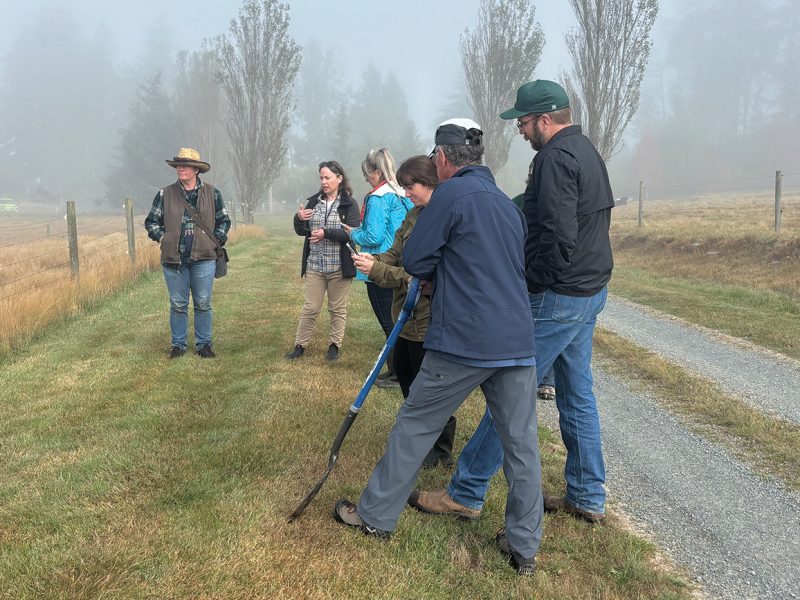
METCHOSIN – Over 20 South Vancouver Island producers attended the livestock drought management field day held at Brass Bell Farm in East Sooke and Parry Bay Farm in Metchosin on September 12. The sessions were facilitated by North Okanagan farmers and professional agrologists Greg Tegart and Mike Witt.

The day started at Brass Bell Farm where owner Amber Rowse-Robinson gave attendees a tour of her 108 leased acres where she raises heritage sheep, pigs, broilers and cows using regenerative practices. She and her family have been on the property full-time for two years and over the last year Rowse-Robinson has put in a concerted effort to restore neglected pastures to provide quality feed for her livestock.

Brass Bell Farm is undergoing pasture rejuvenation due to such challenges as compaction, creeping red fescue, thistles and low soil pH, which limit the growing season and forage quality.

To raise soil pH, Tegart and Witt proposed applying lime and increasing soil organic matter.

“Try to build organic matter through various practices with your livestock feeding program or you can acquire it via compost if you’re able to use compost,” Tegart says. “The beauty of adding organic matter is that it acts as another buffer against the pH and provides nutrition along the way to feed soil microbes.”

To kickstart the pastures back into a productive state with minimal equipment, the agrologists suggested Rowse-Robinson use her pigs to disturb the soil before broadcasting an annual grass seed mix while keeping an eye on animal performance and health. This is consistent with regenerative concepts that recommend managing grazing to maintain a photosynthetic area that feed the soil microbiology.

“Doing that with a broad species of plants means you’ll have different root depths, different growth periods and you go longer through the season with more diversity,” Tegart says.

Fighting invasive weeds

At Metchosin’s Parry Bay Farm, John and Lorraine Buchanan run about 240 sheep and have been dealing with such invasive weeds as wireweed, creeping red fescue and spear grass in their hay fields and pastures. These species thrive in droughty summers and wet winters, conditions common on southern Vancouver Island.

One attempt to clean out a pasture was to grow barley, which the couple harvested, and they will plant cover crops for fall grazing.

High grazing pressure can  help manage problematic weeds as long as animals are able to maintain conditioning, Tegart says.

When the group arrived at Buchanan’s irrigated and thriving annual grass pasture where sheep were grazing, Tegart highlighted frequency, intensity and rest as the three main components that contribute to forage regrowth.

“You can lose tillers off those plants with pressure, whether it’s grazing, weather, haying,” Tegart says. “You’re managing those individual tillers and the growing points within them.”

Each plant has a specific rest period after which, in good growing conditions, the plant will have enough vegetative material that it is no longer using stored energy to initiate growth and has enough photosynthetic area to support above and below-ground growth.

If tillers get chewed off again within that crucial rest period, the plant must use stored energy for vegetative growth, which will result in no root growth and a weakened stand if that continues with long-term grazing, Tegart says.

When producers remove 80% to 90% of physical biomass with haying, for example, root growth may stop for at least two weeks, Tegart adds. If producers grazed this same field, regrowth would happen much more readily because root growth decline is not as dramatic, and tillers don’t need as much stored energy to re-grow.

Management intensive grazing allows farmers to reduce stress on individual species. In addition, a forage mixture of grasses and legumes offers a longer season of palatable and nutritional vegetative matter due to the species’ differing emergence timing, growth point locations, and protein and starch contents.

Also in his presentation, Tegart recommends that producers who buy hay regularly request feed tests and ask about harvest timing, species composition and storage methods to ensure it meets nutritional requirements.

While the field day offered general recommendations, Tegart urged producers to contact their local extension coordinators or agrologists for tailored strategies that fit their specific goals.

Tegart and Witt also facilitated field days that same week at Courtenay’s Hillcrest Farm and Cowichan’s Keating Farm and Promise Valley Farm. These events were brought to producers by the BC Ministry of Agriculture and Food in partnership with the BC Cattlemen’s Association. The ministry’s Livestock Drought Management Guide and workbook will be available online this fall.

Related Posts

You may be interested in these posts from the same category.

Previous Post: « Bird flu returns
Next Post: Beef herd drops »

Copyright © 2025 Country Life in BC · All Rights Reserved