
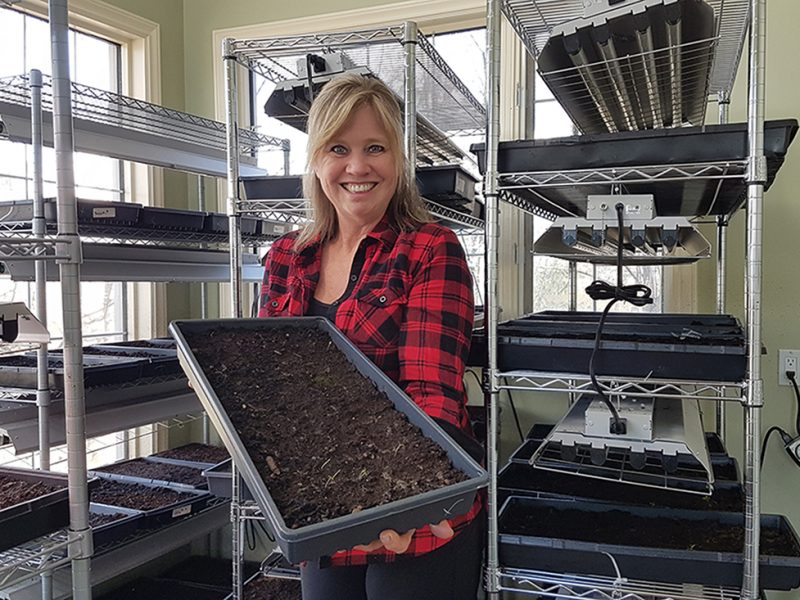
KELOWNA—Two years ago, Jane and Michael Johnston traded life in White Rock for a farm in southeast Kelowna.
She’s a registered nurse who’d risen to be executive director of a chain of high-end seniors residences. He’s the former CEO of an engineering firm. Both were looking for a new business opportunity. What they found was an orchard established in 1953, and the foundation for a venture they call Avoca Farms & Vineyards.
“This is a sector we didn’t know anything about, but that’s good because you’re not locked into traditions and status quo. Everything we look at, we tear it down and figure out how we can do it better,” says Michael.
Together, they’re converting their 18-acre property into an aronia and garlic operation. They’re retaining five acres of table grapes – Coronation, Bath, Skookum and Einset – for good measure.
Jane, whose Indigenous roots trace back to the Tahltan in Telegraph Creek, first heard of aronia from a friend. It sounded unfamiliar but she soon realized she recognized the plant by another name: chokeberry. Although native to North America and used as an ornamental in landscaping, the edible variety had been lost here but is grown in Russia and Ukraine on a commercial scale for its high antioxidant content and nutritional value.
“The First Nations people here told early settlers from those places to eat it to combat colds with its high vitamin C content and high anti-viral benefit, and it worked. So, they took it home to their foreign countries and planted it where it’s used for eating, chutneys and wine, but it’s just been reintroduced back into North America,” says Jane.
Containing zinc, magnesium, iron and vitamins C, B and K, studies have linked aronia to improving immune function and insulin production, reducing symptoms related to stomach disorders, combating the growth of certain cancer cells, reducing blood pressure and also promoting weight loss. It has the highest antioxidant capacity of all fruits.
“In Europe, they’re using aronia after chemotherapy to help rebuild a person’s immune system,” says Jane, adding that in Korea it’s used for anti-aging properties and health benefits.
The berries, which resemble a tiny, deep-purple apple, can be eaten fresh but with their mouth-drying effect are better blended with other foods. Freezing them reduces the effect, leading the Johnstons to envision a market for a freeze-dried, more easily transportable powder.
“We’ve already bought a freeze-drier,” Michael says.
Starting from scratch
To bring aronia back to Western Canada as a viable and marketable crop, Avoca Farms and Vineyards is producing aronia from cuttings and seeds.
“The issue is that it’s new, so you need the right cultivars and we’ve done a ton of research, including visiting the World Agricultural Expo in California. We got our original plants from Oregon, touched base with Kansas City growers, been in touch with a company in Poland and bought seed from Ukraine,” says Michael. “Our four varieties are bred to make bigger, juicier, tastier berries.”
They have 4,200 plants plus 20,000 seedlings. In 2016, they purchased about 1,200 plants of the variety Viking and 800 of Autumn Magic. The plants came in one-gallon pots, and were planted in the farm’s sandy, irrigated soil last July. This year, they added 400 to 500 plants of McKenzie, Elliott and Galicjanka. They think McKenzie is the most suitable for the Okanagan climate.
Aronia is also insect, disease and drought-resistant, an important consideration given climate change predictions. It’s astringent, so birds avoid it, a huge challenge Okanagan haskap growers face. They net their crops at considerable expense.
“This isn’t about lifestyle. Everything has to be profitable. So, although the property came with the grapes, and we want aronia, we’ve also introduced garlic,” says Michael.
They’ve grown 5,000 bulbs into 50,000 plants of different varieties. In October, they’ll plant 150,000 cloves of garlic, with varieties including Red Russian, Majestic, Persian Star and super-sized elephant garlic. While not yet certified organic, they’re moving the farm towards certification.
Speaking of numbers, Michael is all about running highly successful businesses where cash is king. He says newer farm businesses or farms looking for a new crop must have a business plan with quick, near-term cash flow.
Aronia and garlic were chosen for Avoca after extensive research determined they would be complementary, having similar nutrient needs, soil and irrigation requirements. Garlic sales will provide revenue until the aronia comes onstream.
They feel fortunate to have funds from prior businesses support their agricultural venture when they know getting through the first years can be a real challenge for farmers.
“Jane comes up with the ideas and I’m the one who figures out a way to implement [them],” says Michael.
She loves reading, research and learning. He’s more into spreadsheets and building.
To reduce overhead of labour costs, Michael combined two machines to create a plastic plant pot-filling machine. This year, they’ll try growing garlic in pots to avoid the three-year crop rotation cycle. With 36,000 pots in the yard and more on order, they plan to make garlic-growing portable.
“We can actually take the plants and sell them. Michael is originally from Ireland where everyone grows things on their patios,” explains Jane. “No one has land but everyone has gardens so that’s when we realized that maybe this is what we should look at.”
Their business plan also envisions contracting others within the Agricultural Land Reserve who want to grow something to gain tax exemption but want less work. Garlic in pots is a portable option that could fill a niche.
For now, their garlic will be sold at the farm gate and the BC Tree Fruits store in Kelowna. BC Tree Fruits has also approached them to sell the aronia, which will be sold fresh in two-pound clamshells as well as in powdered form.
Seedlings will be sold to others within BC. A potential market also exists in Ontario and Quebec, where they claim there’s a waiting list for the plants. A one-year-old plant sells for about $10 to $12.
“Part of our success in growing seedlings will be helping to ensure that those that buy our plants are successful because if they’re not successful, we’re not,” says Michael.
To that end, they are spearheading a new non-profit Western Canadian Aronia Association with a new website to share information about the plants and crop viability.
Now in their 50s, and having had a fair share of health concerns, they’re enjoying their new life and say farming is making them healthier than ever.
 Marketing board names new entrant winners