
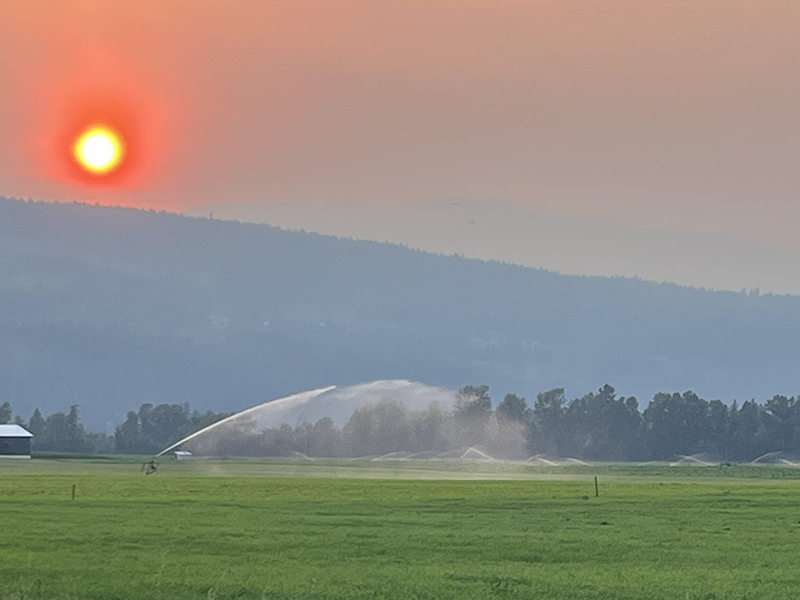
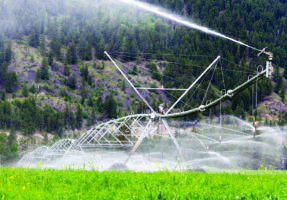
The province is doing its utmost to hold off on fish protection orders that would shut down irrigation in the southern Interior but warns that record low stream flows may leave no other option.
“We do continue to see the Salmon River continue to decline with its flow,” Connie Chapman, executive director of the BC Water Management Branch, told Country Life in BC during a media briefing on July 21.
To avoid a shutdown, the province says producers are irrigating on a schedule, but Chapman says it’s unknown if the strategy will be as effective as in other watersheds, such as the Koksilah on Vancouver Island.
“It’s not clear how much may be water may be returned into the system from the schedule, and what it may be able to buy in terms of time,” she says.
Ranchers and farmers in the region are on the verge of harvesting their second cut but need water to take it across the finish line. And once it’s off, water will be critical for renewing pastures in advance of cattle returning home this fall.
“They usually try to push them as long as they can; last year they pushed it and pushed it right till the very end,” says Trudy Schweb of Schweb Family Cattle in the Salmon River Valley.
That’s unlikely to happen this year, meaning the ranch will be hit both by low precipitation and no irrigation.
“We’re more than willing to significantly reduce our water use, but we can’t grow feed with no water,” she says. “We can do a lot with some water, but we can’t do anything with none. When we finish cutting our second crop, it’s imperative that those freshly cut fields receive water immediately so the new growth can get started.”
This means the second cut will be reduced, and there will be less coming back for fall grazing.
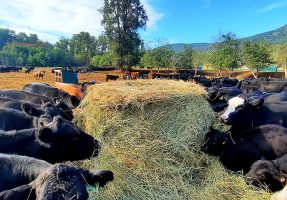
“We’ve already started purchasing feed because we can see the writing on the wall,” she says. “The question isn’t whether we’ll need to buy feed – it’s how much we’re going to need. Until we know when the rain will come or when our cows may have to come home from pasture, there’s a tremendous amount of uncertainty.”
Schweb wants to see the province fast-track construction of a dam on Bolean Lake, like it has for critical mining and green energy projects.
Beavers have added about 40 centimetres to the existing Bolean weir this season, boosting storage capacity while the BC Cattlemen’s Association continues to work with the province to establish a permanent structure.
Water, Land and Resource Stewardship Minister Randene Neill told Country Life in BC that work is happening “really quickly” but gave no timeline for a provincially authorized upgrade to the beavers’ work.
“I’m hoping to head out there next week to take a look,” she says.
All content on this website is copyrighted, and cannot be republished or reproduced without permission.
 Farm communities unite for provincial funding