
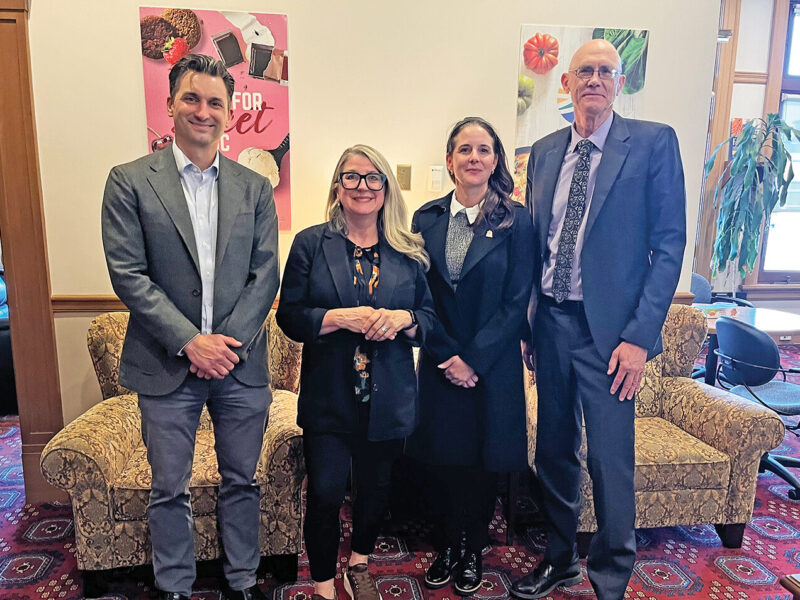
SUMMERLAND – BC’s small agricultural communities are working together to make a collective pitch for more farm infrastructure funding from the province.
Summerland mayor Doug Holmes, along with Pitt Meadows mayor Nicole McDonald and North Cowichan mayor Rob Douglas, proposed the idea of an Agricultural Municipality Initiative (AMI) for farmland to BC agriculture minister Lana Popham last month.
The proposal is based on the Resort Municipalities Initiative (RMI), a $13 million provincial fund that supports 14 small resort municipalities like Sun Peaks and Osoyoos upgrade infrastructure and amenities for the tourism sector.
“The principle of that resort initiative is to recognize the tax base can’t support the high visitor demands that put a strain on their infrastructure. It’s beyond what their tax base supports,” Holmes says. “Agriculture is kind of the same thing – they’re both critical industries for this province.”
Holmes says there are about 12 communities in BC in a similar situation, with the bulk of their land base within the Agricultural Land Reserve. With no mines, factories or other big industries, these small farming communities are feeling increasingly strapped, especially with looming costs for aging infrastructure upgrades such as roads and water systems, to keep their farms operating.
Summerland, for instance, collects $12.5 million in property taxes, but only $600,000 of that comes from farmland. Yet it costs the municipality $2 million to service those properties.
“There’s a big gap there,” Holmes says. “For every dollar in property tax we collect from ALR land, it costs more than $3 to service that land. And that ratio is increasing.”
Holmes says Popham has agreed to meet the group at the Union of BC Municipalities convention on September 14-18. He is encouraging other communities to do their own cost analysis and bring it to the table, saying even a small amount of money to start would help build much-needed infrastructure.
Summerland is considering drawing water from Okanagan Lake for irrigation this year while it works on twinning its water main to provide untreated water for irrigation.
“We’re facing massive growth pressures on our farmland,” Holmes says. “If we’re talking about keeping that land available for food production and supporting the integrity of the ALR, you just can’t let the infrastructure go to rot.”
BC Fruit Growers Association executive director Adrian Arts agrees, noting many roads in Summerland are “beaten up” with bumps and potholes.
“When you’re driving down those with cherries or apples or peaches, you’re going to damage your fruit,” he says. “We fully appreciate the challenges these small rural communities face.”
Pitt Meadows hasn’t yet done an analysis of the cost of servicing farmland, but McDonald says something needs to be done.
Pitt Meadows’ land base is 80% agricultural, yet farmland contributes just 2.4% to the city’s annual budget, which is not enough to fund the massive infrastructure of diking, irrigation and flood protection that benefits the sector as well as the community.
“We just find it’s a very large financial burden to carry,” says McDonald. “We need agriculture to be looked at as an essential service and economic driver for BC. It’s a vital lifeline for those communities.”
According to the BC Agriculture Council, BC invests the least amount of money in agriculture of any province in Canada. Although BC saw spending on agriculture rise a dramatic 68.4% between 2023-24 and 2024-25 (up from $136 million to $229 million), the province still ranks last in terms of investment as a proportion of the sector’s contribution to the provincial economy.
BCAC executive director Danielle Synotte says large municipalities are also facing struggles when it comes to agriculture funding and suggests mayors lobby to update BC Assessment’s criteria for farm class status.
Currently, all farms in the province fall under one tax category, Class 9, regardless of size or impact on community infrastructure. The current sales threshold for farm tax status is $10,000 for properties of less than two acres, and a $2,500 minimum for properties of two acres or more.
A discussion paper on this issue is expected in the next few months.
Cranberry farmer Travis Hopcott is on board. He cites Maple Ridge, where the bulk of agricultural land is now farmed on two to 10-acre lots.
“[The sales threshold] is extremely low; it probably should be around $7,000,” he says. “What kills food security is food produced on small lots.”
The mayors’ proposal is the latest in a string of funding proposals to the province. The District of Coldstream, which is also part of this latest proposal, is calling on the provincial government to introduce additional subclasses to differentiate between larger farms and smaller, less intensive operations.
Holmes isn’t sure the Coldstream motion would work, questioning where they would draw the line and still ensure farmers get a break.
“We see ourselves as partners in protecting farmland and providing food security for the province, but we need support,” Holmes says. “We’re growing food for everybody, not just for ourselves. We’re really at a critical point where those small municipalities with land in the ALR can’t financially bear the costs to support it. It’s as simple as that.”
Popham says she values the opportunity to meet with representatives to discuss opportunities to support B.C.’s food security and economy.
“Working collaboratively with local governments, ministries, and agencies to support agriculture and food security in British Columbia is key to the industry’s success,” she says in an email to Country Life in BC. “While the ministry is always open to ideas on how to support BC farmers, including those that offer sector specific funding models for local governments, the ministry’s focus will continue to be placed on programs that provide direct support to BC producers and processors.”
All content on this website is copyrighted, and cannot be republished or reproduced without permission.

 BCAC policy forum kicks off