• Menu
  • Skip to primary navigation
  • Skip to main content
  • Skip to primary sidebar

Country Life In BC Logo

The agricultural news source in British Columbia since 1915

  • Headlines
  • Calendar
  • Subscribe
  • Advertise
  • About
  • Archives
  • Contact
  • Search
  • Cart
  • Checkout
  • Headlines
  • Calendar
  • Subscribe
  • Advertise
  • About
  • Archives
  • Contact
  • Search
  • Cart
  • Checkout

Primary Sidebar

Current Issue:

AUGUST 2026
Vol. 112 Issue 8

Subscribe Now!

Sign up for free weekly FARM NEWS UPDATES

Loading form…

Your information will not be
shared or sold ever

Follow us on Facebook

Comments Box SVG iconsUsed for the like, share, comment, and reaction icons

5 days ago

The province has extended its provincial state of emergency until August 29 as wildfire risk remains elevated across much of the province, particularly in the Okanagan. While thousands have returned home since the August 8 declaration, evacuation alerts and orders remain in effect in several areas. Government urges residents to stay prepared, review emergency plans and check EmergencyInfoBC.ca for updates.

#BCAg
... See MoreSee Less

The province has extended its provincial state of emergency until August 29 as wildfire risk remains elevated across much of the province, particularly in the Okanagan. While thousands have returned home since the August 8 declaration, evacuation alerts and orders remain in effect in several areas. Government urges residents to stay prepared, review emergency plans and check EmergencyInfoBC.ca for updates.

#BCAg
View Comments
  • Likes: 2
  • Shares: 0
  • Comments: 0

Comment on Facebook

6 days ago

Chilco Ranch–Miller Ranches of Hanceville received the national environmental stewardship award from the Canadian Cattle Association at this week's Canadian Beef Industry Conference in Winnipeg. The fourth-generation ranch blends traditional values with modern innovation as it manages 1,000 cow-calf pairs of Hereford cattle across 170,000 acres. Rotational grazing, soil health improvement and careful land stewardship as well as advanced water-monitoring technology ensures sustainable ranch operations, while deep community involvement through 4-H and other organizations support future generations. You can read more of their story in the September issue of Country Life in BC, which goes to press next week. Photo | Facebook/Canadian Cattle Associat#BCAg#BCAg ... See MoreSee Less

Chilco Ranch–Miller Ranches of Hanceville received the national environmental stewardship award from the Canadian Cattle Association at this weeks Canadian Beef Industry Conference in Winnipeg. The fourth-generation ranch blends traditional values with modern innovation as it manages 1,000 cow-calf pairs of Hereford cattle across 170,000 acres. Rotational grazing, soil health improvement and careful land stewardship as well as advanced water-monitoring technology ensures sustainable ranch operations, while deep community involvement through 4-H and other organizations support future generations. You can read more of their story in the September issue of Country Life in BC, which goes to press next week. Photo | Facebook/Canadian Cattle Association

#BCAg
View Comments
  • Likes: 47
  • Shares: 5
  • Comments: 0

Comment on Facebook

6 days ago

The deadline to weigh in on BC's proposed food-processing rules in the Agricultural Land Reserve has been extended to September 18. Proposed changes would open nearly 1.3 million acres of protected farmland to food processors by allowing processors to build plants on Class 5-7 soil (and Class 4, in some cases) as long as 5% of inputs are grown in BC. Currently, all processors must source at least 50% of inputs from BC. The existing 50% rule would stay in place for Class 1-3 soils. The BC Agriculture Council, which has previously raised concerns that the proposal reflects a narrow set of interests, says it's still reviewing the details with its #BCAgrs.

#BCAg
... See MoreSee Less

The deadline to weigh in on BCs proposed food-processing rules in the Agricultural Land Reserve has been extended to September 18. Proposed changes would open nearly 1.3 million acres of protected farmland to food processors by allowing processors to build plants on Class 5-7 soil (and Class 4, in some cases) as long as 5% of inputs are grown in BC. Currently, all processors must source at least 50% of inputs from BC. The existing 50% rule would stay in place for Class 1-3 soils. The BC Agriculture Council, which has previously raised concerns that the proposal reflects a narrow set of interests, says its still reviewing the details with its members.

#BCAg
View Comments
  • Likes: 22
  • Shares: 26
  • Comments: 11

Comment on Facebook

Funny how they always release these proposals in August when most farms are working overtime.

Let’s use our brains for a moment and think about this. Let’s say I’ve got a farm in bc, where i grow a crop that I then turn into jam. I have a small window each year where my produce is ready. I turn it into jam. Now my jam becomes a big hit and people want it year round. The only way for me to produce outside of my fruit bearing window is to bring in fruit from other places. I’m supposed to let my investment sit idle for most of the year? You can extrapolate this to many things we grow in bc and have short windows where it is ready. Our goal shouldn’t be to make it harder for people to succeed. Maybe 5% is too low, but 50% means it’s going to sit idle.

The current rules actually say 50% from the farm or related farms (ie. in the same producer group). The new rule is 5% from BC. This would likely be good for abattoirs, and I'm sure wineries would be excited too. However, both thise enterprises can be located away from ALR land. The proposed regulations will do the opposite of supporting agriculture. They will foster the removal of farmland from protection, and the increased impoverishment of our food system.

emails can be sent here: AF.Minister@gov.bc.ca

5%? Yeah, that’s a big “no” from me… the whole point of allowing processing on farmland is to make farms more economically viable by increasing the market for their product.

Where is the link for input?

I find that 5% vs 50 % equation very unsettling. In this situation it is not 5% from the farm it is 5% from bc. The rest can come from anywhere else. This is fine for industry standards but does not help agriculture in bc. So if we are going to give up limited agricultural land for this endeavour it had should help farming in bc. Farmers are expected to use 50% of their own on farm product on alr. Farmers would continue to be expected to use 50% while processors need not grow anything nor support bc farms. This doesn’t pass the sniff test to me

5% that’s nothing and how long what happens then after 5 years it is 0% they are not going to say oh you need to shut down.

I am by far, no expert, but why would you even propose to build a plant on good farmland, isn’t that for growing a plant? You can build a plant on any ground. Reminds me of all the greenhouses built on prime soil, to me it reduces capacity and takes away from local farmers so big business can come in and take over.

Here is the link: news.gov.bc.ca/files/FoodProcessingALR_DiscussionPaperAug18_2026.pdf Taking input until September 18th. In my opinion, lowering the sources to just 5% does nothing to build food sovereignty which is what we desperately need.

This is such bs

View more comments

7 days ago

The province has just issued a new temporary protection order for the Salmon River, effective immediately, restricting irrigation water for forage crops such as hay, alfalfa, and corn. A previous order was issued on July 28 and rescinded on August 8 due to wildfire risk, but low stream flows persist, threatening over 200 spawning Chinook salmon in the watershed. Affected licence holders will be contacted directly. Drought support is available to farmers through the Ministry of Agriculture and Food. The province has invested $120 million in the Agriculture Water Infrastructure Program to support farmers facing water scarcity.

#BCAg
... See MoreSee Less

The province has just issued a new temporary protection order for the Salmon River, effective immediately, restricting irrigation water for forage crops such as hay, alfalfa, and corn. A previous order was issued on July 28 and rescinded on August 8 due to wildfire risk, but low stream flows persist, threatening over 200 spawning Chinook salmon in the watershed. Affected licence holders will be contacted directly. Drought support is available to farmers through the Ministry of Agriculture and Food. The province has invested $120 million in the Agriculture Water Infrastructure Program to support farmers facing water scarcity.

#BCAg
View Comments
  • Likes: 15
  • Shares: 9
  • Comments: 7

Comment on Facebook

Can someone explain why they irrigate during the day in the blistering heat. Would it be better to water early morning and at sunset?

200 fish over all the feed that grows in this valley wow that some expensive fish

Time to start new methods of agriculture, ive watched our ecosystem take a beating in my lifetime, iym not against any productivity of our economic development within our structures, really its not rocket science. Its just going to cost alot to change to a better, more viable solution. Banks and your intellectuals, wanna run this country with money, then quit, wasting it on ignorance. The solutions are all easy, just how much money, do we waste, and how much are we going to spend, on actually fixing the issues.

This is just an exceptionally dry year from low snow cap. It does happen!

Get your water off fly hills two big lakes off there Spa and author

And they continue to ignore CHASE CREEK....

The methods we have now are because settlers always saw what was excess resources in their eyes - the riches of the ‘New World’ have been used and abused and as the limits have been reached are in disbelief and still trying to push for more….when the problem is US and how settlers have always been about extraction and not living with and much less understanding the landscapes in their integration because the next crop is the horizon and there is no compassion for the land its flora and fauna because it needs to be remade in the settler image and naive ideal

View more comments

1 week ago

Kwantlen Polytechnic University has established a one-acre research hopyard at Molson Coors' Chilliwack plant, housing 10 experimental selections and 40 heritage varieties. The multi-year partnership supports new hop variety development and breeding decisions for BC growers, building on Chilliwack's history as Canada's former largest hop-producing region. www.countrylifeinbc.com/kpu-sets-up-rese#BCAgh#kwantlenpolytechnicuniversityc#MolsonCoorsty #MolsonCoors ... See MoreSee Less

Kwantlen Polytechnic University has established a one-acre research hopyard at Molson Coors Chilliwack plant, housing 10 experimental selections and 40 heritage varieties. The multi-year partnership supports new hop variety development and breeding decisions for BC growers, building on Chilliwacks history as Canadas former largest hop-producing region. https://www.countrylifeinbc.com/kpu-sets-up-research-hopyard/

#BCAg #kwantlenpolytechnicuniversity #MolsonCoors
View Comments
  • Likes: 27
  • Shares: 2
  • Comments: 1

Comment on Facebook

What is old is new again in Chilliwack.

Subscribe | Advertise

The agricultural news source in British Columbia since 1915
  • Email
  • Facebook

Southern Interior irrigators shut down

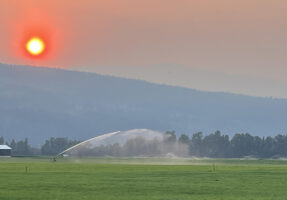
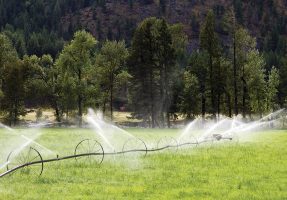
Producers say they were blindsided by this week's announcement to turn off irrigation in the Salmon River and Bessette Creek watersheds. File photo

September 10, 2025 byTom Walker

The province says it listened to local growers when it shut down forage irrigation in the Salmon River and Bessette Creek watersheds on September 8, but producers say they were blindsided.

“We did not receive any direct communication from [Water, Land and Resource Stewardship] staff that this was about to happen,” says Andrea van Iterson of Westwold View Farms in the Salmon River watershed. “They have all our emails, particularly those of us on the drought committee who are there to liaison with the community. [But] we heard about it in the media.”

The temporary protection orders (TPOs), under Section 88 of the Water Sustainability Act, affect 397 licensees in the Salmon River watershed and 112 licensees in the Bessette Creek watershed. Both watersheds were previously impacted by orders in 2023 and 2021.

Van Iterson says the orders undermine the trust built with community members over the past two years, following the heavy-handed enforcement of the last TPO in 2023.

“It just feels like an overreach of power that doesn’t need to be there,” she says. “We just had our weekly drought meeting and we told them everybody has finished their irrigation for the year. … A TPO now would be an absolute waste of everybody’s time and in poor faith.”

Van Iterson isn’t sure how that message failed to reach senior government staff.

BC Minister of Water, Land and Resource Stewardship Randene Neill told Country Life in BC during a media briefing minutes after the orders were issued that the province had learned from its past missteps.

“What we’ve really learned is that communication is key, and the province can’t just decide to unilaterally issue these orders without working with farmers and industry and cattle ranchers,” she said. “We reached out to many of the farmers, we reached out to BC Cattlemen’s Association. … We talked to the farmers, let them know what was happening.”

Neill claims many farmers had “voluntarily stopped irrigating because they knew the water levels were low,” but says representatives of the federal government and First Nations requested the TPOs.

Neill doesn’t expect the orders to be in place for long, but Connie Chapman, executive director of the Water Management Branch, says compliance is mandatory regardless of whether or not licensees receive a notice in the mail.

“We are hopeful people will voluntarily listen to this order,” she says. “If compliance is not met, then that is when Natural Resource officers or other compliance individuals would undertake the necessary investigations.”

Consequences could include administrative monetary penalties or fines.

With files from Peter Mitham


All content on this website is copyrighted, and cannot be republished or reproduced without permission.
Related Posts

You may be interested in these posts from the same category.

BC ranchers brace for wildfires

Cash Flows

Fish protection orders loom

Drought forces Salmon River farmers to act

Island farmers fish for water solutions

Popham back as ag minister

Groundwater enforcement picks up

Water licence fight highlights need for change

Communication critical to solve water issues

Westwold producers challenge curtailment

Water cut to growers

No licence, no problem

Previous Post: « Indigenous agriculture faces regulatory reality
Next Post: ALC rejects Cowichan dike removal »

© 2026 COUNTRY LIFE IN BC - ALL RIGHTS RESERVED