• Menu
  • Skip to primary navigation
  • Skip to main content
  • Skip to primary sidebar

Country Life In BC Logo

The agricultural news source in British Columbia since 1915

  • Headlines
  • Calendar
  • Subscribe
  • Advertise
  • About
  • Archives
  • Contact
  • Search
  • Headlines
  • Calendar
  • Subscribe
  • Advertise
  • About
  • Archives
  • Contact
  • Search

Primary Sidebar

Originally published:

MARCH 2020
Vol. 106 Issue 3

Subscribe Now!

Sign up for free weekly FARM NEWS UPDATES

Loading form…

Your information will not be
shared or sold ever

Stories In This Edition

Going solo

Perfect sleeper

Province pares ag budget

Government slow to act on trespass legislation

Seeing is bee-lieving

Editorial – The old normal

Back Forty – Biosecurity no stranger to Canadian farmers

Viewpoint – Food trends challenge farmers to keep pace

Fruit growers grapple with third year of losses

Sidebar: Ambrosia and the future

Provincial task force charts a path forward

Cutting edge

Second health authority signs on to FeedBC

Sold-out gala honours the best of agriculture

Island farm takes long view on climate change

Broader mandate boosts hort memberships

Islands show puts emphasis on small-lot farming

Ag initiatives lack support across regions

Got her goat

Strong dairy demand underpins bright future

Farm groups weigh in on climate change

Wine grape council charts R&D priorities

Institute forms action plan

New round of traceability funding available

Island farmers briefed on new ag waste regs

Robotic milkers make life easier for dairy farmers

Selective grazing provides options to fertilizers

Cariboo cattlemen take steps with 20-year plan

Wildfire risk increases need for preparation

Small-lot ranchers can benefit from certification

Celebration

New toolkit aids with farm flood preparation

Hazelnut research focuses on water use

Sheep at risk next to popular island trail

Good nutrition makes for a good future

Cater to chefs

Sidebar: Sage advice

Research: Bumblees prefer low-fat, low-sugar diet

Agroforestry entrepreneurs need to plan ahead

Where milk really comes from

Value-added marketing critical to success

Growing degree days not just for tree fruits

Farm Story: Duck antics provide late winter amusement

Good ditches are critical for good drainage

Accounting, entrepreneurship for small farms

Land to Table forum focuses on food access

New location for Langley’s spring break Farm Camp

You are the farm’s most important asset

Woodshed: The jig is up for Junkyard Frank’s love scheme

Jude’s Kitchen: Spring for greens

More Headlines

Follow us on Facebook

Comments Box SVG iconsUsed for the like, share, comment, and reaction icons

6 days ago

A BC Forest Practices Board investigation has found overgrazing has damaged grasslands in the Coutlee Range Unit near Merritt — and the range-use plan meant to prevent it was unenforceable. With complaints about overgrazing on the rise and grasslands covering just 1% of BC's land mass, the findings raise fresh questions about how the province manages one of its most vulnerable — and valuable — food-producing ecosyste#BCAg#BCAg ... See MoreSee Less

Link thumbnail

Board finds overgrazing rules unenforceable unmeasurable

www.countrylifeinbc.com

MERRITT – A BC Forest Practices Board investigation has found instances of non-compliance related to overgrazing have damaged open grasslands in the Mine pasture, part of the Coutlee Range Unit near...
View Comments
  • Likes: 6
  • Shares: 6
  • Comments: 6

Comment on Facebook

Several ranchers in recent years have gone into temporary non use on that range , so that means the grass should grow. But drought conditions/lack of rain and snow don’t allow that to happen . Dried up springs , creeks waterholes in various pastures add to over grazing where there is water , as livestock and everything else stay close to the water source . So even though less cattle are on it , over grazing appears. There is a large volume of horses on it 365 days/year which is wrong ! They pull grass right out of the ground when it’s just trying to grow ,, opens the door for weeds to grow in. That don’t help it. Aging infrastructure ( fences) laying on the ground, pipe line building , ( lack of commitment to fence maintenance) amongst all users contributes also to over grazing. Recreational atv users leaving gates open between pastures allows livestock to go back or ahead in pastures also expidites over grazing. Logging ( bcts) has no problem laying out cut locks on both sides of a fence , then it gets smashed down during logging and they don’t take responsibility to stand it back up or clean the cattle gaurds out when they are done , that happened 4 years ago on pasture 5 up there . I bet it is still not fixed . There are lots of contributing factors to the problem.

Tragedy of the commons.

I looked through the report. I saw nothing about the effects of noxious weeds on productive grasslands. This particular area is vulnerable because of the Ministry’a efforts to diversify the use of the Grasslands.

This pasture is under tremendous pressure not only from cattle but from irresponsible local residents who treat it as a landfill dumping all manner of household debris here. And don't even get me started on the mud bogging and camping in sensitive riparian areas. The feral horses are in this pasture 365 days a year just hammering it. Would sure be nice to see some enforcement action on people who are intentionally ripping up the grasslands and riparian areas. Cattle could be a valuable resource for rebuilding soils and native grasses in this area with the help of electric fencing and/or e-collars. The humans will be harder to manage.

The Forest and Range Practices Act was written by lawyers for global forest licencee shareholders. Results-based = unenforceable.

Also, can we talk about the impact of a pipeline being built through the middle of this field for multiple years?

View more comments

1 week ago

East Kootenay rancher Randy Reay is digging a new well after two natural water sources dried up on his Crown tenures. A new Living Lakes Canada assessment found 15% of mapped aquifers in the region are high-priority for monitoring, yet 80% of those go unmonitored. With over 48% of BC's provincial observation wells reporting below-normal groundwater levels, ranchers and researchers are sounding the alarm on water security. The story is in our March edition, and we've posted it to our website thi#BCAgk.

#BCAg
... See MoreSee Less

Link thumbnail

Water woes: groundwater under pressure across BC

www.countrylifeinbc.com

JAFFRAY – As a young boy growing up in the Kootenay-Boundary region, Randy Reay never expected to run out of water. But this year, in mid-February, his fields are bare. There is no snow halfway up t...
View Comments
  • Likes: 8
  • Shares: 7
  • Comments: 1

Comment on Facebook

Jaffrey is in the east Kootenays not kooteney boundary

2 weeks ago

BC farmers are bracing for prolonged higher input costs as war in the Middle East drives up fuel and fertilizer prices. Nitrogen fertilizer costs were already climbing before the Iran conflict began, with prices still roughly 60% above pre-pandemic levels. Farm Credit Canada warns that unlike 2022, strong commodity prices may not offset rising costs this time. Local suppliers expect supply challenges and further price increases ahead.

#BCAg
... See MoreSee Less

Link thumbnail

Fertilizer prices on the rise

www.countrylifeinbc.com

War in the Middle East has delivered a generational shock to energy prices, meaning BC farmers can expect a prolonged period of higher costs not just for fuel but also for fertilizer.
View Comments
  • Likes: 2
  • Shares: 1
  • Comments: 0

Comment on Facebook

2 weeks ago

... See MoreSee Less

View Comments
  • Likes: 1
  • Shares: 0
  • Comments: 0

Comment on Facebook

2 weeks ago

Cameron Stockdale is the new executive director of provincial farm safety organization AgSafeBC. Find out more in this week's Farm News Update from Country Life in B#BCAg#BCAg ... See MoreSee Less

Link thumbnail

New leadership at AgSafe BC

www.countrylifeinbc.com

Cameron Stockdale is the new executive director of provincial farm safety organization AgSafeBC, succeeding Wendy Bennett. Bennett left AgSafeBC in September 2025, following 12 years with the…
View Comments
  • Likes: 5
  • Shares: 1
  • Comments: 0

Comment on Facebook

Subscribe | Advertise

The agricultural news source in British Columbia since 1915
  • Email
  • Facebook

Fruit growers grapple with third year of losses

Annual convention passes resolutions seeking relief

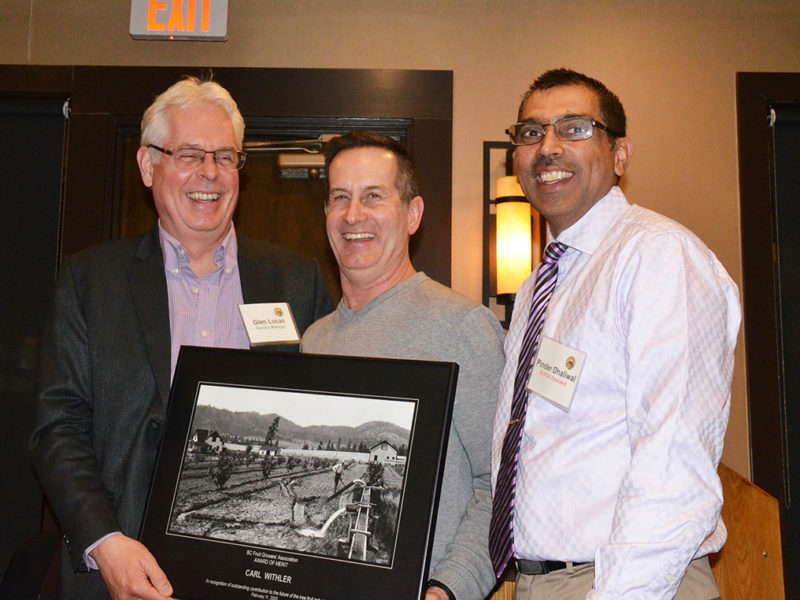
Grape and tree fruit specialist Carl Withler, centre, was given the BC Fruit Growers Association’s Award of Merit by general manager Glen Lucas, left, and BCFGA president Pinder Dhaliwal. TOM WALKER PHOTO

March 4, 2020 byTom Walker

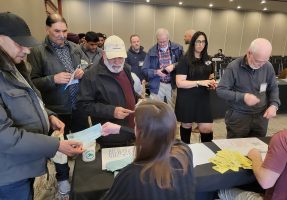
KELOWNA – Poor apple prices were the focus of the 131st annual BC Fruit Growers Association convention in Kelowna, February 11-12.

“This is the third consecutive year of declining grower returns,” says BCFGA president Pinder Dhaliwal. “Returns are now below the cash cost of production.”

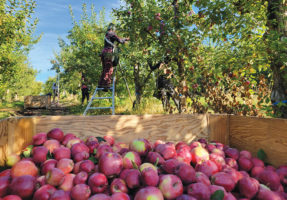
Payouts as low as nine and 10 cents a pound for Gala apples were reported by top growers on their first pool advance from BC Tree Fruits Co-op. These figures are being called the lowest ever in real terms and compare with the 30 cents a pound it costs to produce apples in BC.

“BCFGA is hearing that apple growers do not have resources to pay for the upcoming season’s agriculture activities such as pruning, thinning, fertilizer and harvesting,” says Dhaliwal. “The provincial government needs to recognize the complex economics of our industry.”

BCFGA general manager Glen Lucas said growing conditions during the 2019 season were not ideal, declining soon after fruit set.

“Though pollination and fruit set were satisfactory, things went downhill from there,” he says, with near-weekly rain events and extreme heat in August creating problems.

“The rains split cherries and increased culls and the rains and heat caused poor colour, weakened fruit and storage issues for apples,” he explains.

Grower costs continue to rise, with BC’s minimum wage rising to $13.85 an hour last summer and increasing to $14.60 an hour on June 1, 2020. Crop protection, fertilizer, fuel and equipment are also more expensive.

Delegates shared their frustration with increasing food safety and environmental demands.

“There are too many regulations we have to pay for,” says Denise MacDonald, an apple grower from Summerland. “It’s too costly for young growers, especially with land over $100,000 an acre, to get 20 cents a pound for top Ambrosia apples.”

Many of the convention’s resolutions called for the association to approach government to seek relief from costs and improve farm income, including funding food safety equipment, exemption from the provincial sales tax and allowing value-added enterprises within the Agricultural Land Reserve.

A late resolution directed the association’s board to seek a special provincial per-pound payment to apple growers in respect of market losses in 2019. The resolution suggested a cash payment and/or other proposals such as an increase in AgriStability coverage, a PST exemption, a rebate on irrigation fees, provincial guarantees and interest-free grower operating loans, and a duty against US apples being dumped into Canada at prices below the cost of production.

“This industry is in dire need of help right now,” says Amarjit Lalli, a Kelowna grower who supported the late resolution. “We just need short-term help and we will turn the ship around.”

Talk between members on the convention floor focused on the role of the BC Tree Fruits Co-op in the current financial difficulties. The co-op is the largest sorting, storage, packing and marketing group in BC.

“We are at a pivotal time,” acknowledges BCTF board chair Steve Brown. “These low returns are not sustainable.”

Conceding that there have been similar promises before, Brown outlined four areas for change: marketing and sales, governance, infrastructure planning and government support.

“The difference now is qualified leadership,” he says. “But we have to act fast or we are in trouble.”

Brown promised information on new strategies in the near future and urged BCFGA members to attend the co-op’s upcoming meetings, as they’ll be the proper place to discuss strategies addressing the co-op’s four focus areas.

“We need to vote to survive and thrive,” he says. “We can be better together, but the biggest hurdle is staying united.”

The co-op’s new CEO, Warren Sarafinchan, did not deliver his report in person, but sent a video as he was in Asia exploring new market opportunities.

“The co-op definitely has a future,” he says. “But it is abundantly clear we need to change things. The status quo is not an option.”

Sarafinchan alluded to the lack of transparency that has dogged the co-op in the past.

“I think in the past we have been perhaps less collaborative, our communication has been less frequent,” he says. “We need to be working with all stakeholders in an open and transparent way to make sure we are positioning the industry for success.”

Sarafinchan outlined some of the work that has gone on over the last several months.

“If we have trust, collaboration and innovation, I think we can do amazing things with the business and the industry,” he says.

Opposition agriculture critic Ian Paton addressed the convention and noted that there was no mention of agriculture in the February 11 throne speech.

“Many of the issues that I have discussed with your board affect farmers all over the province,” says Paton.

“You can appreciate what we are going through,” says Amarjit Lalli. “We have individuals who are on the verge of losing their properties. Consecutive governments have failed farmers.”

Vernon grower Dave Dobernigg thanked Paton for showing up, something the province’s current agriculture minister, Lana Popham, has not done.

“I assure you that it has not gone unnoticed that you have made the trip to our AGM twice now and the ag minister has not,” he says.

Lucas says that concerned growers met and discussed their individual financial situations following the formal convention proceedings. Their personal stories will give the executive more information to share during their next meeting with Popham.

“We have been in dialogue with the ministry over the last three years now,” says Lucas. “It began with concerns over the 2017 crop.”

BCFGA met with Popham on November 5, 2018, April 3, 2019 and, most recently, on February 6. A meeting was scheduled for February18, but government staff were ill and the meeting was cancelled. A new date has not been set.

“We now have specific proposals to bring forward from the late resolution and clear examples of the desperate situation that many growers are in,” says Lucas. “The board will push as hard as it can for a brighter future for the industry.”



Related Posts

You may be interested in these posts from the same category.

Federal budget kills Living Labs

Cherry bonanza no jubilee

Arts leads BCFGA forward

Tesche leaving BCFGA

United front for fruit growers

Apple growers discuss marketing commission

BC Fruit Growers list test orchard

New fruit co-op discussed

Peach report bullish on future opportunities

BC Tree Fruits shuts down

Stabilization initiative yet to bear fruit

Veteran orchardist dies

Previous Post: « Ag initiatives lack support across regions
Next Post: Going solo »

Copyright © 2026 Country Life in BC · All Rights Reserved