
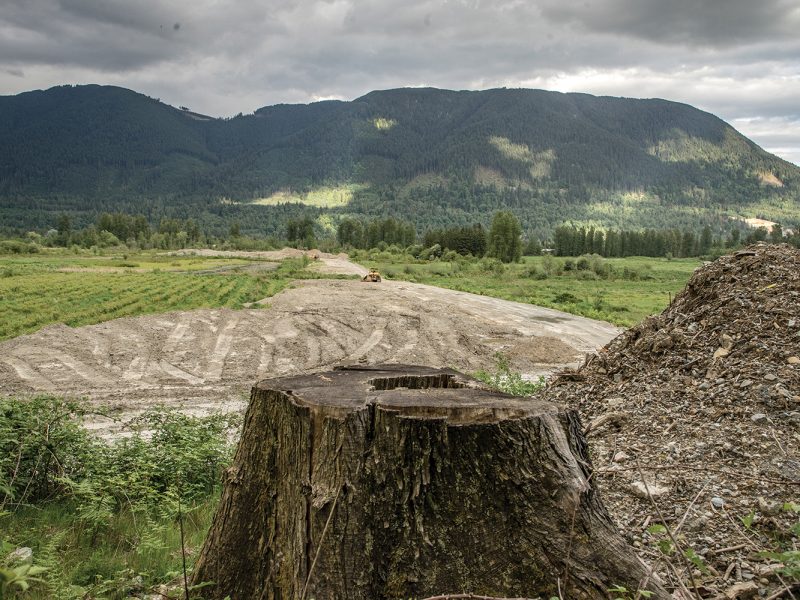
HATZIC – A rocky outcrop on Stave Lake Road east of Mission offers a panoramic view of the Hatzic Valley, the flat land and alluvial soils ideal for blueberries, nurseries, livestock and poultry farms.
But in 2021, the valley also began attracting other kinds of operations. Dozens of trucks hauling fill from across the Lower Mainland began arriving, offering local property owners free fill and contracting with others for ongoing deposits. In some cases, the trucking companies themselves bought properties to deposit fill.
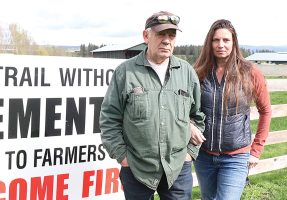
“Two and a half years ago, traffic on our roads increased and everybody noticed all these gravel trucks come in,” says Beata Kunze, a hatching egg producer and president of the Hatzic Valley Community Association. “[This] past year, a couple of trucking companies bought up blueberry farms and started using them as construction fill dumping sites.”
The turnout on Stave Lake Road sits at the entrance to one of those properties. Just over 16 acres in size, it sold at the beginning of April 2023 for $1 million. Thanks to farm class status, its assessed value is just $15,372.
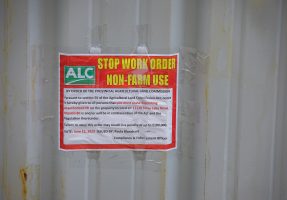
But the rows of berries were soon being filled with a mix of excavation material and construction waste, drawing complaints that prompted the Agricultural Land Commission to issue a stop work order within three months of the property’s sale.
It’s not an isolated incident. Close to 40 stop-work orders have been issued at properties in the Hatzic Valley since 2022 following complaints from neighbours.
Dozens more orders have been issued across the Lower Mainland, with reports of illegal fill coming in from Matsqui Prairie in Abbotsford, the Columbia Valley in Chilliwack as well as within Metro Vancouver, which has historically been a hot spot for fill complaints.
The issues are just up the road from Delta South MLA Ian Paton, agriculture critic for BC United, who says dozens of trucks have been delivering fill to 30 acres that were planted to potatoes until last year prior to a planned greenhouse expansion.
While greenhouses are allowed on agricultural land, Paton is shocked at the kind of fill that’s arriving.
“There’s a dump truck with a trailer behind it every five minutes,” he says. “Why do we have to cover prime agricultural land with three feet of crappy fill material to build a greenhouse?”
Paton has filed a complaint, one of a growing number the Agricultural Land Commission is receiving.
The number of files related to illegal fill in the year ended March 31 was up 44% versus 2021, hitting 476 versus 331 three years ago.
The situation in the Lower Mainland is so dire that the ALC has assigned its six compliance and enforcement officers to the region.
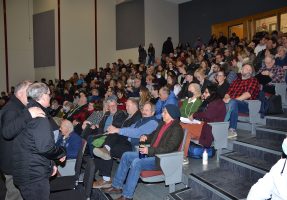
“We want to gain some more compliance with this blatant dumping on agricultural land,” ALC operations director Avtar Sundher told Hatzic Valley residents who gathered for a community meeting on May 13. Representatives of Sran Trucking Ltd., one of the companies involved in the dumping, were also present.
Sundher says additional resources were allocated to address the issue with the premier’s blessing.
“The focus on this valley, it all happened because … the premier, minister, our deputy minister were all involved,” Sundher says. “That allowed us to release resources from other parts of the province and bring them here. And we’re going to continue.”
Property owners that ignore stop-work orders face penalties as well as remediation orders, something that’s happened with the property on Stave Lake Road.
“There’s many more that are going to follow,” Sundher says.
Remediation orders go on a property’s title, compromising the ability to sell the property until the illegal fill is removed and the property is restored to its original agricultural capability or better.
The commission is also speaking with the attorney general and Crown counsel regarding further action.
“We are in conversation with the Civil Forfeiture Office,” Sundher says. “The proceeds of crime also includes the proceeds of regulatory offences. … We can actually hand the file over to that office, and they can look at what gains were made from this illegal activity that they can recover.”
While dumping on farmland is a perennial issue, the dramatic rise in files over the past year is almost certainly linked to the growing cost of soil removal.
Revisions last year to the province’s contaminated sites regulation added tens of thousands of dollars to development costs because it required the characterization of soils from not only Schedule 2 sites (including gas stations and machine shops) but adjacent properties that may have been impacted by Schedule 2 sites.
While the province has allowed greater leeway for professional judgment, the costs remain high and paperwork is also required for sites receiving affected soils.
This has developers seeking cheaper disposal options, something Hatzic Valley residents pointed out.
“When you dig a foundation for a highrise, as of last March the dirt does have to be tested as to where it goes,” one speaker said. “But the problem is no one wants to deal with it, so everybody just puts a blind eye on it.”
A site on Farms Road in Mission that was slapped with a stop-work order May 1 is a case in point, with petrochemical smells reported at the site. (Sundher confirmed the report, but said he wasn’t aware of any testing conducted as part of BC Ministry of Environment investigations.)
The lack of effective enforcement has made communities in the eastern Fraser Valley a dumping ground, according to speakers at the Hatzic Valley meeting, some of whom formed a working group April 30 to establish their own citizens patrol. They were complemented by members of the Leq’á:mel First Nation, but the arrangement isn’t sustainable for the long-term.
“We can’t patrol our roads 24/7 forever,” Kunze says.
While greater enforcement has meant a reprieve from truck traffic, it doesn’t address the fill that’s been delivered to properties.
This is where remediation is key, says Fraser Valley Regional District director Hugh Davidson, who represents Electoral Area F that includes the Hatzic Valley.
“Without that remediation, at the end of the day for me it’s all a fail,” he says.
Davidson would like to see ALC staff authorized to issue stop-work orders on the spot.
But such changes are not on the books, Sundher says, adding that investigators need to follow due process to ensure any orders they issue are legally defensible.
ALC staff have been told to work within the existing framework, which includes a budget that has increased by increments since the 33% boost delivered by the BC Liberals in 2016.
“We’ve been given the reins to control as much as we can through the resources we have,” Sundher says. “We are committed as staff to use our resources as efficiently as possible, try to find new tools that we can [use] without having legislative changes.”




 Saanichton Farm launches Hall of Fame for Island farmers