
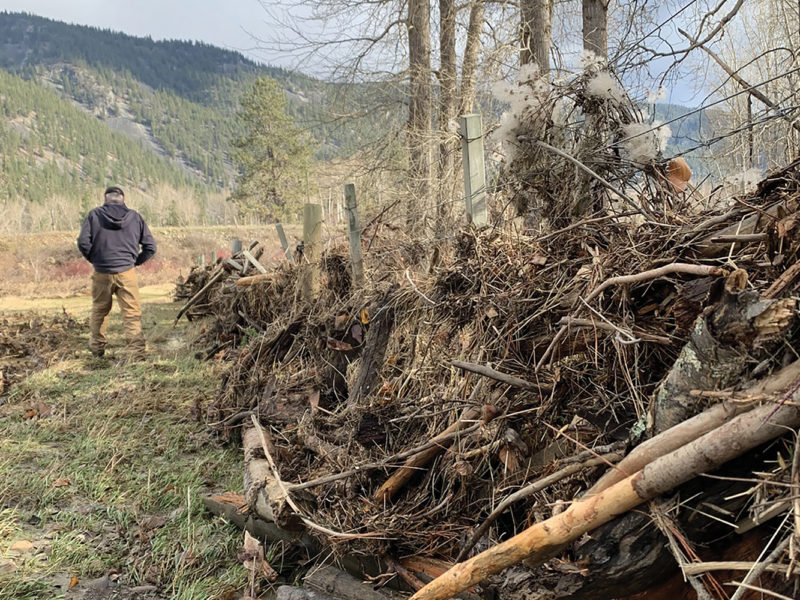
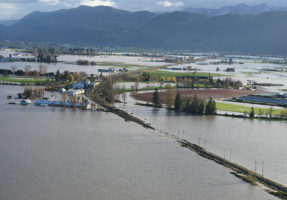
PRINCETON – All hands were on deck to help residents in Abbotsford and the eastern Fraser Valley after record rainfall in mid November cut highway connections to the rest of Canada. Repair crews rushed to remove debris from major freight corridors, including Hwy 7, the Coquihalla and Hwy 1.
But ranchers in the southern Interior who saw their properties reconfigured and isolated by the flooding of the Similkameen, Tulameen, Coldwater and Nicola rivers say the province has been slow to help as they face the monumental task of rebuilding ranch infrastructure, rehabilitating pastures and accessing properties cut off by washouts.
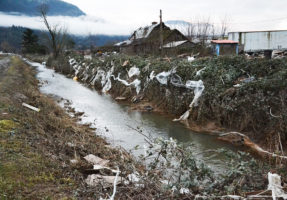
“We have a lot of clean up to do,” says Catherine Brown, who with her husband Phil manages Copper Creek Ranch just off Hwy 3 on the Similkameen River near Princeton. “The flood waters lifted asphalt and spread it all over the fields.”
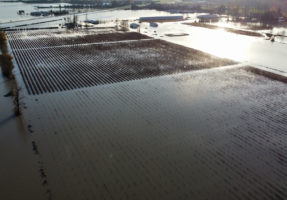
Water covered about 140 acres following the final atmospheric river event on November 30, including wintering grounds, summer pastures and a hay field. They had no warning it was coming.
“Princeton was put on a state of emergency, but we didn’t get anything,” she says. “Our ranch road was quickly flooded over, and the cattle were in water well over their bellies.”
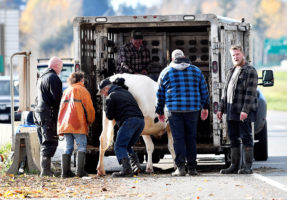
They had to move about 120 of their top-end purebreds, donor cows and bulls and replacement heifers, which were scattered over the flooded acreage.
“The water was too high for us to get much equipment across the road, so Phil had to do the job solo in a high tractor, which was risky. The water was moving the tractor,” says Brown. “The cattle were trying to stay on knolls in the field and by the fences. And when Phil went to move them, the water would sweep them away and they took out fencing.”
She estimates that about 2,500 feet of fencing has been flattened.
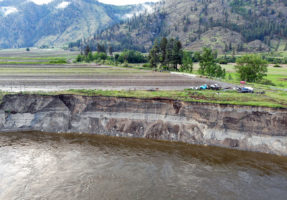
In addition, their fields experienced extensive erosion and sections of Old Hedley Road, their ranch road, need to be repaired. While they didn’t lose any feed, the damage to their fields means they’ll have to feed the cattle earlier rather than letting them graze into December.
The combination of wildfire and flooding within a five-month span means Emergency Management BC has their information, but the Browns have yet to be told what kind of emergency financial support to expect.
“We don’t know how that will play out at all. They say they will be in touch with us,” she says.
Waiting to hear
Rhonda and Wayne MacDonald of Bar FX Ranch west of Merritt have also been waiting to hear from government. While family, friends, neighbours and the ranching community came together to support them, it took weeks for the province to start paying attention to damage in the Nicola Valley, where the Nicola River washed out 23 sections of Hwy 8, including three bridges.
Moreover, at least 87 power poles and 14 transformers were destroyed along the corridor, leaving many residents in the area without heat or running water and no estimated time for restoration.
The MacDonalds count themselves fortunate: they had anticipated being without power for most of the winter but BC Hydro was able to reconnect them to the grid on December 5.
With many of the roads to their ranch washed out, moving cattle and accessing stored feed has been difficult. There’s also no guarantee that they’ll be able to get back on the land to rehabilitate it.
“We have approximately 10 acres of land that are gone, with about another 90 of once-productive hay land that’s now buried in silt and boulders,” says Rhonda. “The government’s response, in our case, has been non-existent.”
When they asked EMBC for fertilizer totes to stabilize their riverbanks in advance of the November 30 atmospheric river system, they were refused.
“Our house is in danger of washing away should the river rise again, and they have no answers and are unwilling to help in a timely manner to save our house,” she told Country Life in BC.
Costly repairs
Also west of Merritt, John and Kate Anderson of Kane Lake Ranch are assessing and repairing damages on their ranch, which is home to 250 cattle.
Decades of riparian improvements the Andersons have undertaken along the Nicola River protected their property, they say, but will also require costly repairs. The pumphouse for their irrigation system also sustained damage.
But John says it could have been worse.
“We are in a better position than a lot of people,” he says, noting that between 400 and 500 tons of hay in the Nicola Valley was lost. “People have lost hay that they can’t retrieve … and that’s on top of a drought year.”
Anderson says the top priority for government needs to be ensuring local ranchers have access to feed (the province announced a
$1 million Emergency Flood Forage Program on
December 17). It also needs to streamline regulations governing works in riparian areas that could help make the landscape and ranches more resilient.
Government also needs to step up with funding for rural infrastructure, such as the hundreds of orphan dikes located around the province. Water from the Kettle River breached one such dike In Grand Forks in 2018, and the Similkameen washed out 400 feet from another at the foot of Happy Hollow Farm in Cawston in November.
The breach put about 100 acres of alfalfa under water or about a third of the farm, says owner Bev Greenwell, who runs sheep and leases pasture to local cattle ranchers.
“We’ve been here for 20 years, and no one has looked at it,” she says, noting that she made calls during a lull in the rains hoping someone would come fill the breach. “I don’t know how many phone calls I made but everyone pointed fingers at other people. … Eventually, the guy who I phoned in the first place was the one who came out and looked at it.”
By December 8, Greenwell had an agreement with the BC Ministry of Transportation and Infrastructure to repair the dike. Work was set to start immediately.
Unprecedented damage
The scale of the damage is unprecedented, and will take months to tally. Damaged infrastructure on and off ranches, as well as lost land, will make ranching difficult, if not impossible, without government assistance says Kevin Boon, general manager of BC Cattlemen’s Association.
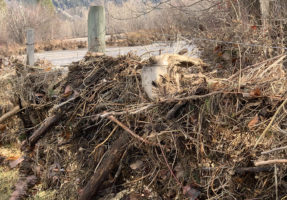
“The damage that is most concerning is the land that has eroded and washed down the river as well as the accumulations of silt and debris that have been left behind,” he says. “In some cases, (ranchers) have lost their entire farm sites.”
Boon also notes damages to and loss of corrals, fences, buildings, irrigation infrastructure, roads and feed supplies, but he remains hopeful the AgriRecovery package promised will give ranchers critical support.
“We have been working with government to make sure they are getting everything we can included, but until we get an announcement and commitment from the federal government, we won’t know for certain,” he says.
BC agriculture minister Lana Popham confirms that there’s been “a soft handshake” with Ottawa on funding, which should be announced this month.
“There are major challenges ahead of us as far as infrastructure goes – irrigation, fencing etc – but the thing I think is the most urgent is probably feed,” she says, noting the launch of the Emergency Flood Forage Program on December 17 that will provide interim relief until AgriRecovery funding kicks in.
Rebuilding roads and dikes is a larger task beyond the capacity of any one ministry, she says, but notes, “There’s going to have to be some kind of new approach.”
“Our main focus is urgency and emergency right now,” she says. “We’re just trying to get things up and working. It’s all hands on deck.”
Weather frustrated two attempts Popham made to visit the Nicola Valley last month. While producers have sent her a steady stream of images and information, she looks forward to visiting local farms and ranches and seeing the situation first-hand.

 Kootenay growers target winter deliveries