
• Menu
  • Skip to primary navigation
  • Skip to main content
  • Skip to primary sidebar

Country Life In BC Logo

The agricultural news source in British Columbia since 1915

  • Headlines
  • Calendar
  • Subscribe
  • Advertise
  • About
  • Archives
  • Contact
  • Search
  • Headlines
  • Calendar
  • Subscribe
  • Advertise
  • About
  • Archives
  • Contact
  • Search

Primary Sidebar

Originally published:

AUGUST 2023
Vol. 109 Issue 8

Subscribe Now!

Sign up for free weekly FARM NEWS UPDATES

Loading form…

Your information will not be
shared or sold ever

Stories In This Edition

Lettuce Grow!

Turning off the taps

Drought threatens feed supply

Fire, drought and now grasshoppers

Editorial: Public service

Back 40: Food democracy will decide relavance of ALR

Viewpoint: Reconciliation is more than just a land deal

Peace Region land-sharing proposal nixed

Sinkholes blamed on Fraser Valley pipeline work

Ag Briefs: BC Ferries steps up protocols for hay shipments

Ag Briefs: Bird processing goes mobile

Ag Briefs: Penticton agriculture committee fails

Huge cherry crop sparks dumping allegations

Soil, leaf testing key to gauging nutrient needs

Drought prompts cattle sell0ff

Urban farm almost shut down by noise complaint

Watchdog call for overhaul of fire management

CYL semi-finalists share positive outlook

Grain producers share experience during field day

Range management showcased on tour

Prescribed burns improve range health

Sheep breeders flock to BC for national show

Farmers look to fill wool processing gap

Smart tools point a way to more efficient weeding

Farm Story: Doing the “right” thing comes at a price

Island couple future-proof new farm operation

Instrumental insemination boosts bee vigour

Growing opportunities for fellow farms

Partnerships underpin success of Langley stewardship program

Woodshed Chronicles: Gladdie reminisces about long-ago truth or dare

Christmas tree growers look to scale up local

Jude’s Kitchen: Patio fare for the lazy days of summer

More Headlines

Follow us on Facebook

Comments Box SVG iconsUsed for the like, share, comment, and reaction icons

6 hours ago

The Township of Langley Farm and Ranch Exhibition Society is hosting a public open house this evening to gather input on plans to transform the historic Belmont Farm into an agricultural exhibition, education and heritage hub. Farmers, ranchers, and community members are invited to share their feedback. The open house is at the George Preston Rec Centre, 6-8 pm.

Township of Langley Farm and Ranch Exhibition Society
#BCAg
... See MoreSee Less

The Township of Langley Farm and Ranch Exhibition Society is hosting a public open house this evening to gather input on plans to transform the historic Belmont Farm into an agricultural exhibition, education and heritage hub. Farmers, ranchers, and community members are invited to share their feedback. The open house is at the George Preston Rec Centre, 6-8 pm. 

Township of Langley Farm and Ranch Exhibition Society 
#BCAg
View Comments
  • Likes: 6
  • Shares: 0
  • Comments: 0

Comment on Facebook

9 hours ago

The sold-out Southern Interior Horticulture show continues today. Education sessions range from rodent control to new tree fruit varieties, with the afternoon devoted to improving spraying techniques for orchardists and vineyard managers. When not listening to speakers, producers are checking the trade show.

#BCAg
... See MoreSee Less

The sold-out Southern Interior Horticulture show continues today. Education sessions range from rodent control to new tree fruit varieties, with the afternoon devoted to improving spraying techniques for orchardists and vineyard managers. When not listening to speakers, producers are checking the trade show.

#BCAg
View Comments
  • Likes: 6
  • Shares: 0
  • Comments: 0

Comment on Facebook

11 hours ago

The BC Poultry Association has lowered its avian flu biosecurity threat level from red to yellow, citing declining HPAI risk factors and fewer wild bird infections. Strong biosecurity practices helped BC limit cases this winter to 38 premises, down from 81 last year. For more, see today's Farm News Update from Country Life in #BCAg#BCAg ... See MoreSee Less

Link thumbnail

Poultry biosecurity notches down

www.countrylifeinbc.com

Declining risk factors for highly pathogenic avian influenza (HPAI) have prompted the BC Poultry Association to lower the industry’s biosecurity threat level from red to yellow. The decision…
View Comments
  • Likes: 11
  • Shares: 2
  • Comments: 1

Comment on Facebook

🐥💛

1 day ago

The application deadline for cost-shared funding through the Buy BC program is coming up on February 20. Up to $2 million through the Buy BC Partnership Program is available annually to BC producers and processors to support local marketing activities that increase consumer awareness of BC agriculture and BC food and beverages. For more information, visit buybcpartnershipprogram.ca/.

Buy BC

#BCAg
... See MoreSee Less

Link thumbnail

Home - Buy BC Partnership Program

buybcpartnershipprogram.ca

Buy BC Partnership Program Increase your visibility with Buy BC The Buy BC Partnership Program is a fundamental component of Buy BC that provides up to $2 million in cost-shared funding annually to lo...
View Comments
  • Likes: 3
  • Shares: 0
  • Comments: 0

Comment on Facebook

1 day ago

The Sik-E-Dakh (Glen Vowell) First Nation's Skeena Fresh hydroponic operation has doubled production capacity thanks to a $130,632 Northern Development Infrastructure Trust grant. Growing lettuce, kale, herbs and more in shipping containers, the operation uses 90% less water than traditional farming while providing 1,200 people with year-round access to fresh, locally grown greens. Their story is in the February edition of Country Life in BC, the agricultural news source for BC’s farmers and ranchers.

Northern Development Initiative Trust
#BCAg
... See MoreSee Less

The Sik-E-Dakh (Glen Vowell) First Nations Skeena Fresh hydroponic operation has doubled production capacity thanks to a $130,632 Northern Development Infrastructure Trust grant. Growing lettuce, kale, herbs and more in shipping containers, the operation uses 90% less water than traditional farming while providing 1,200 people with year-round access to fresh, locally grown greens. Their story is in the February edition of Country Life in BC, the agricultural news source for BC’s farmers and ranchers. 

Northern Development Initiative Trust 
#BCAg
View Comments
  • Likes: 15
  • Shares: 1
  • Comments: 0

Comment on Facebook

Subscribe | Advertise

The agricultural news source in British Columbia since 1915
  • Email
  • Facebook

Island couple future-proof new farm operation

Land costs and water scarcity drove business decisions

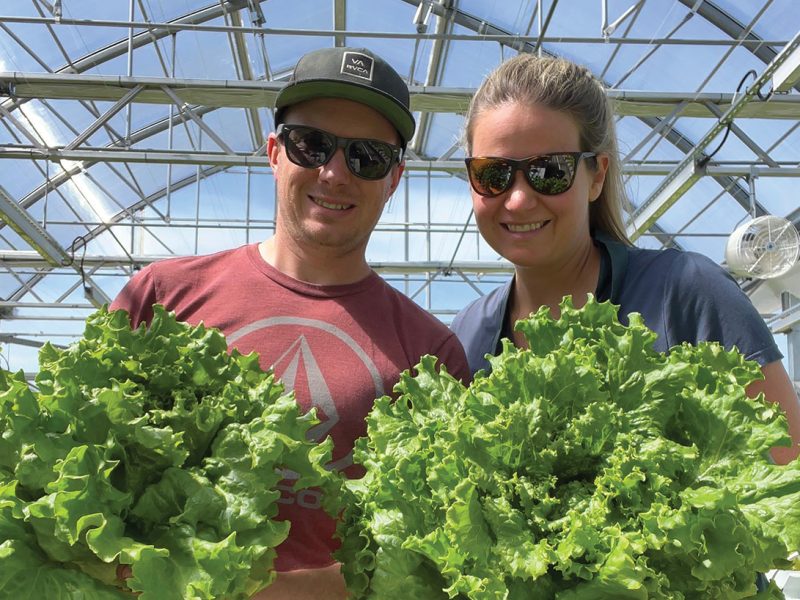
Matt and Selena Lawrence know two heads are better than one in life and in business as they work to establish a hydroponic greenhouse in Cumberland producing four types of lettuce. The small-scale operation was ideal for the growing family, and makes efficient use of water resources to produce 2,000 heads of lettuce a week. Read their story on page 29. FOREST VALLEY ACRES

August 2, 2023 byKate Ayers

COURTENAY – First generation farmers Matt and Selena Lawrence knew they wanted an acreage and to raise their family on a farm, but securing land and water for a large-scale operation in the Comox Valley was not in the cards.

However, after creating a viable farm business model, the couple were able to secure a mortgage and loan to buy a five-acre property in Courtenay and construct a hydroponic lettuce facility.

“Land is very expensive up here,” Selena says. “We thought, what can we farm small-scale that is sustainable if we can only afford up to five acres of land? We couldn’t have these massive cornfields and you know, water is very scarce on the Island. … So, we decided a greenhouse was going to be our best bet.”

The couple bought the property in June 2022, incorporated their business as Forest Valley Acres and ordered a greenhouse from Harnois Industries in Quebec. Delivered with instructions, greenhouse assembly was more of a challenge than Matt, a Red Seal carpenter, expected – even with his father’s help.

“Coming from working with wood as a carpenter to putting up the steel infrastructure frame with polycarbonate was definitely a challenge,” he says. “It probably took us twice the amount of time that we had budgeted. We had budgeted maybe three months but then the snow came, and we didn’t have that roof on.”

The unfinished building sustained some damage during a late November snowstorm, but once cleaned up, the gas fitters and electrical contractors were able to complete installing the building systems and commission the facility.

“There’s a thermometer, humidity sensor, sheet screens, fans and a cooling system and heater,” Lawrence says. “It stays between 21°C and 24°C at all times all through the year.”

With some help from Matt’s parents, the couple now manage a fully operational Nutrient Film Technique hydroponic system in which nutrient-rich water continuously flows down the channels past exposed plant roots. Any unused solution is captured at the end of each channel, returned to the reservoir, remixed for nutrient balance and recirculated to the plants.

The system recycles up to 95% of the water, Lawrence says. The plants consume about 100 gallons of water per day, which is replaced by their service well. It has been able to keep up with the daily demand so far, but the couple are considering alternatives as drought conditions persist on Vancouver Island.

One option is to buy municipal water from the Comox Valley Regional District at $1.50 per 400 gallons and truck it back to the farm. The other option is to dig a deeper well, but Lawrence says that’s a $20,000 project.

Now that their facility is up and running, the couple hope they can get an environmental farm plan audit and apply for some funding or grants to help cover the cost of a new well.

On June 27, the BC Ministry of Agriculture and Food announced the $20-million Agricultural Water Infrastructure program that will be administered by the Investment Agriculture Foundation of BC over the next three years. The program consists of three funding streams that support the improvement of water storage and delivery systems and agricultural water supply assessments, engineering studies or plans.

Water scarcity a limiting factor

Carmen Wakeling, owner of Eatmore Sprouts and Greens in Courtenay, says water scarcity is a significant limiting factor on regional production.

Each week, Eatmore produces about 10,000 pounds of sprouts, which are 99% water. This means a significant volume is regularly removed from the farm.

One of the main reasons Carmen and her husband bought their property was because it has two very deep wells that draw from the Quadra sand aquifer.

“The aquifer actually takes quite a long time to empty and recharge so probably the impact to us is about a six-month time from when we have an extreme weather event,” Wakeling says. “We’re really lucky because we have wells here so we can actually go online and see the wells on a regular basis and access all that information.”

The data allows Wakeling to plan half a year ahead if they experience drought conditions. She also has a drought plan and staged approach as to what they would do as a business if water access became restricted.

“We’re not being impacted this second, but we’re certainly paying attention and we certainly know that we could be.”

Patience

At Forest Valley Acres, April marked the start of the couple’s first growing season. They planted their first seeds on Easter, passed the CanadaGAP food safe certification in May and harvested their first plants on June 1.

In July, the couple were selling their lettuce at mid-Island Quality Foods, Thrifty Foods, the Real Canadian Superstore and their farm stand, with logistical support from Vancouver Island Farm Products Inc. From farm to grocery store should only be about 48 hours, Lawrence says, which together with having the lettuce’s live root ball attached extends its shelf life.

Forest Valley Acres currently supplies four varieties: green leaf, red leaf, green and red butter lettuce with seeds sourced from West Coast Seeds and Stokes Seeds in Ontario.

In their first month of production, patience was the biggest lesson learned, Lawrence says.

“We expected the sales to be there right away. … We hit the market when it was lettuce-growing season for everyone,” Lawrence says. “Our germination rates and our crop loss percentages are not exactly where we want them to be because we’re kind of still learning. We’re experimenting with seeds. We’re switching delivery companies to have better distribution.”

Despite the steep learning curve and evolving logistics, the couple are still providing products for local residents. Other destinations for their lettuce include local schools and Comox Valley Food Bank. Lawrence provides elementary students with fresh greens through the Salad Bar program.

“We were having some product that didn’t quite make the requirements for the grocery stores but was still like a very fine product, very edible. … And I tried to figure out how to kind of get rid of that product and be able to provide somebody with lettuce instead of just having it in our little farm stand,” Lawrence says. “It warms my heart as a mom being able to help these kids get some really fresh, local, clean produce.”

As they continue to refine their production techniques, the couple’s goal is to grow between 1,800 and 2,300 heads of lettuce per week. Right now, they can harvest about 2,000 plants over two days each week. They have a storage cooler on site that can hold about 4,800 heads of lettuce.

Moving forward, the couple eye consistency and expansion.

“Where we placed the greenhouse on the property, we could have up to four greenhouses. They’re a gutter-connect greenhouse, so you actually connect them side by side,” Lawrence says. “I would say the next five-year plan would be to add another greenhouse, whether it’s going to be lettuce or a different product in that greenhouse expansion is definitely in the works.”

However, the expansion will have to wait until Lawrence has a bit more time as her hands are now full with two boys under the age of four and another child due in September.

Related Posts

You may be interested in these posts from the same category.

Previous Post: « Oat, wheat harvests down
Next Post: Water curtailments squeeze forage production »

Copyright © 2026 Country Life in BC · All Rights Reserved