
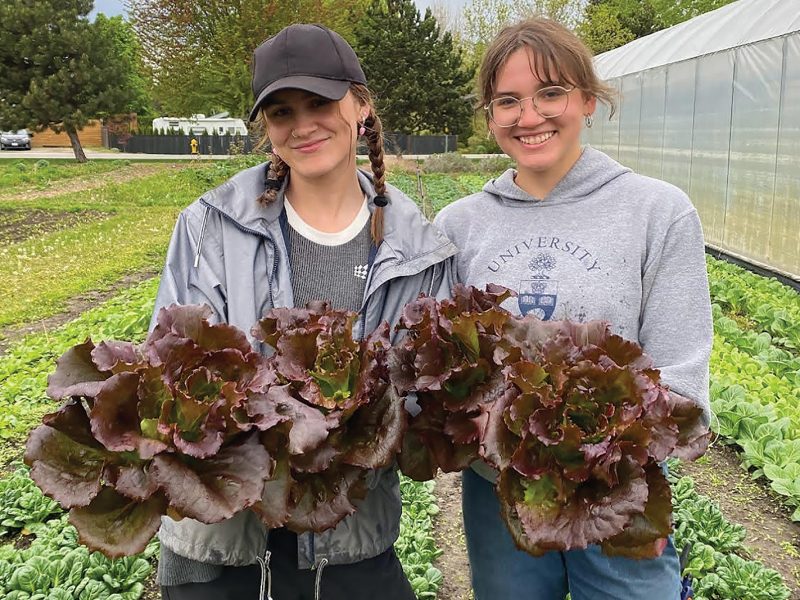
KELOWNA – Of all the challenges farmers face – from unpredictable weather to finding workers – one of the greatest often occurs when it’s time to transition the farm.
Whether a farm is passed to a family member, sold to an outside buyer or placed on the auction block, planning an exit strategy should begin well before the plan becomes a formal document. Work can begin years in advance in the form of discussions with family members about their wish to own or be involved in the farm as part of the transition, assembling information interested buyers will need to make their decision, and maintaining detailed financial statements. The alternative is often a complex and costly process.
The transition for Wise Earth Farm in Kelowna demonstrates succession planning at its best. When John Hoffer and Brenda Paterson sold their successful market garden after 10 years, they achieved their own goals for the transition and provided a rare opportunity for a family of aspiring farmers in Ontario to begin their farming careers in BC.
John and Brenda leased two acres of land near Mission Creek in 2011 and quickly earned a reputation as experts in Small Plot Intensive (SPIN) farming, a biointensive production system well suited to urban farming projects and any setting where there is limited space and resources. SPIN farming produces a higher-than-average amount of crop from a very small area of land, uses less water and sustains soil fertility.
“At the beginning we were just flying by the seat of our pants,” says John. “We were only selling a third of what we grew, so we researched in more depth what people wanted to buy and focused on improving efficiency.”
By tracking how much time and cost was associated with each task required to produce their vegetables, Wise Earth wised up to the nuances of the business.
“We learned it was more profitable to grow larger amounts of certain varieties than more varieties overall,” he says. “Eventually, we knew exactly how many workers we needed and when we needed them which enabled us to lower our labour costs. Keeping good records also helped us forecast and prepare for expenses well in advance.”
It was just as important for the farming couple to identify what they were good at as individuals and make the most of their complementary skills.
“I’m always thinking of the big picture and I tend to test new ideas and techniques before completing the last one,” says John. “Brenda is excellent at implementation and managing the team on a day-to-day basis.”
Brenda credits John for his vision and desire to continually innovate.
“He has also kept awesome records and financials all these years,” she says. “Every detail of the business was put into a spreadsheet, and we used (online platform) Tend to help us integrate our crop plan with our production schedule and sales channels. We really had a handle on our cost of production, so when we put the business up for sale, we had a detailed, accurate package to present to potential buyers.”
Maintaining diverse sales channels and strong customer relationships was also key to the farm’s success. Wise Earth was a regular weekly vendor at the Kelowna Farmers and Crafters Market, the largest farmers market in BC with hundreds of visitors each week. It also cultivated valuable relationships with local chefs, securing steady restaurant business.
In their fifth year, the couple had the opportunity to farm a 10-acre property nearby and encountered numerous problems, from flooding to equipment breakdowns and inefficient work areas.
“We realized we were growing too fast and refocused on the original two acres,” says John.
By their tenth year, they wanted to have their own land. With the high cost of land in the Okanagan they began looking at communities in the more affordable Kootenays, eventually buying a 27-acre property with a home in Grand Forks.
Meanwhile, on the other side of the country near Windsor, Ontario, Myles Ferber, his partner Ariana Gagnon and Ariana’s sister Miranda had decided to move to BC. Ariana was studying psychology online through the University of Windsor and Myles, who grew up on his grandfather’s hobby farm, wanted to work in a community with more small-scale farming than the large-scale commercial environment of southern Ontario.
“We were also inspired by the number of other young farmers in their 20s gravitating towards the Okanagan,” says Ariana.
Ariana’s sister Miranda was accepted at UBC Okanagan and moved to Kelowna as well. When second sister Gabby completed her studies in environmental science, biodiversity and conservation biology at the University of Toronto, she also moved to Kelowna to be closer to the family. Once in the Okanagan, Myles, Ariana and Gabby were hired at Wise Earth Farm.
“When the farm went up for sale, the price was much lower than what I expected because the land was leased and didn’t have to be purchased,” says Myles. “We talked with Ariana’s mother, Raine Gagnon, about purchasing the business.”
Raine’s business skills developed through her career in corporate finance and real estate were invaluable in completing the farm sale. John and Brenda stayed on as mentors to the family for a year before they moved to their new home in Grand Forks.
The family made only a few changes once they took over. They increased production of some crops and reduced others, and made small price increases due to increased production costs during the pandemic. They continued to focus on efficiencies and maintain the relationships John and Brenda had with local restaurants, ensuring the same quality and availability of produce local chefs had come to expect.
“From our landlord to our customers, the community has embraced us throughout the transition,” says Myles.
Today, Ariana works alongside Myles and is the farm’s social media expert. Gabby oversees the nursery. Miranda is completing her Certified Holistic Nutritionist diploma and is planning an expansion of the farm’s veg box program with products such as pesto, salsa and pickling veggies made on the farm. The team recently hired their first employee outside of the family which allows for a manageable eight-hour day for all.
“We basically purchased a turnkey operation,” says Myles. “Many farmers starting out can’t afford the land and building costs. We were so fortunate to learn John and Brenda’s way of farming. We knew the soil, the customers and what the local market wanted. It was an incredible set of circumstances that allowed us to do this.”
In Grand Forks, John and Brenda are planting their first garden on their property and John is planning to start a farm tool manufacturing business.
“Many farmers stop what they’re doing due to age or injury,” Brenda says. “We thought about how and when we would transition the farm for a long time and it’s so good to know what we started is in good hands.”
The BC Ministry of Agriculture provides a number of online resources to assist with farm succession planning including the publication “Family Farm Business Succession Plan Checklist.” The latter is a step-by-step guide to the transfer of knowledge, skills, labour, management, control and ownership of a farm in British Columbia.
 Nicola ranches wait for help