
• Menu
  • Skip to primary navigation
  • Skip to main content
  • Skip to primary sidebar

Country Life In BC Logo

The agricultural news source in British Columbia since 1915

  • Headlines
  • Calendar
  • Subscribe
  • Advertise
  • About
  • Archives
  • Contact
  • Search
  • Headlines
  • Calendar
  • Subscribe
  • Advertise
  • About
  • Archives
  • Contact
  • Search

Primary Sidebar

Originally published:

JANUARY / FEBRUARY 2025
Vol. 111 Issue 1

Subscribe Now!

Sign up for free weekly FARM NEWS UPDATES

Select list(s) to subscribe to


By submitting this form, you are consenting to receive marketing emails from: Country Life in BC. You can revoke your consent to receive emails at any time by using the SafeUnsubscribe® link, found at the bottom of every email. Emails are serviced by Constant Contact
Your information will not be
shared or sold ever

Stories In This Edition

Silver Lining

DCCs hit farms hard

Dairy producers on alert: AI

Popham picks up where she left off

Editorial: Staying connected

Back 40: Roots to growth in an agrarian community

Viewpoint: Polarized legislature offers industry an opportunity

Mega-barns on Delta farmland raise concerns

Sidebar: Noise concerns from air show

Dairy meetings look forward to more stable times

Ag Briefs: Property sales continue as fruit sector retrenches

Ag Briefs: Farm-class properties rise

Ag Briefs: Creston bee keeper wins award

Letter: Rural customers want telephone service from Telus, not innovation

Margins key as costs rise faster than revenues

Software aims to improve Interior food distribution

BC producer groups nourish the needy

AI puts the focus on waterfowl management

Prevention, control efforts go full boar

PAS Preview: Trade show features drone, AI supplies

Sidebar: Kick-off in style

Going with the flow

Sidebar: Berried treasure

Sidebar: Beyond the Lower Mainland

Common pressures face Canada’s farmland

Good job

Vineyards enter new year with recovery in sight

Sidebar: Relaxed rules give wineries production option

Culture change as winterkill chills industry

Farm Story: Plan B keeps the cash flowing through winter

BC Cattlemen’s holds townhalls with producers

Making memories

Fundamentals strong as ranchers enter a new year

Collaborative spirit buoys new winery

Little Cherry Disease going to the dogs

Woodshed: Kenneth heads to the barn to meet Rocket

Scale-model builder creates true-to-life farms

Jude’s Kitchen: Begin a new year with new flavours

More Headlines

Follow us on Facebook

Comments Box SVG iconsUsed for the like, share, comment, and reaction icons

6 days ago

... See MoreSee Less

View Comments
  • Likes: 4
  • Shares: 0
  • Comments: 0

Comment on Facebook

6 days ago

On the last day of the BC Organic Conference, Thursday, Molly Thurston of Pearl Agricultural Consulting helped growers learn how to manage bugs such as codling moth, wireworm, and rootworm in organic growing systems. Her talk alongside Renee Prasad included hands-on activities in which participants checked out various traps and examined pests under microscopes. Be sure to look for more upcoming ag events on our online calendar at www.countrylifeinbc.com/calendar/

#BCAg
... See MoreSee Less

On the last day of the BC Organic Conference, Thursday, Molly Thurston of Pearl Agricultural Consulting helped growers learn how to manage bugs such as codling moth, wireworm, and rootworm in organic growing systems. Her talk alongside Renee Prasad included hands-on activities in which participants checked out various traps and examined pests under microscopes. Be sure to look for more upcoming ag events on our online calendar at www.countrylifeinbc.com/calendar/

#BCAg
View Comments
  • Likes: 15
  • Shares: 0
  • Comments: 0

Comment on Facebook

1 week ago

Well-known organic farmer and podcaster Jordan Marr gets interviewed by Country Life in BC’s own columnist and potato mavin Anna Helmer during the opening session of the BC Organic Conference at Harrison Hot Springs yesterday. Sessions run today (Wednesday) and Thursday and include organic and regenerative growing practices and expanding and advocating for the organic sector, all under the background of the newly launched Organic BC banner.

#BCAg
... See MoreSee Less

Well-known organic farmer and podcaster Jordan Marr gets interviewed by Country Life in BC’s own columnist and potato mavin Anna Helmer during the opening session of the BC Organic Conference at Harrison Hot Springs yesterday. Sessions run today (Wednesday) and Thursday and include organic and regenerative growing practices and expanding and advocating for the organic sector, all under the background of the newly launched Organic BC banner.

#BCAg
View Comments
  • Likes: 37
  • Shares: 2
  • Comments: 1

Comment on Facebook

Interested in finding out more about this

3 weeks ago

Today, we remember those who sacrificed their lives or their well-being for our freedom. Lest we forget. ... See MoreSee Less

Today, we remember those who sacrificed their lives or their well-being for our freedom. Lest we forget.
View Comments
  • Likes: 8
  • Shares: 0
  • Comments: 0

Comment on Facebook

1 month ago

FarmFolk CItyFolk is hosting its biennial BC Seed Gathering in Harrison Hot Springs November 27 and 28. Farmers, gardeners and seed advocates are invited to learn more about seed through topics like growing perennial vegetables for seed, advances in seed breeding for crop resilience, seed production as a whole and much more. David Catzel, BC Seed Security program manager with FF/CF will talk about how the Citizen Seed Trail program is helping advance seed development in BC. Expect newcomers, experts and seed-curious individuals to talk about how seed saving is a necessity for food security. ... See MoreSee Less

Link thumbnail

BC Seed Gathering - FarmFolk CityFolk

farmfolkcityfolk.ca

Save the date for our upcoming 2023 BC Seed Gathering happening this November 3rd and 4th at the Richmond Kwantlen Polytechnic University campus.
View Comments
  • Likes: 1
  • Shares: 0
  • Comments: 0

Comment on Facebook

Subscribe | Advertise

The agricultural news source in British Columbia since 1915
  • Email
  • Facebook

Roots to growth in an agrarian community

THE BACK 40

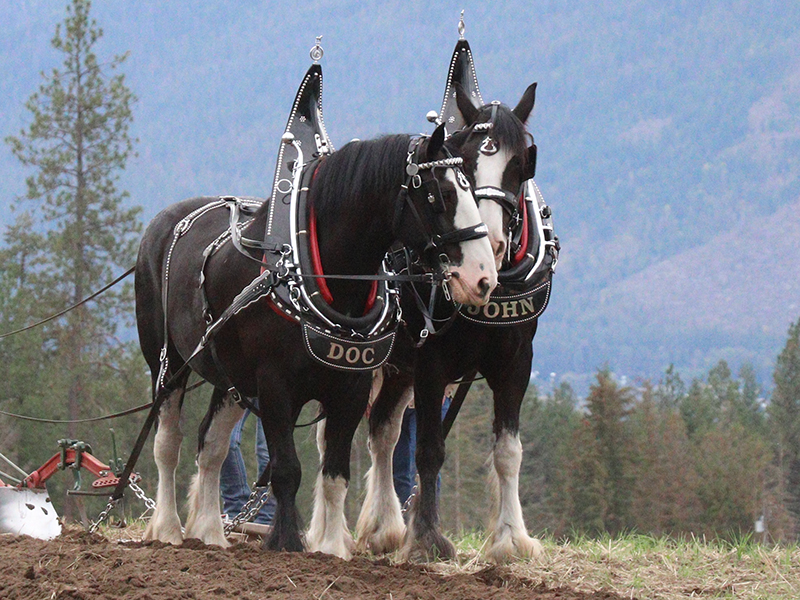
The use of heavy horses, once a necessity of farming, has become all but a thing of the past. Photo | Cathy Glover

January 1, 2025 byBob Collins

The public space in our office/farm store building has recently become a regular meeting place for a local group of wool spinners, my wife Ann among them. Their gatherings are informal two-hour afternoon spinning sessions.

The activity is communal, tactile and agrarian. Stories are told, knowledge is shared, and fleece is turned into yarn with admirable skill born of knowledge, practice and aptitude. Not unlike the careful husbandry of sheep, or a good working herd dog, or a well-tended garden or the manner of a quiet and competent teamster.

Many such skills have largely disappeared. My grandfather told stories of his youth handling horses in fields and woods, but there was no need or opportunity to transmit his skill to any of his grandchildren. I knew one man who used horses his entire life. He is gone now, and though he did leave many amusing stories with those who knew him, few of his teamster skills survived his passing.

Many such skills are now deemed to be hopelessly old-fashioned and irrelevant to the agricultural industry of today. Any agricultural economists seeing this will be rolling their eyes at this point. Farmers and ranchers need to be, first and foremost, business managers, firmly focussed on the bottom line and growing their business. There is no place for nostalgic pursuits and pipe dreams. Where on the asset ledger would you list pride of place or husbandry?

Properly industrialized agriculture will eliminate the need for any such skills or local knowledge. The global, corporate, integrated, high-tech, AI-operated, industrial-scale, bioengineered and chemically manipulated biome agriculture industry will dismiss the inefficient folly of domestic, communal agrarianism, its practices and ultimately its practitioners, as obsolete. Their skills and stories are no longer relevant or required, and their efforts near-comic as they march toward inevitable replacement by global, industrial agri-business. Or so they say.

This replacement has now been underway for more than 60 years. I first came face-to-face with it in the office of my Grade 10 guidance counsellor in the fall of 1963. It was a one-on-one session to determine what path my high school education should be preparing me for. According to the aptitude test results, I should be aiming for a career in the military. I passed on that. Ditto the second suggestion to be a forest ranger. Somewhat exasperated, the counsellor asked what I planned to do when I graduated. I said, “Go farming.” He laughed out loud and rolled his eyes.

It occurred to me then and there he didn’t understand or appreciate where food came from before he found it on a store shelf. He may have given it some thought because a few days later he asked if I was serious, apologised for laughing, and said he thought I was probably smart enough to go to university. Long story short, I didn’t go to university and I didn’t graduate from high school, but I’m still farming 61 years later.

Twenty-some years later at a parent-teacher conference discussing my son’s under-achievement in Grade 10 math, I was told it was lucky for him I was a farmer because he probably wasn’t smart enough to do anything else. Turns out that wasn’t an accurate assessment, either.

I offer this reminiscence to illustrate the often-held negative perception of what farming and being a farmer is all about.

Doubtless there are many who will agree with those teachers and the agri-economists, agri-industrialists, agri-venture capitalists and agri-monopolists and lay the blame for the high price of pickles in Paraguay at the feet of all those pampered, inefficient yokels who still shell peas by hand and call their cows by name.

Be that as it may, though the number of farms and ranches continues to decline, 98% of them are still family-owned and operated. And though the average age of all those farmers and ranchers continues to climb, nearly every one of them still takes pride in the care of their land and being part of the agrarian community. They still know the true value of having good neighbours, and willingly understand the obligation to be one in return. They still appreciate the value of sharing the skills and stories that have been passed on and learned.

None of that ever shows up on a balance sheet and the algorithm at your bank won’t recognize it. It might be fiscally intangible, but it is essential to the 2% of the population who keep making this work. I knew it in 1963, and I still know it today.

I expect most of you do, too.

Thanks to everyone who takes the time to read the Back Forty. Happy New Year to all of you and those you love. Take a bit of time to swap a yarn or even spin some!

Bob Collins raises beef cattle and grows produce on his farm in the Alberni Valley.

Related Posts

You may be interested in these posts from the same category.

Previous Post: « Vineyards enter new year with recovery in sight
Next Post: AgriStability program boosted »

Copyright © 2025 Country Life in BC · All Rights Reserved